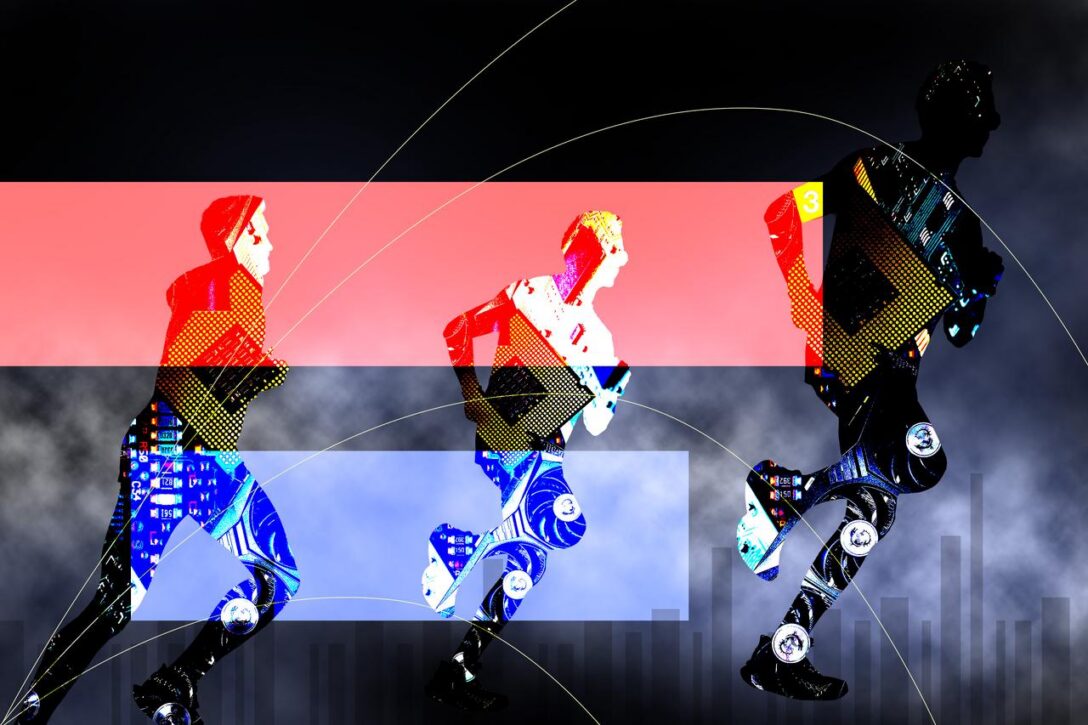
Gloria Mendoza’s image ‘The AI Race’ sparks questions and challenges the widely used and enforced “AI race” narrative. While the depicted skylines are representative of cities and progress, heavy smoke cruising along the image represents the pollution, e-waste, and debris the AI race leaves behind. The runners are the workers running the race for entire nations, and their silhouettes contain the materials, hardware, and resources (often hidden) needed to build generative AI technologies.
Gloria’s image prompts reflection about who the AI race is for, where it is taking us, and why it is being run. In this blog post, we go ‘Behind the Image’ with Gloria to explore the motivations behind her image, its connection with her other creative endeavours, and the impact (and difficulties) of visualising AI metaphors.
You can download and use ‘The AI Race’ from our library for free (with correct attribution). You can also explore some of Gloria’s other work here.
“It’s a race nations have signed up for, but nobody asked for it.” – Gloria Mendoza
What is the AI Race, and why did you choose to visualise this concept?
The term ‘AI race’ is usually used to describe where nations compete for AI development, including software, hardware capacity, power, leadership, and influence in the field.
“As Europeans, we often tell ourselves a specific story about the AI race. The Americans are ahead. The Chinese are coming on strong. And we are somewhere in the back of the pack, haggling over the fine print of AI regulation while the real thing gets built on the other side of the Atlantic and the Pacific.” – Johannes Kleske
However, it’s a race nations have signed up for, but nobody asked for it: a race where we have no conditioning period, but we jump right into a sprint with cold muscles. Where the workforce, neighbourhoods, communities, and working-class people are impacted by the harms it causes to the environment due to the monstrous resources it requires. Indeed, Kleske argues that the ‘AI race’ has “become so deeply embedded in how we discuss artificial intelligence that it no longer registers as a metaphor at all. It sounds like a description of something that is simply happening.”
Consequently, illustrating this subject felt like a nice challenge to take on. The imagery online that depicts it relies heavily on robots, blue hues, and language, and my goal is always to be explicit, clear and concise, so that people who are not immersed in the field can also understand these heavily abstract and value-laden concepts.
What motivated the creation of The AI Race?
I have seen so many Youtube videos about the AI race both from both a catastrophic perspective and an informational one, and I even though I am not a researcher or technologist, I am curious to understand the implications of this technology on society and individuals, the moment in history we are traversing, and what impacts it will have on future generations.
As an individual, I feel powerless and without agency, none of these involvements were made through consensus or democracy; but rather as decisions made by a few on behalf of an entire civilisation. It’s difficult to grasp the direct implications on my life, to be honest, but one thing is for certain: online data privacy is out of the conversation; agency and protection of individual rights seem to be low on the priority list, and not to mention the harms to the environment addressed in my previous illustrations. Some countries seem to prioritise these issues and therefore are not competing in race, assessing what’s the cost of running, what’s at stake and what’s the price; why is it so important to win it if society is at large in disfavour?
Could you talk us through the different parts of your image and the meaning behind it?
In this illustration, I bring people to the foreground. I strive to show the implications of technology on communities, in this case, the figure of the runner is the action taker, the worker running the race for entire nations, and its silhouette contains the aforementioned parts needed to build automated technologies. And as an ornamental but still meaningful element, the lines you find on race tracks bring the audience to that spatial reference. I find it helpful to feed my ideas of those metaphors the field uses over and over again, because it resonates with that group, but also brings civil society into the conversation with a reference they can also relate to.
Skylines are representative of cities and progress, and with this faint element on the bottom of the composition; I’m giving the audience context. Stylistically an abstracted take on skyscrapers are subtle and wouldn’t attract all the attention of the piece – the runner is. I also wanted to imply with the use of color the current main runner but without being overly specific; China and the U.S.
The reason is that I didn’t want to include flags to leave it suggestive and open to interpretation, but also to pass the test of time in case the players change in the future. However, the flags and countries are not the most important aspect of the illustration, the consequences of the race are. There is heavy smoke cruising along the image, representing the pollution, e-waste, and debris the race leaves behind. It is pretty noticeable by now that the environment is a constant subject in my work, and it’s simply because of the risky and detrimental state we have driven ourselves to and how much more damage these developments carry.
Is there a specific reason that your work focuses on visualising the environmental implications of AI?
I am terrified of climate change. I see the disasters happening all over the world because of the lack of commitment from governments to lower emissions and slow temperature rise. I think some geographies are more vulnerable than others; however, it doesn’t mean that some are safer than others. Catastrophes can happen in North America, in Southeast Asia, or in Southern Europe—different kinds…but still catastrophes that could be prevented if governments could take stronger actions to deter global warming. The rise of data centres is not helping improve the current climate conditions; they are adding to the problem, and strict measures are badly needed.
How did you go about visualising the AI race as a metaphor specifically?
“Citizens become spectators of a geopolitical contest they did not choose and cannot participate in. The only available role is watching and cheering.” – – Johannes Kleske
The metaphor was there, the term has been pushed out in every article, video, and newsfeed I could think of, and Johannes Klerske makes a good point of the urgency it implies, it makes us feel like we want to win, we don’t know what, but nobody wants to be a loser, so we may as well comply. But, when you investigate what it actually entails, and how little this process resembles the actual process of preparing for a marathon and the work athletes do behind the scenes you wonder “why was it even called a race?”
Even signing up for a marathon has its prerequisites; you cannot wake up one day and say “I’m gonna run a 5k” without having run 1k before, without having conditioning training in your routine, without having a proper nutritional plan. So the AI Race feels like it came from nowhere; we were just allowed to sign up for the marathon with no background checks required. I hope my image can serve as a support tool for emerging research about the topic, to be explanatory enough that civilians can feel empowered to have an opinion, a say, and a voice in this discourse.
About the artist and author

Gloria Mendoza is a Colombian-American artist and designer dedicated to using visual storytelling to spark conversations around social issues and societal challenges. With a background in art direction, brand identity, and illustration, she creates research-based imagery that bridges the gap between data and public understanding. Her work invites critical thinking about equity, inclusion, and accessibility.
Image credits: Gloria Mendoza / Better Images of AI / CC BY 4.0