Images spread across tables, sheets pinned to walls, scissors and glue sticks everywhere. An incongruous setting for people who work in tech, more used to tapping keyboards than wrestling with rolls of tape. And yet… this was the best response FARI found to a problem that’s harder to pin down than it seems: the depressing homogeneity of AI imagery that fails to capture individuals’ own experiences and encounters with the technology in local communities.
FARI – AI for the Common Good Institute is a Brussels-based research institute bringing together over 300 researchers in artificial intelligence, robotics and digital data. In February, FARI hosted a workshop on “Localising Visuals of AI” – aiming to engage its group to create visuals of AI anchored in the lived realities of a citizen in Brussels.
In this blog post, Ulysse Gerkens, who led the workshop, explains why localised visuals of AI are important and necessary. In particular, how drawing upon digital commons and an individual’s own materials can create conditions for sensitivity and lived expertise to translate into visualisations of AI. Ulysse also offers some tips and advice for hosting your own “Localising Visuals of AI” workshop in your local community.
You can find some of the images from the workshop in our library here.
“We don’t localise AI to promote it; we localise it because it’s already here. By cutting out images of bus stops or Brussels facades, participants made visible what standard AI imagery erases: the presence of these technologies in our daily lives.” – Ulysse Gerkens
AI images mislead us
The mission of digital mediators goes beyond facilitating access to technology. It also involves reflection: inviting every citizen to question the technologies that run through their daily lives, to form their own opinion, to voice it. It’s a deeply democratic mission, and one that echoes FARI’s reason for being. When the only available images of AI are misleading, it is precisely this capacity for expression and critical judgment that is weakened. Driven by this mission and this assessment, we chose to host a workshop based on Better Images of AI. More than a library of alternative images, Better Images of AI addresses a challenge that digital mediators face every day:
How do you explain the stochastic workings of language models with images of humanoid robots? How do you convey AI’s ecological impact when the only images show clean, shiny machines?
“The spectacle presents itself as a vast inaccessible reality that can never be questioned. Its sole message is: ‘What appears is good; what is good appears.‘”— Guy Debord [2]
Better Images of AI proposes to build a different visual vocabulary of AI. One that is useful, anchored in reality, and that can shift our gaze.
Appropriation as the goal, localisation as the method
Beyond these observations, we can’t rebuild the entire imaginary of AI in a single workshop. So, where to start? Perhaps with our immediate environment and our culture. “Localising AI” was our first starting premise. In a globalised culture, we proposed putting the human, with all their specificity, back at the centre of the debate. So we decided to anchor AI imagery in Brussels, drawing from our experiences and encounters with the technology.
Tania Duarte, Founder of We and AI which runs the Better Images of AI collaboration, spoke at the workshop. She stressed a point we kept coming back to: we are all experts of our own ground. Digital mediators know their audiences, their neighbourhoods, and the concrete situations where AI enters people’s lives. The workshop aimed to turn this lived expertise into images.
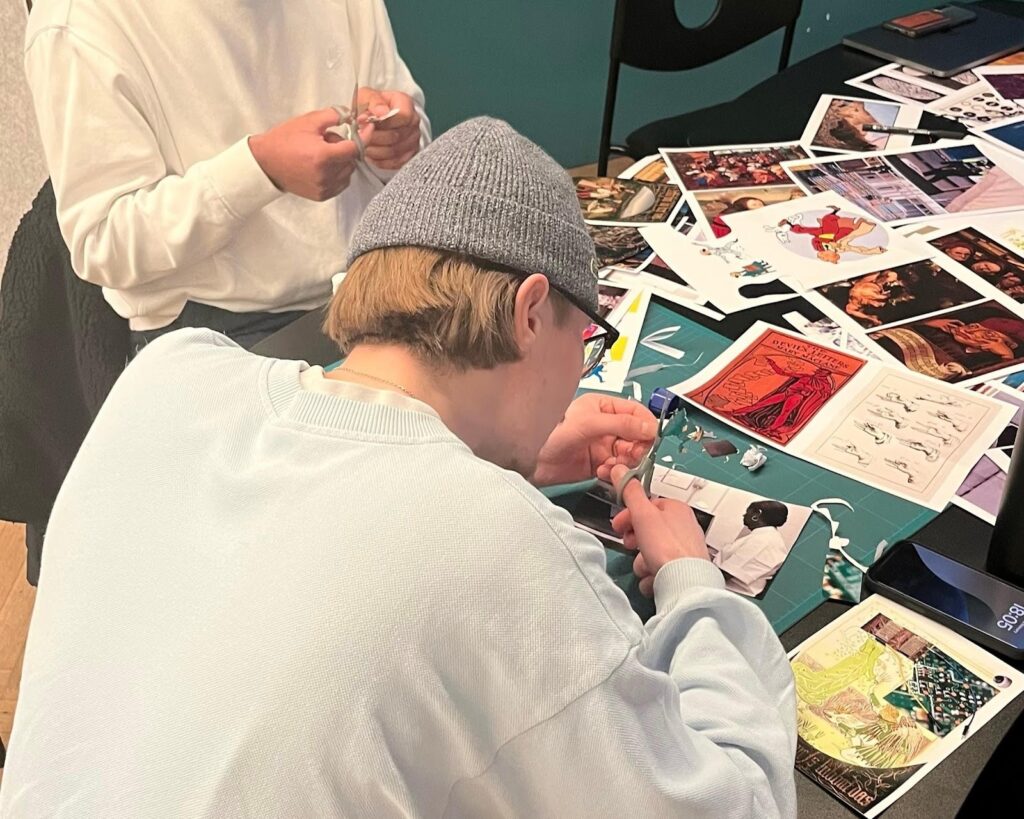
What remained was finding a practical method. A human choice prevailed: collage.
Initially, we had considered several techniques, including digital editing tools. The “Archival Images of AI” playbook by AIxDESIGN offers several interesting methods for creating alternative AI images from archival material. But it was a first testing session with the Citizen Engagement Hub team, Léa Rogliano and Alice Demaret, that gave us clarity. The cut-and-paste technique worked not only for creating strong images; it was also particularly inclusive: it encourages interaction through shared materials, is playful and immediately accessible. It met all our goals, so we made it our method of choice.
However, this technique came with a challenge: we needed to prepare enough pre-printed images and materials for the day. Once again, AIxDESIGN’s resources saved us. Thanks to their recommendations, I discovered Are.na, a platform for collecting large numbers of images from varied sources and formats. The platform describes itself as “ad-free, open source by default, to promote ethical design principles in the tech industry”.
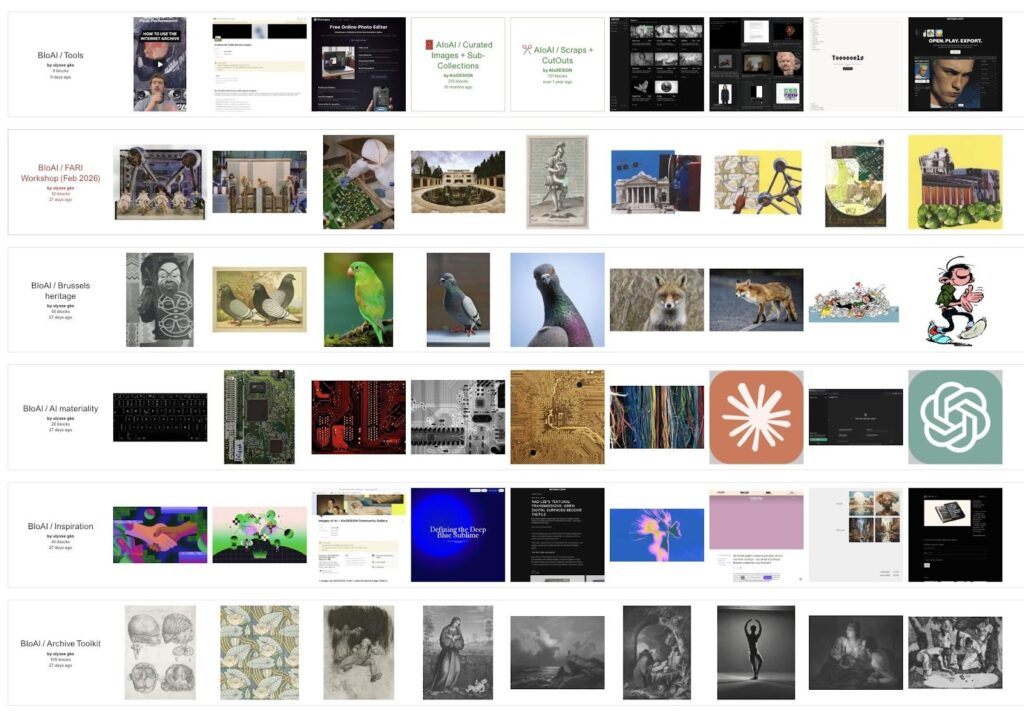
You can find the collections created for this workshop here.
Gathering images was time-consuming, but fairly easy thanks to the links shared by AIxDESIGN. This resulted in three collections: archival images, images of Brussels and images of digital materiality. One problem persisted: the images of Brussels found online reflected very little of our actual environment. I mostly found images of the historic tourist centre, along with well-known cultural symbols. Missing were all those subtler elements that make you recognise your city. Léa Rogliano (Head of Citizen Engagement Hub) proposed an original solution: invite participants to bring their own images and photographs.
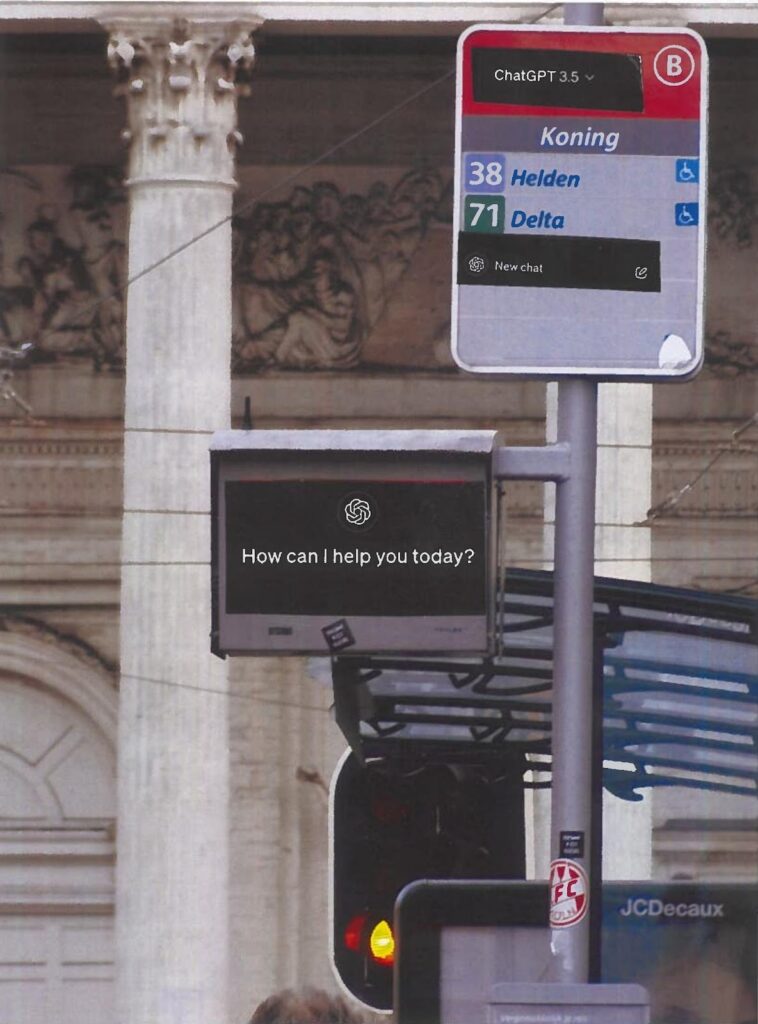
One participant took up the challenge and prepared a series of street photographs: bus stops, screens, electric devices, and so on. Elements that AI could very well integrate… and a far cry from white humanoid robots. Their relevance surprised us, and on the day of the workshop, they turned out to be especially popular!
Far from Brussels’ tourist clichés: a simple bus stop. Here subverted with a fictional ChatGPT integration:
Scissors and glue
With the materials ready, another challenge emerged: How do you get people from very diverse backgrounds, who don’t consider themselves “creative”, to produce powerful images? How do you create the conditions for their sensitivity and expertise to translate into images?
Our approach was fairly direct. We prepared a presentation tracing the story behind Better Images of AI and what it seeks to build, with each concept illustrated by concrete examples. We also presented the collage techniques participants could use: cutting, layering, text collage, subverting existing images… The idea was for everyone to leave with a clear visual toolkit. Tania Duarte’s talk anchored this introduction: by putting a face to the project, she reminded participants that they had the opportunity to join an initiative that reaches beyond borders.
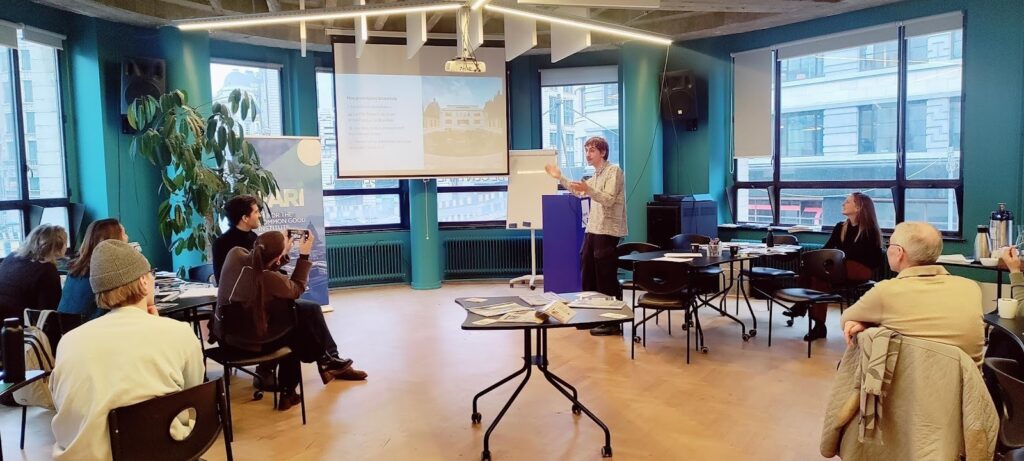
We then invited the group to create images that avoid these tropes, with no further instructions. The idea was that they could represent AI from every angle, positive and negative alike. But also, quite simply, to create images for illustration purposes, however abstract. Images that could stand on their aesthetic qualities alone, without necessarily carrying a critical message.
Insisting on this creative freedom put everyone at ease. The first round of creation naturally sparked conversation, which gradually steered the work towards more developed images. The setup, gathering around a table and sharing creative tools, was decisive in sparking exchanges.
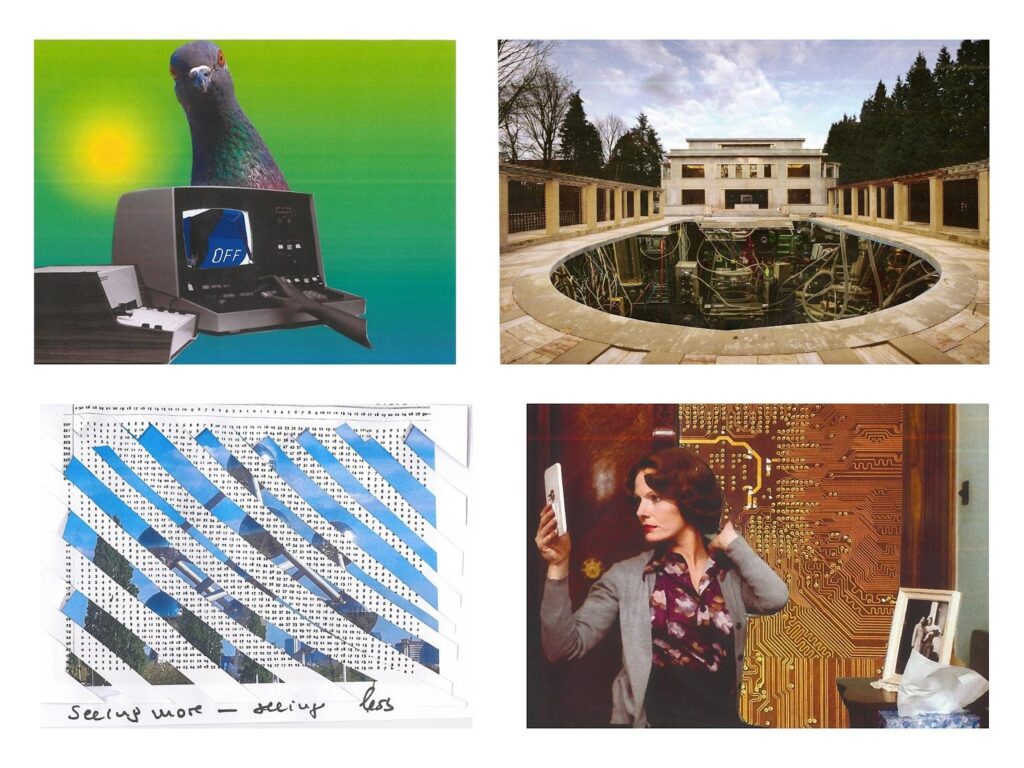
Among the creations, a few images are worth pausing on:
- A Brussels pigeon presides over an old computer. The image doesn’t necessarily mean anything, but it makes people laugh, and that’s already a lot.
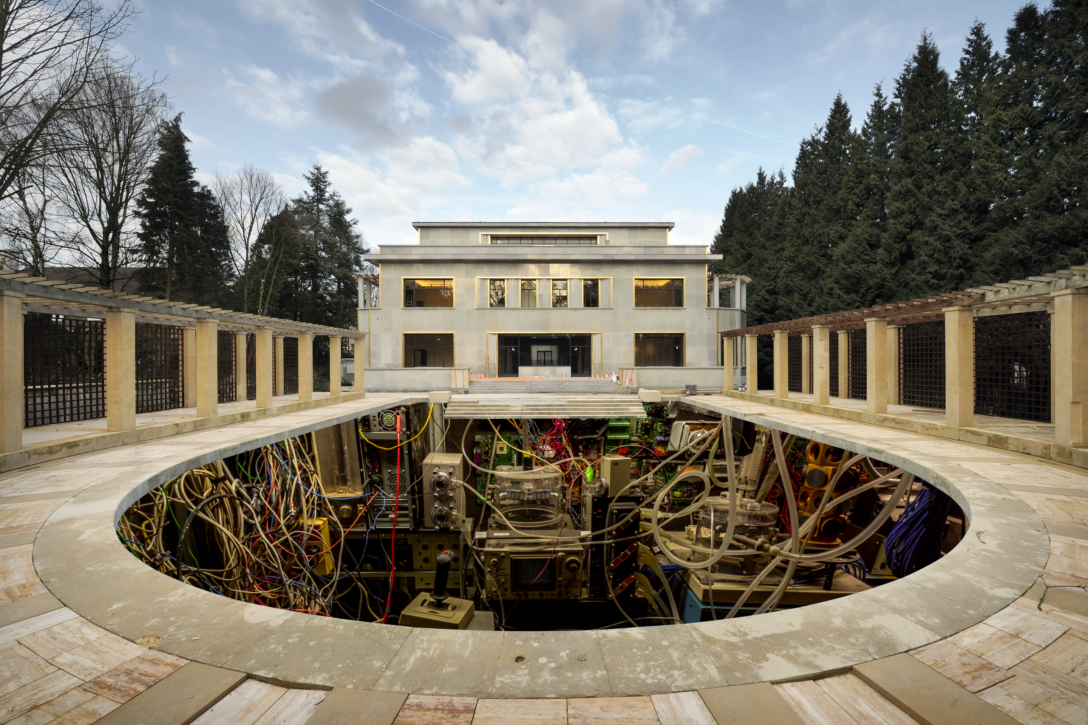
- More pointed, another creation repurposes the swimming pool of the Villa Empain, a Brussels contemporary art venue. The pool is drained of its water and filled with computer servers. The image exposes the colossal consumption of data centres, but also questions resource allocation: when budgets shift towards digital infrastructure, what’s left for culture?
- A third collage subtly weaves technology into a Chantal Akerman film. A woman looks at herself in a mirror that could also be a smartphone. Technology as an evocative backdrop.
- Finally, the collage “Seeing More — Seeing Less” depicts the Atomium, an iconic monument built for the 1958 World’s Fair, at a time when science promised a radiant future. The giant atom can also evoke neural networks, and here conceals a dataset.
From humour to critical reflection, these images show that using archives and local symbols makes it possible to create representations that are as striking as they are varied.
It should be said that we were fortunate to gather around the table a wide variety of professions: a digital inclusion coordinator, a data protection researcher, a learning designer, an artist, a communications officer at a cultural institution, a European Commission executive, and FARI’s own communications team. A mix that turned out to be a catalyst for creativity and exchange.
In just over an hour, everyone had time to produce several images. The first images unlock creativity; the ones that follow gain in intention and relevance.
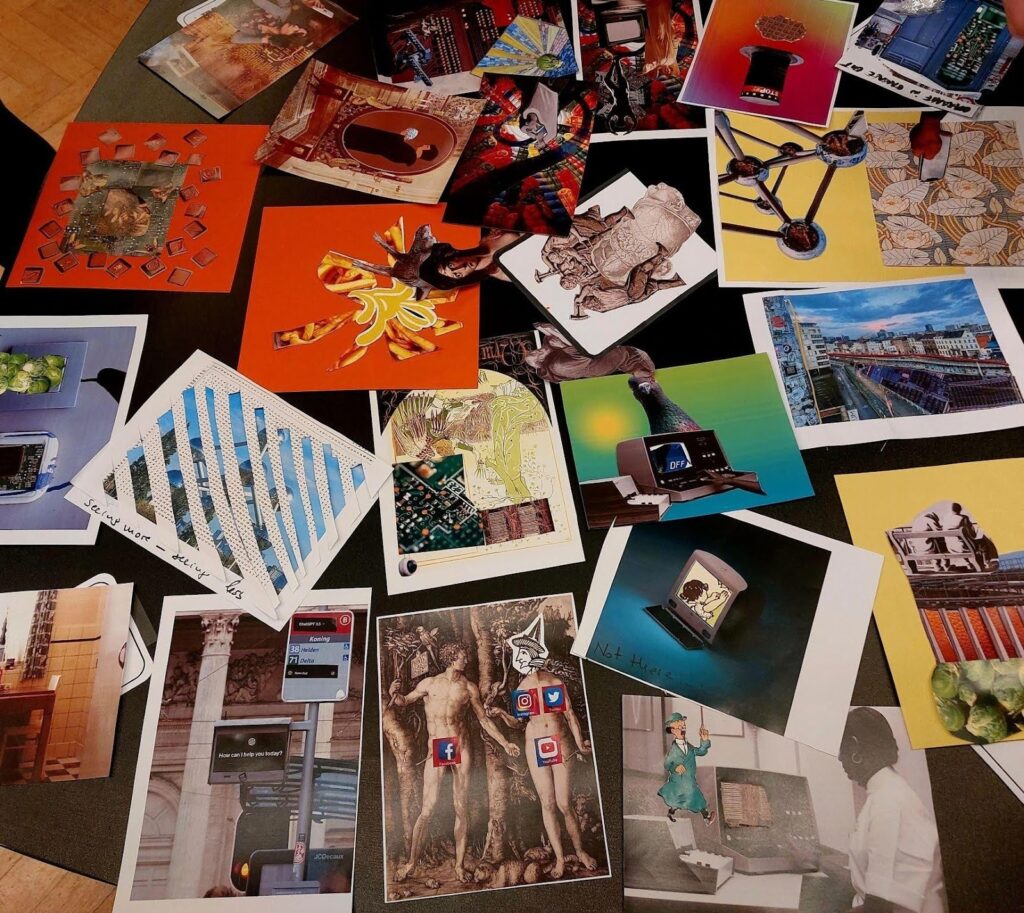
All creations can be viewed here: BIoAI / FARI Workshop (Feb 2026) | Are.na. Some have been published on the Better Images of AI library. [3]
If you want to organise a similar workshop, here are a few very practical lessons we’d like to pass on:
- Allow at least one hour for creation. Making several images lets people move past their first ideas and feeds a collective momentum.
- Test internally first. That’s how we identified the right methods and spotted missing images.
- Print plenty of images. Local archives, everyday images, digital materiality. We can’t predict what participants’ creativity will call for.
- Ask participants to bring their own images. We haven’t found the right formula yet (low response rate), but the contributions we received were very relevant.
- Free up creation before demanding meaning. Abstract or aesthetic images first; critical discourse will follow.
Emancipation through images
We don’t localise AI to promote it; we localise it because it’s already here. By cutting out images of bus stops or Brussels facades, participants made visible what standard AI imagery erases: the presence of these technologies in our daily lives.
Recommendation algorithms shape our news feeds, language models slip into our conversations, and automated systems sort our job applications. Better representing this reality, by shifting the frame, is already to reclaim it. It’s a step towards emancipation.
“Images […] contribute to drawing new configurations of the visible, the sayable and the thinkable, and thereby, a new landscape of the possible.” — Jacques Rancière [4]
In this spirit, the images created during this workshop were published under a Creative Commons licence. This is the very principle of Better Images of AI: building a library of resources accessible to all. It is also FARI’s reason for being as an institute dedicated to the common good. The entire creation chain rests on shared resources: Are.na, AIxDESIGN’s playbook, public-domain archives, and finally the images themselves under a free licence. Many digital commons dedicated to a better understanding of AI.
About the author
I’m Ulysse Gerkens, a Brussels-based developer and graphic designer. I studied social sciences and economics to understand how society works, then switched to programming at 42 to understand how technology reshapes the world I’d been studying. My internship at “FARI – AI for the Common Good Institute” brought both sides together. Today, I explore how technology and human sensitivity interact through art and collaborative practice.
About FARI and the workshop
FARI – AI for the Common Good Institute is a Brussels-based research institute bringing together over 300 researchers in artificial intelligence, robotics and digital data. Within the institute, the Citizen Engagement Hub bridges laboratories and civil society: associations, digital mediators, and citizen collectives.
In 2025, the Citizen Engagement Hub committed to digital inclusion. Belgium has an entire network of digital mediators (Espaces Publics Numériques [1], libraries, associations) who help citizens navigate an increasingly connected world every day. It was from this collaboration that the “Tea-Times” [5] were born: welcoming workshops to discover open-source educational resources together, over tea and cake. My task? To find and prepare these resources in advance. That’s how I discovered Better Images of AI and the idea for hosting this workshop on “Localised AI” visuals.
Acknowledgements
This article concludes my internship at the Citizen Engagement Hub of “FARI – AI for the Common Good Institute Brussels”. I would like to thank Léa Rogliano and Alice Demaret for their mentorship and the trust they placed in me to co-organise this workshop. Thanks to the entire FARI team for their support in organising this event. Finally, thank you to Tania Duarte for her generous contribution during the workshop.
Endnotes and references
[1] Espaces Publics Numériques (EPN): free-access digital spaces staffed by mediators who help citizens with online services and digital skills. In Brussels, they are coordinated by the CABAN network.
[2] Guy Debord, The Society of the Spectacle, trans. Ken Knabb, PM Press, 2024, §12. Originally published as La Société du spectacle, Buchet-Chastel, 1967.
[3] This workshop resulted in the publication of four images on the Better Images of AI library, you can view the FARI collection here.
[4] Jacques Rancière, Le spectateur émancipé, La Fabrique, 2008. Translation by the author.
[5] Tea-Times are funded by the ERDF and the Brussels-Capital Region.