The glowing blue brain – the visual myth of AI cognition 

Four overlapping, staggered rectangles in different shades of blue are overlayed by a glowing circle. beneath, the title reads 'The glowing blue brain – the visual myth of AI cognition'

There is a blue hue in the darkness. Upon closer examination, it is a glowing blue brain, threaded with circuits and inscribed with binary code. This is not an unfamiliar sight; instead, for many of us, it is a common visual of the expansive and unstable notion of ‘artificial intelligence’ (‘AI’). Such visual representations of AI systems have become commonplace.

In this blog post, Raghu Krishnan unpacks the prominence of the glowing blue brain imagery as a visual signifier of AI and considers its implications for public understanding. The post focuses on three primary visual tropes: the use of luminosity or glow, the brain form and personhood, and lastly the colour blue itself, which combine to create an elaborate visual myth of AI cognition.

“The blue, the glow and the brain form combine to create a culturally situated myth of machine cognition.” 

Blue, Glow, Brain

Images associated with the blue brain metaphor for AI often include a luminous brain form surrounded by circuits and binary code, placed near a dark, futuristic background. Instead of showing AI as infrastructure, code, machinery, data or labour, it is depicted as a glowing centre of thought. In this vein, meaning comes from a combination of different components, from the brain to the use of the colour blue, and even the use of luminosity itself, that combine to provide us with a trope which presents the alignment of computation and cognition.
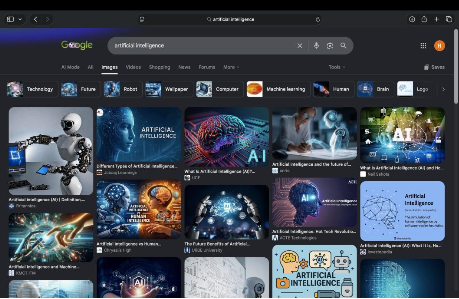
A screenshot of Google imagery shows a series of futuristic images of glowing blue brains, white robots, and holograms.
Figure 1. A quick Google search for ‘visualising AI confirmed the prominence of blue brain imagery. Screenshot by author on 14 July 2026.

Here, semiotic work by Sorensen and Thellefsen (2024) is useful; they claim that the blue brain metaphor in all its forms has become a foundational part of the contemporary imagery around AI. In their view, the “blue brain metaphor” for AI is clearly related to the primarily verbal metaphor “the computer is a brain”, while also moving beyond this and attaching itself to a diversity of other meanings related to potential cognition. In terms of signs and symbols, they view the metaphor as part of Umberto Eco’s notion of a socio-cultural encyclopaedia, where Eco proposed that a larger shared cultural knowledge is utilised to interpret such signs. So, for instance, the blue brain can be assigned ideas of trust due to an existing shared cultural understanding of the brain; this ‘encyclopaedia’, in his view, is open-ended, where people attach endless contextual meanings to signs embedded in a shared societal network. Simply put, these visual signs are connected to expanding and interconnected cultural knowledge, which impacts interpretation. It is this contextual nature of interpretation of images and signs that is underscored throughout the article. 

Make me Glow

Glow or illumination may seem almost natural in imagery surrounding future technology, as well as in attempts to showcase the inner workings of the mind. More recently, there have been attempts to construct an ‘anthropology of luminosity’ showing how the use and experience of light are culturally embedded. Bille and Sørensen (2007), in their work, An Anthropology of Luminosity, argue that philosophical treatises and critiques have often neglected the social role of light, the role of illuminating people, places, experiences, biases, and myth. While light is a concrete physical phenomenon, it also has its ‘lux’, or the sensual qualities formed through sight and vision. The Western primacy of vision perpetuates the importance of light and vision in experiencing the world and, often, in forming concepts (Levin, 1993). It is this emphasis on light which finds itself represented in the ‘glow’ of the blue brains used to represent AI. 

Here, this importance is sketched onto social settings, as ‘lightscapes’ operating through the interaction of light and its environment. An example of the culturally relative experience of light comes from the work of Japanese author Tanizaki, who argues that the role of shadows, or the appreciation of shadows, was crucial in Japanese material culture and way of life. Japanese aesthetics, in this view, placed a cultural emphasis on indirect light, in which material culture was meant to interact with shadows, from lacquer and ceramics to paper. Appreciation for such items, in Tanizaki’s account, relied heavily upon their emergence from the darkness, an appreciation that eventually gave way to ‘intense illumination from the west’. Therefore, the glowing brains borrow the social role of light, which is situated in the West, neglecting other cultural notions of light, as seen in Tanizakis account. 

While light is physical and sensory, it may also extend to the sacred. Morphy (1989), Gage (1995) and Pinney (2001) all argue that colour and light create luminosity, which may have sacred and spiritual dimensions, and that brilliant objects are conceived as the material manifestation of light. Here, brilliant glowing orbs, lamps, and, in our case, blue brains become objects emitting light. In these contexts, light is often imagined as a signifier of ancestral power or, in our case, future power, where the glowing blue brains signal technological potency and imagined authority in the future. Luminosity gives the AI an aura, where computation may appear as sacred.

Apart from affective qualities, the presence or absence of light has also functioned as an important metaphor in Western philosophy. From the classical age, light has often been interpreted as an important metaphor through which people experience the world; for instance, in Plato’s allegory of the Cave, prisoners mistake shadows for reality, while the movement towards light represents a transition from illusion to knowledge (Plato, 2007). 

Similarly, from the Enlightenment, light was seen as a medium through which knowledge was revealed; light hence finds itself deeply entwined with the notion of life and existence, the dead, or the soulless find themselves depicted as dark or lacking illumination. A more recent example is the use of the ‘lightbulb moment’ in comicbooks, where a lightbulb over a character’s head would signal a sudden moment of inspiration. Therefore the glowing brains borrow this  association of light with knowledge and inspiration  situated in the west, to construct an elaborate myth of cognition.

In essence, we have three different notions of light: the material lux, or glow, the social agency of light, and lastly the metaphorical light; importantly, all of these are culturally embedded. In the context of our image, materially the brain glows, socially it signals future authority, and metaphorically it points to ideas of consciousness and life. The glow of the brain  condenses these notions into a single image. The anthropology of light, in a way, provides a framework to interpret the powerful visual of the glowing blue brain, where material, social and psychological notions of light are projected onto the (blue) brain form.
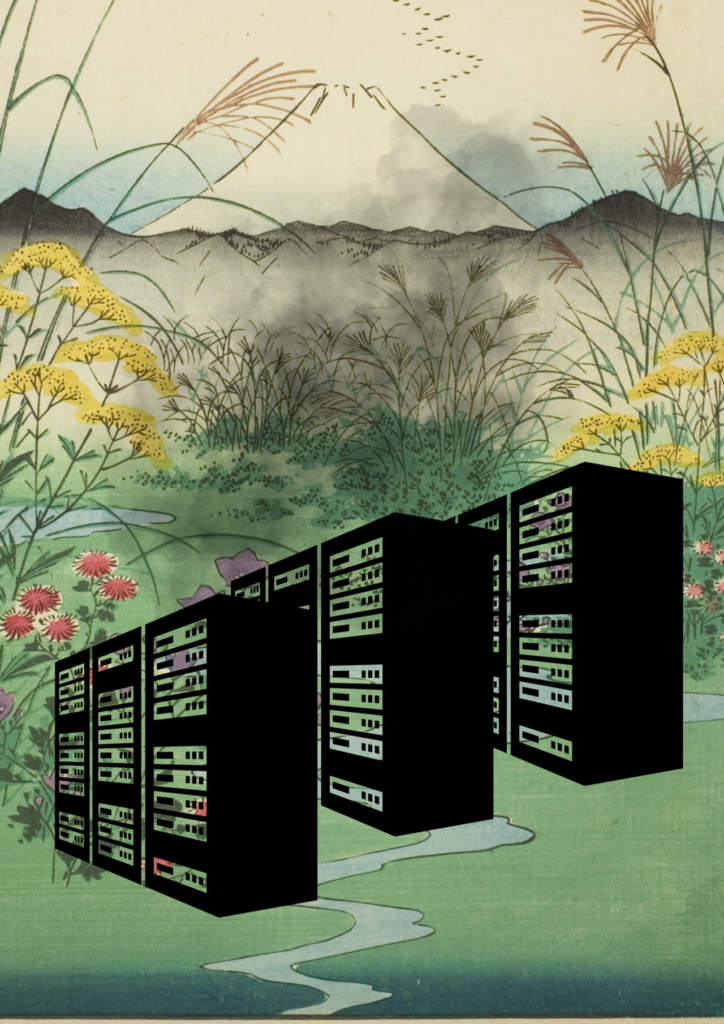
This image is a collage with a colourful Japanese vintage landscape showing a mountain, hills, flowers and other plants and a small stream. There are 3 large black data servers placed in the bottom half of the image, with a cloud of black smoke emitting from them, partly obscuring the scenery.
Deborah Lupton / Better Images of AI / CC BY 4.0

Deborah Lupton’s image, ‘Servers in a Landscape ’, directly challenges the ‘glowing’ visuals of AI by representing AI as a dark cloud of smoke. The image demonstrates the impacts of data centres on the natural world through pollution emitted from the operation of the centres.

Brain dead and Brain alive.

The brain form itself has traditionally had a persuasive influence on public perception. Experimental work by McCabe and Castel (2008) argued that brain images played a role in public acceptance of neuroscience research. They argued that such images or scans of the brain provide a physical basis for abstract cognitive processes, appealing to people’s affinity for reductionist explanations of cognitive phenomena. Later work has complicated the strength of the “seductive brain image” effect (Michael et al,2013); the claim is not that brain images automatically convince people, but that they belong to a wider visual culture in which cognition seems more credible when it is made visible in the brain. Essentially, they aid communication by making the internal cognitive process seem visible and scientific. 

Dumit, in his account of brain scans and personhood, presents this notion in pop culture, showing that the AI brain is a borrowed form of scientific visual authority, where the brain, in a variety of pop culture , and has become synonymous with a modern Euromerican notion of personhood. He gives the example of brain scans being framed with simple labels like “normal,” “depressed,” or “healthy,” reducing visible types of people into individual brains. Moreover, he shows us how this imagery travels extensively from medical literature to pop culture, forming an important mediascape shaping narratives. Dumit’s (2004) ethnographic account reveals that brain scans and imagery do not travel across mediascapes alone; they carry with them culturally situated ideas of personhood. As they move through realms of journalism, medicine, film, and courts, they are important cultural lenses through which people interpret illness and identity. Therefore, the glowing blue brains take on elements of personhood and identity based on how brain images have been viewed across western mediascapes. 

Racine et al’s 2005  notion of ‘neurorealism’ is also useful here, where brain images can make mental phenomena appear more real by providing them a physical location. These interlinked narratives of personhood and the brain have been crystallised by Vidal and Ortega in their (2017) book ‘The Cerebral Subject’, arguing that increasingly there is a tendency for people to be visualised through their brains. In a sense, our physical health, our mental health, our ability, and even our relations are seen through this image of the brain; in other words, they argue we are increasingly being visualised as our brains, where the brain becomes a symbol of our agency, intelligence, identity and moral responsibility. 

In the context of AI imagery, the glowing blue brain borrows from what we can call ‘neurocultural authority’, appealing to ideas of personhood and intelligence, where the narrative moves beyond computation to potentially misleading tropes of consciousness. The use of the physical brain enables the viewer to visually locate the machine, giving it potential for cognition. While the glow lights the machine up, the brain form provides an important visual architecture for us to visualise this active cerebral process; here the explicit use of the brain form helps transform luminous computation into a potential digital mind. This elaborate multi-modal trope, hence, removes us from the harsh reality of labour and infrastructure, and instead posits an anthropomorphic myth of a computer that is alive.
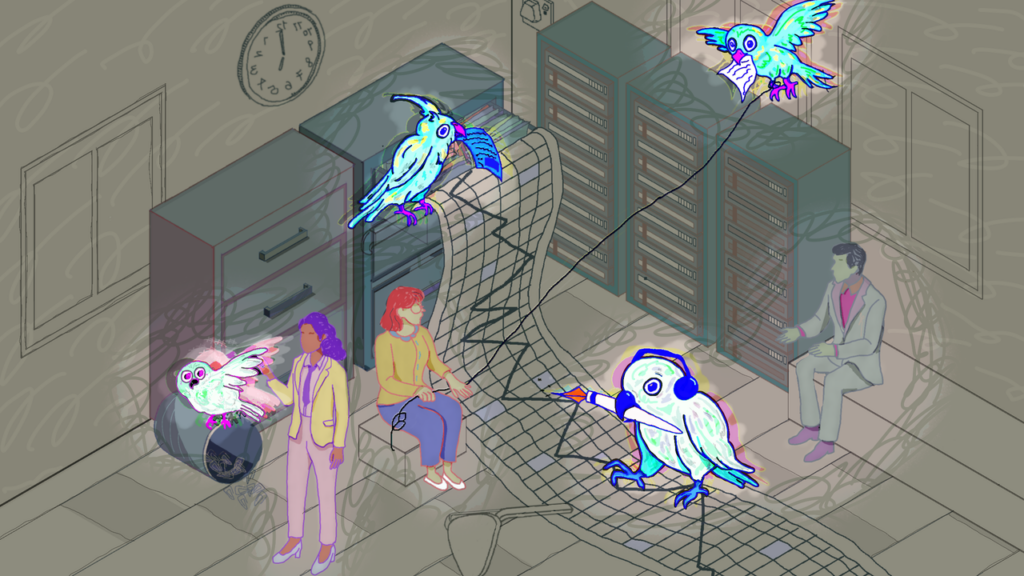
Illustration of a surreal office scene with neon birds interacting with digital elements around three people near servers and file cabinets; one bird writes on a digital mesh, another carries a paper.
IceMing & Digit / Better Images of AI / CC BY 4.0

Ice Ming’s image challenges the representation of AI as a brain through a different visual metaphor: stochastic parrots. The ‘stochastic parrot’ is a metaphor for large language models (like ChatGPT) that generate text by statistically predicting the next word based on large datasets, rather than by understanding the meaning, truth or context of the user’s prompts – perhaps like a cognitive being. 

Don’t Look so blue.

The use of the colour blue may seem a matter of ‘fitting the aesthetic’, given that such imagery is commonplace in science fiction cinema. However, the colour choice is an atmospheric device to make the visuals appear clean. Blue further helps remove AI from its socio-material context of data centres, energy use, supply chains, and labour. Sørensen and Thellefsen (2024) show that the role of colour in the blue brain metaphor is to ground the visuals in legitimacy. Crucially, this is not to claim that the use of blue, or the effect of blue, is universal, with Jonauskaite et al (2020) demonstrating that colour emotion associations are shaped by language, geography and culture, and this use of blue is perhaps limited to contemporary Euroamerican stock image culture, which has become the face of AI. 

This culturally situated use of the blue glow belongs to a wider regime in which AI imaginaries have been dominated by particular sections of society. This is connected to what Cave and Dihal (2020) have called the ‘whiteness of AI’, where the future seems Western and sanitised. The image further extends the erasure of other cultural and material ways of imagining AI; in a way, other ways to develop and conceive of AI  have been crowded out by such deterministic narratives. One can further draw a parallel to anthropologist Alex Taylor’s (2019) work on the aesthetics of data centres, where imagery used to depict data centres has emphasised them as sterile and technical spaces, devoid of fallible human labour. In both cases, visual narrative conveniently  distracts the viewer from human labour, which is at the core of the supply chain.
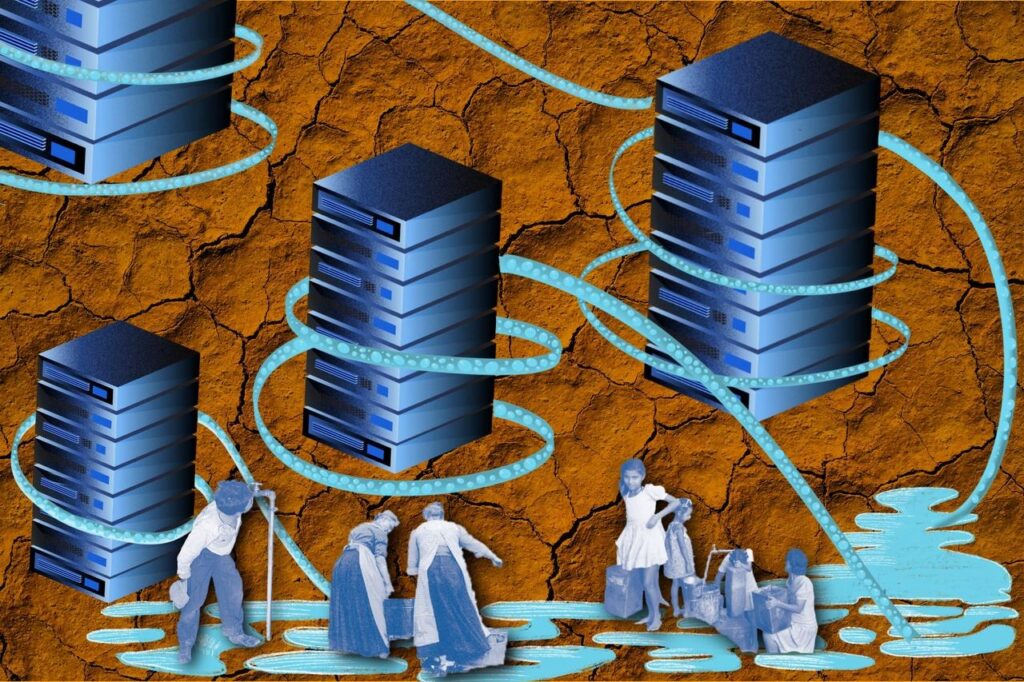
Cooling pipes hug data servers, extracting water from a shared reservoir while people collect water from the same source, set against a background of eroded soil textures.
Gloria Mendoza / Better Images of AI / CC BY 4.0

Gloria’s image, while still including elements of blue, is not used to represent AI, but the resources it relies upon – including water, local communities, and servers. It symbolises how data centre operations contribute to erosion, water scarcity, and drought.

Conclusion

The blue, the glow and the brain form combine to create a culturally situated myth of machine cognition. The myth has many layers: where a brain may provide it with physical authority, glow may suggest activation, and blue may signal a sanitised future in the Global North. This, when combined  with circuits placed upon a dark digital background, removes AI from physical infrastructure and human labour to a luminous future. This is symptomatic of visual media describing AI systems, which is disengaged from the social and environmental effects of such systems, while also perpetrating a grossly misleading narrative about the capabilities of current large language models.

About the author

Raghu Krishnan is an undergraduate reading archaeology and anthropology at the University of Oxford, interested in digital anthropology and human-AI interaction. 
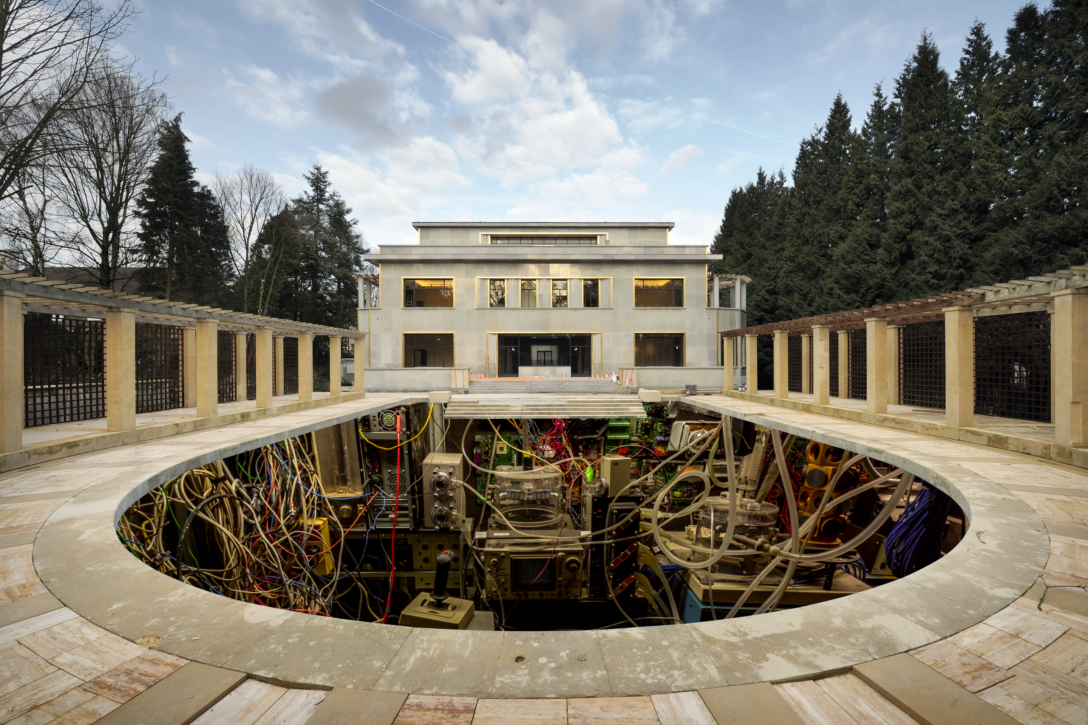
Localising AI’s Visual Culture with Brussels Heritage

Paper collage. The Art Deco swimming pool of the Villa Empain in Brussels, its elegant facade visible in the background, with the water replaced by rows of computer servers.

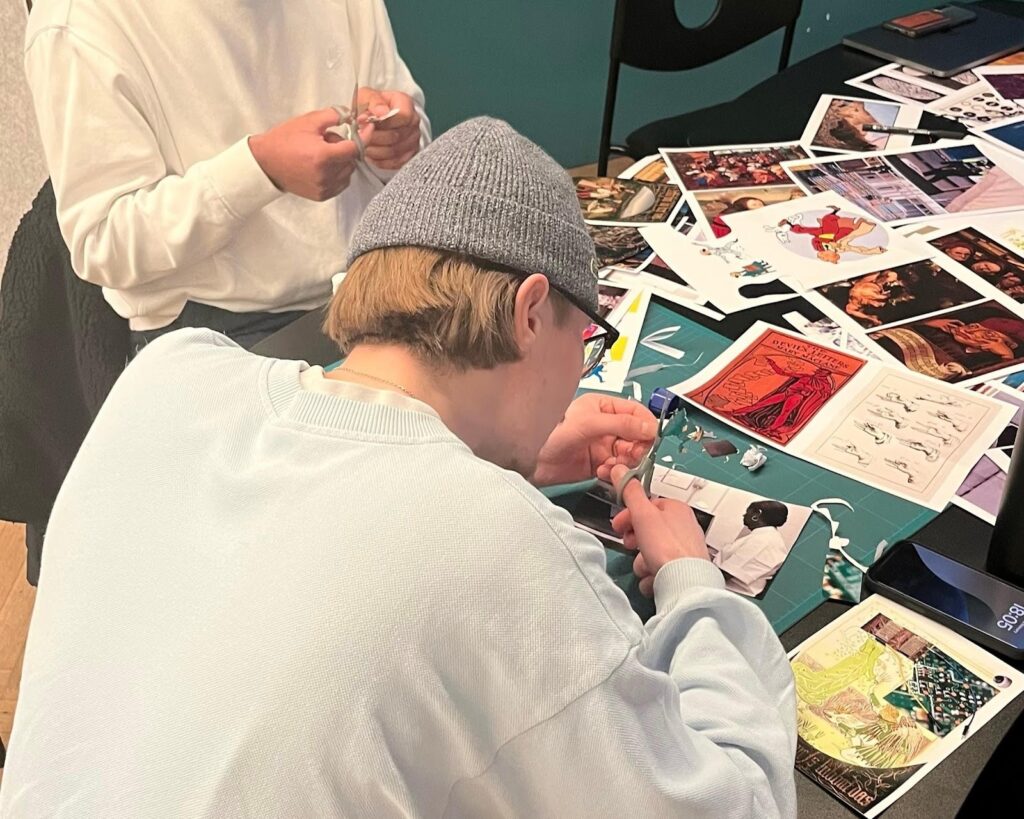
Images spread across tables, sheets pinned to walls, scissors and glue sticks everywhere. An incongruous setting for people who work in tech, more used to tapping keyboards than wrestling with rolls of tape. And yet… this was the best response FARI found to a problem that’s harder to pin down than it seems: the depressing homogeneity of AI imagery that fails to capture individuals’ own experiences and encounters with the technology in local communities.

FARI – AI for the Common Good Institute is a Brussels-based research institute bringing together over 300 researchers in artificial intelligence, robotics and digital data. In February, FARI hosted a workshop on “Localising Visuals of AI” – aiming to engage its group to create visuals of AI anchored in the lived realities of a citizen in Brussels. 

In this blog post, Ulysse Gerkens, who led the workshop, explains why localised visuals of AI are important and necessary. In particular, how drawing upon digital commons and an individual’s own materials can create conditions for sensitivity and lived expertise to translate into visualisations of AI. Ulysse also offers some tips and advice for hosting your own “Localising Visuals of AI” workshop in your local community. 

You can find some of the images from the workshop in our library here.

“We don’t localise AI to promote it; we localise it because it’s already here. By cutting out images of bus stops or Brussels facades, participants made visible what standard AI imagery erases: the presence of these technologies in our daily lives.” Ulysse Gerkens

AI images mislead us

The mission of digital mediators goes beyond facilitating access to technology. It also involves reflection: inviting every citizen to question the technologies that run through their daily lives, to form their own opinion, to voice it. It’s a deeply democratic mission, and one that echoes FARI’s reason for being. When the only available images of AI are misleading, it is precisely this capacity for expression and critical judgment that is weakened. Driven by this mission and this assessment, we chose to host a workshop based on Better Images of AI. More than a library of alternative images, Better Images of AI addresses a challenge that digital mediators face every day: 

How do you explain the stochastic workings of language models with images of humanoid robots? How do you convey AI’s ecological impact when the only images show clean, shiny machines?

“The spectacle presents itself as a vast inaccessible reality that can never be questioned. Its sole message is: ‘What appears is good; what is good appears.‘”— Guy Debord [2]

Better Images of AI proposes to build a different visual vocabulary of AI. One that is useful, anchored in reality, and that can shift our gaze.

Appropriation as the goal, localisation as the method

Beyond these observations, we can’t rebuild the entire imaginary of AI in a single workshop. So, where to start? Perhaps with our immediate environment and our culture. “Localising AI” was our first starting premise. In a globalised culture, we proposed putting the human, with all their specificity, back at the centre of the debate. So we decided to anchor AI imagery in Brussels, drawing from our experiences and encounters with the technology.

Tania Duarte, Founder of We and AI which runs the Better Images of AI collaboration, spoke at the workshop. She stressed a point we kept coming back to: we are all experts of our own ground. Digital mediators know their audiences, their neighbourhoods, and the concrete situations where AI enters people’s lives. The workshop aimed to turn this lived expertise into images.

An over the shoulder shot of an individual cutting with scissors at a table which is full of cuttings and images spread out.
Participant cutting during the workshop

What remained was finding a practical method. A human choice prevailed: collage.

Initially, we had considered several techniques, including digital editing tools. The “Archival Images of AI” playbook by AIxDESIGN offers several interesting methods for creating alternative AI images from archival material. But it was a first testing session with the Citizen Engagement Hub team, Léa Rogliano and Alice Demaret, that gave us clarity. The cut-and-paste technique worked not only for creating strong images; it was also particularly inclusive: it encourages interaction through shared materials, is playful and immediately accessible. It met all our goals, so we made it our method of choice.

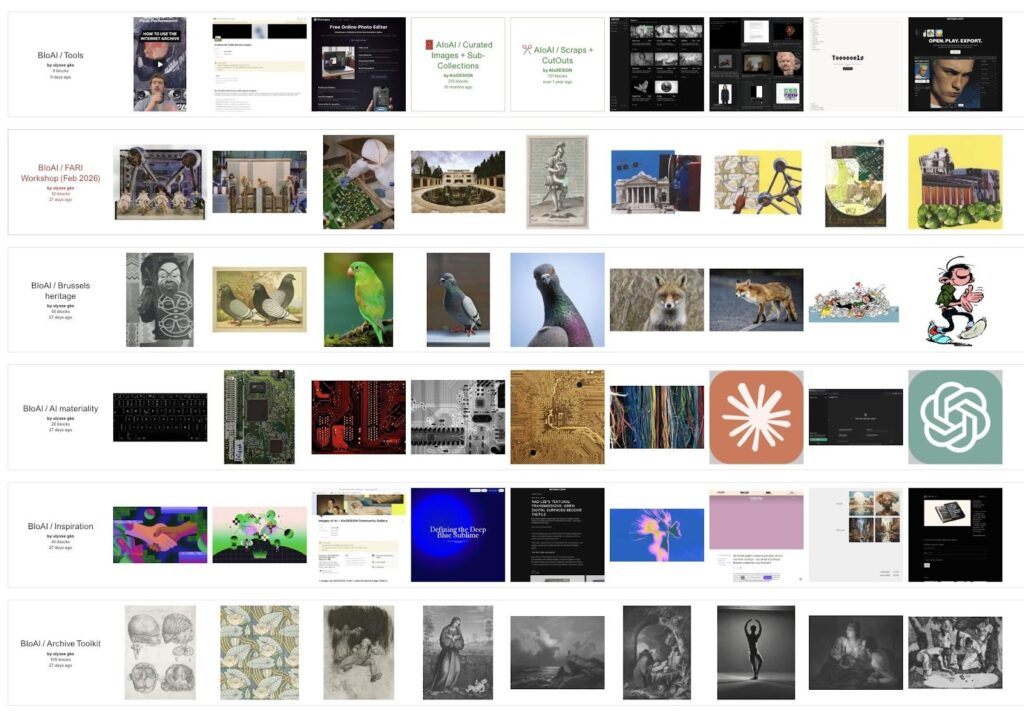
However, this technique came with a challenge: we needed to prepare enough pre-printed images and materials for the day. Once again, AIxDESIGN’s resources saved us. Thanks to their recommendations, I discovered Are.na, a platform for collecting large numbers of images from varied sources and formats. The platform describes itself as “ad-free, open source by default, to promote ethical design principles in the tech industry”.

A screenshot of the digital images in a library. Images shown range from AI company logos to parrots.
Are.na collections

You can find the collections created for this workshop here.

Gathering images was time-consuming, but fairly easy thanks to the links shared by AIxDESIGN. This resulted in three collections: archival images, images of Brussels and images of digital materiality. One problem persisted: the images of Brussels found online reflected very little of our actual environment. I mostly found images of the historic tourist centre, along with well-known cultural symbols. Missing were all those subtler elements that make you recognise your city. Léa Rogliano (Head of Citizen Engagement Hub) proposed an original solution: invite participants to bring their own images and photographs.

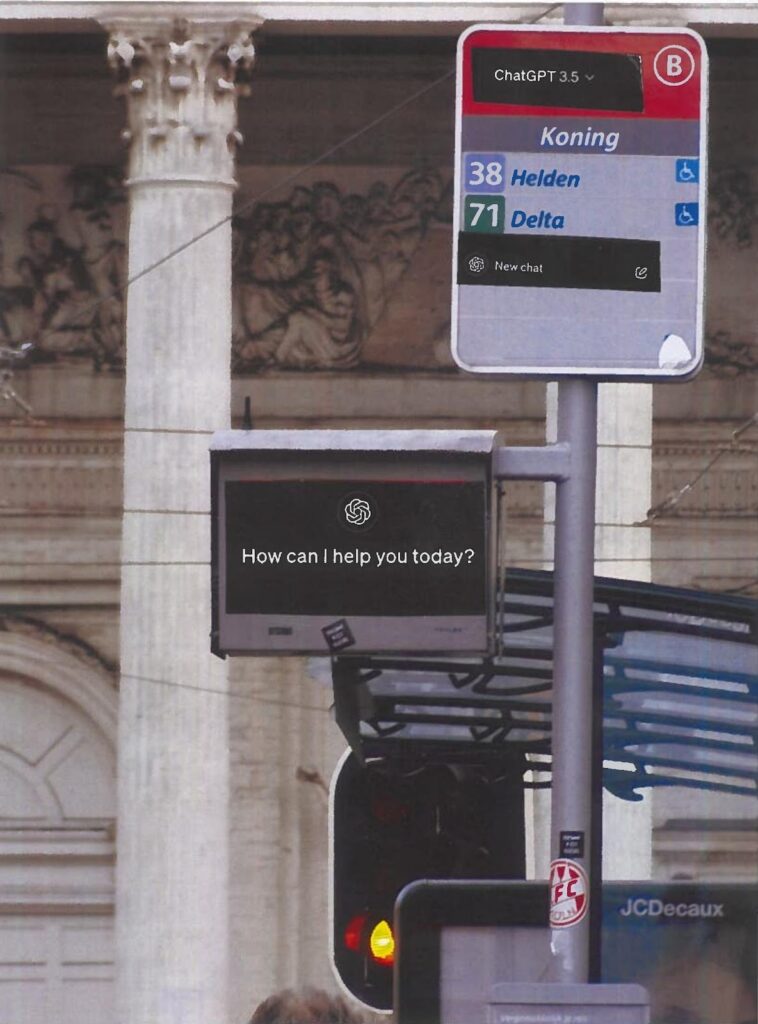
One participant took up the challenge and prepared a series of street photographs: bus stops, screens, electric devices, and so on. Elements that AI could very well integrate… and a far cry from white humanoid robots. Their relevance surprised us, and on the day of the workshop, they turned out to be especially popular!

Far from Brussels’ tourist clichés: a simple bus stop. Here subverted with a fictional ChatGPT integration:

A bus stop with screenshots from ChatGPT's interface overlayed, including "How can I help you today" with the OpenAI logo above on the traffic light. "ChatGPT 3.5" is at the top of the list of stops, and "New chat" beneath "38 Helden" and "71 Delta" as an additional stop.
Bus stop with fictional ChatGPT integration

Scissors and glue

With the materials ready, another challenge emerged: How do you get people from very diverse backgrounds, who don’t consider themselves “creative”, to produce powerful images? How do you create the conditions for their sensitivity and expertise to translate into images?

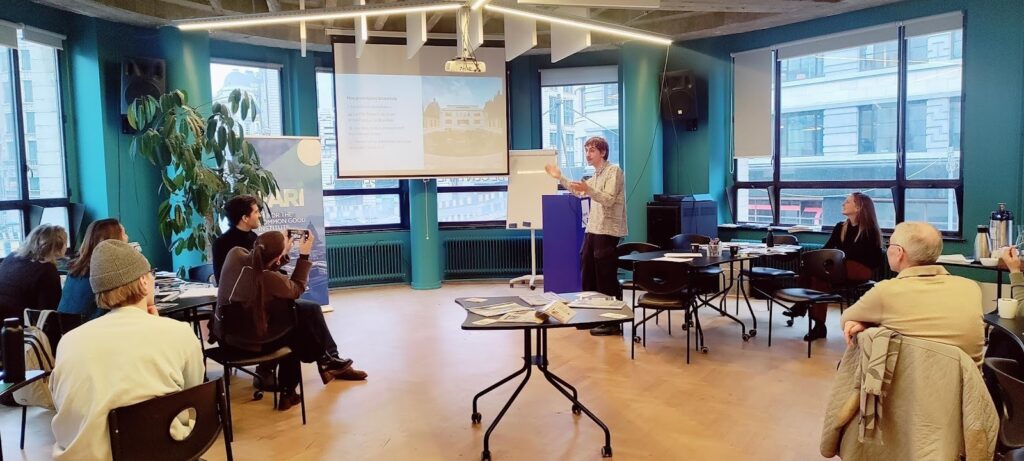
Our approach was fairly direct. We prepared a presentation tracing the story behind Better Images of AI and what it seeks to build, with each concept illustrated by concrete examples. We also presented the collage techniques participants could use: cutting, layering, text collage, subverting existing images… The idea was for everyone to leave with a clear visual toolkit. Tania Duarte’s talk anchored this introduction: by putting a face to the project, she reminded participants that they had the opportunity to join an initiative that reaches beyond borders.

An image taken from the back of a room where individuals are sat around tables watching Ulysse present on a screen. The tables have materials such as papers and images scattered on them.
Workshop presentation

We then invited the group to create images that avoid these tropes, with no further instructions. The idea was that they could represent AI from every angle, positive and negative alike. But also, quite simply, to create images for illustration purposes, however abstract. Images that could stand on their aesthetic qualities alone, without necessarily carrying a critical message.

Insisting on this creative freedom put everyone at ease. The first round of creation naturally sparked conversation, which gradually steered the work towards more developed images. The setup, gathering around a table and sharing creative tools, was decisive in sparking exchanges.

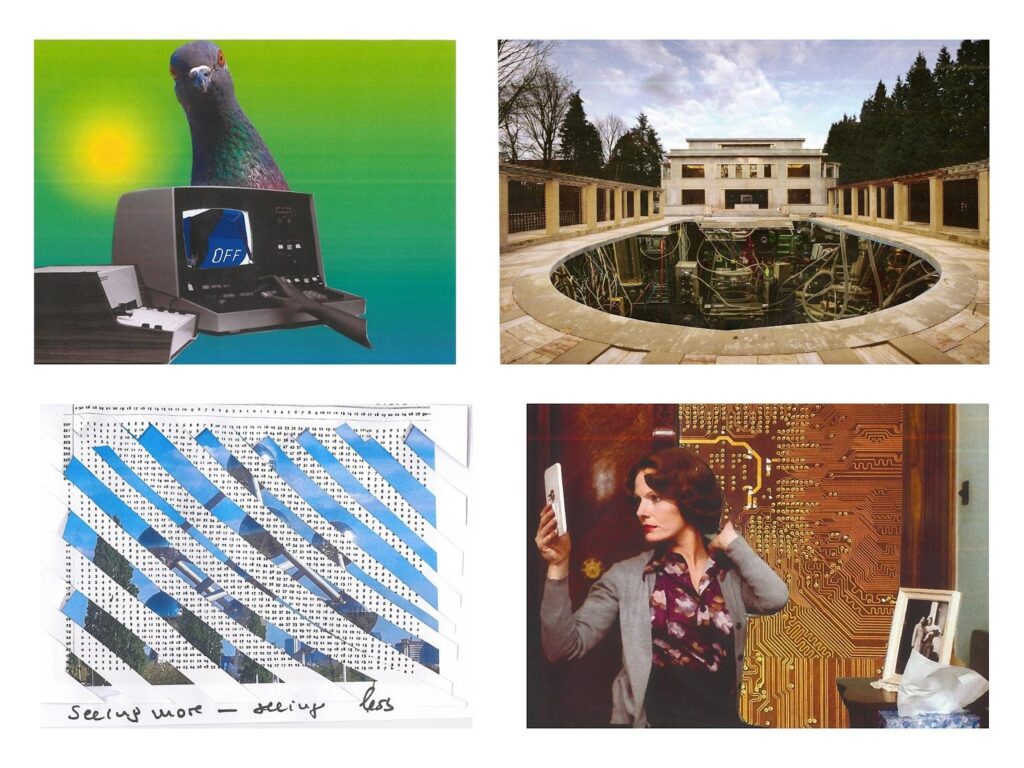
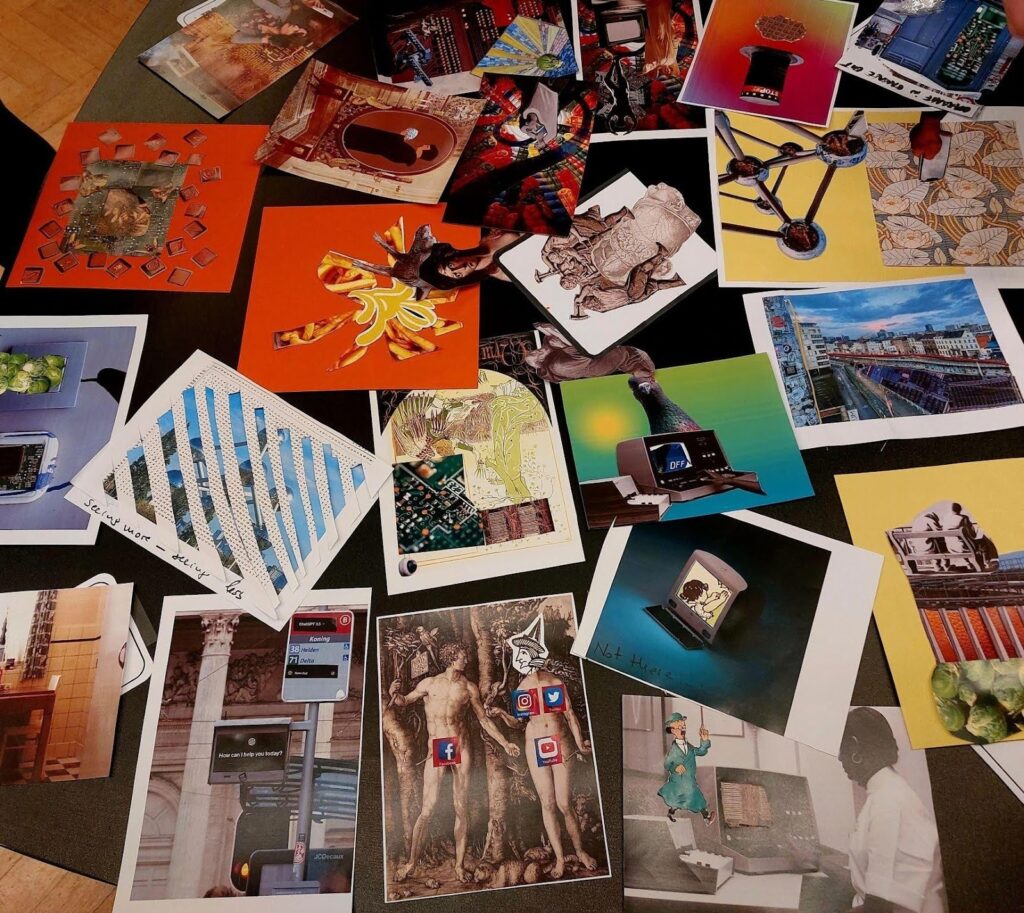
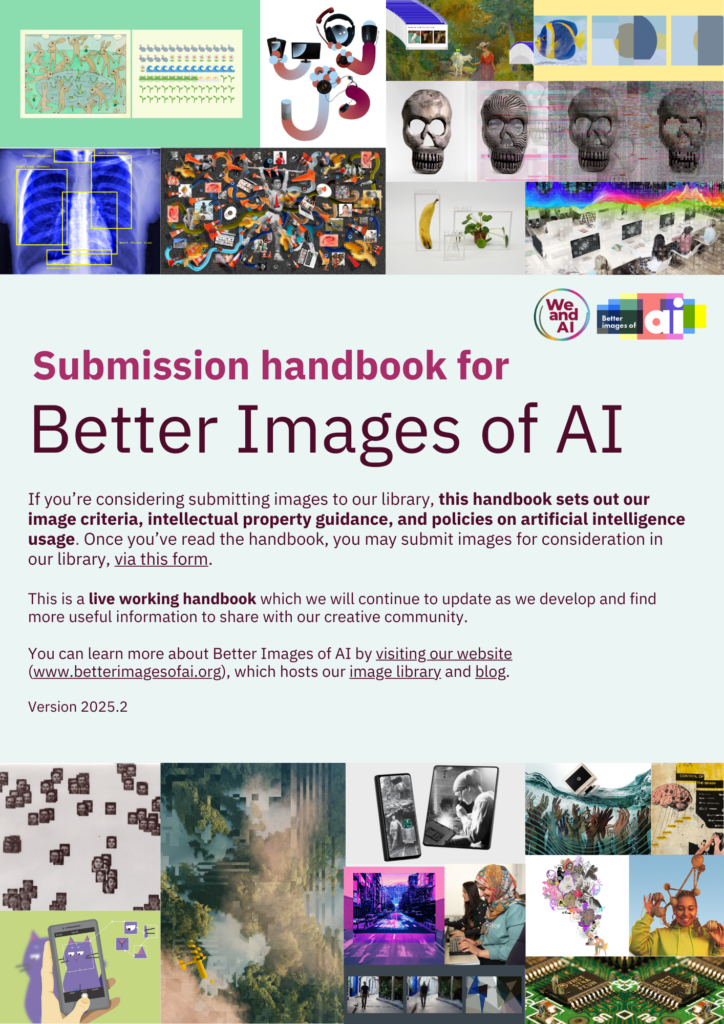
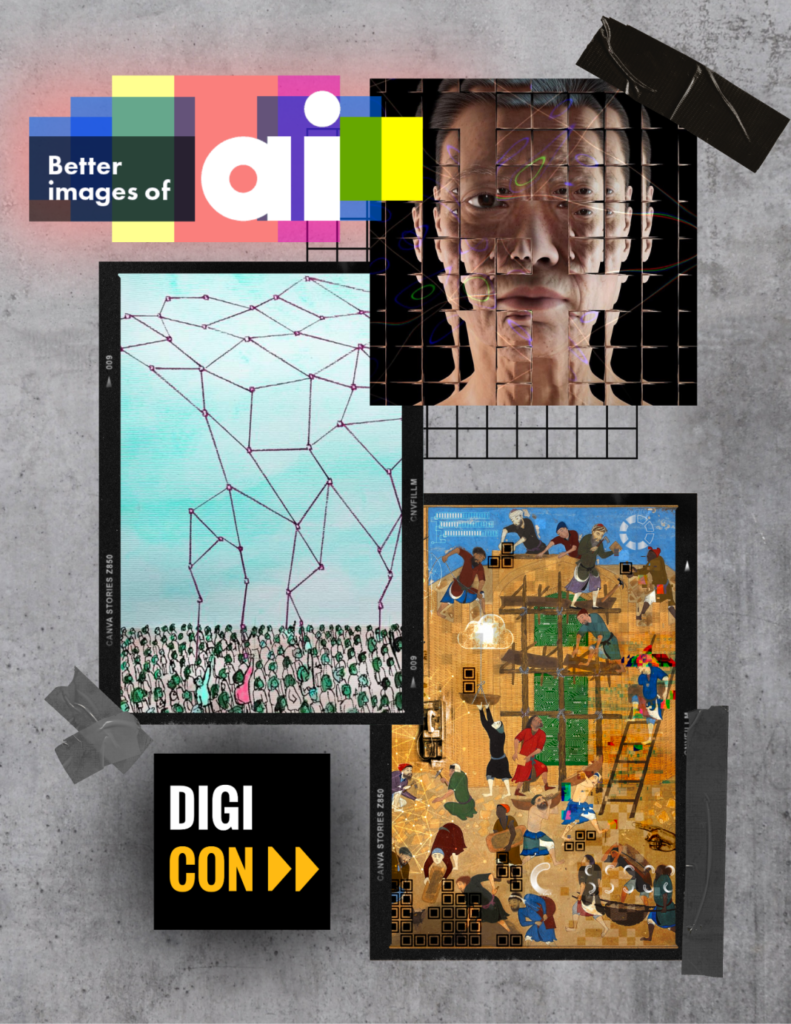
4 images from the workshop which are described below.

Among the creations, a few images are worth pausing on:

  • A Brussels pigeon presides over an old computer. The image doesn’t necessarily mean anything, but it makes people laugh, and that’s already a lot. 
  • More pointed, another creation repurposes the swimming pool of the Villa Empain, a Brussels contemporary art venue. The pool is drained of its water and filled with computer servers. The image exposes the colossal consumption of data centres, but also questions resource allocation: when budgets shift towards digital infrastructure, what’s left for culture? 
  • A third collage subtly weaves technology into a Chantal Akerman film. A woman looks at herself in a mirror that could also be a smartphone. Technology as an evocative backdrop. 
  • Finally, the collage “Seeing More — Seeing Less” depicts the Atomium, an iconic monument built for the 1958 World’s Fair, at a time when science promised a radiant future. The giant atom can also evoke neural networks, and here conceals a dataset.

From humour to critical reflection, these images show that using archives and local symbols makes it possible to create representations that are as striking as they are varied.

It should be said that we were fortunate to gather around the table a wide variety of professions: a digital inclusion coordinator, a data protection researcher, a learning designer, an artist, a communications officer at a cultural institution, a European Commission executive, and FARI’s own communications team. A mix that turned out to be a catalyst for creativity and exchange.

In just over an hour, everyone had time to produce several images. The first images unlock creativity; the ones that follow gain in intention and relevance.

All workshop creations

All creations can be viewed here: BIoAI / FARI Workshop (Feb 2026) | Are.na. Some have been published on the Better Images of AI library. [3]

If you want to organise a similar workshop, here are a few very practical lessons we’d like to pass on:

  • Allow at least one hour for creation. Making several images lets people move past their first ideas and feeds a collective momentum.
  • Test internally first. That’s how we identified the right methods and spotted missing images.
  • Print plenty of images. Local archives, everyday images, digital materiality. We can’t predict what participants’ creativity will call for.
  • Ask participants to bring their own images. We haven’t found the right formula yet (low response rate), but the contributions we received were very relevant.
  • Free up creation before demanding meaning. Abstract or aesthetic images first; critical discourse will follow.

Emancipation through images

We don’t localise AI to promote it; we localise it because it’s already here. By cutting out images of bus stops or Brussels facades, participants made visible what standard AI imagery erases: the presence of these technologies in our daily lives. 

Recommendation algorithms shape our news feeds, language models slip into our conversations, and automated systems sort our job applications. Better representing this reality, by shifting the frame, is already to reclaim it. It’s a step towards emancipation.

“Images […] contribute to drawing new configurations of the visible, the sayable and the thinkable, and thereby, a new landscape of the possible.” — Jacques Rancière [4]

In this spirit, the images created during this workshop were published under a Creative Commons licence. This is the very principle of Better Images of AI: building a library of resources accessible to all. It is also FARI’s reason for being as an institute dedicated to the common good. The entire creation chain rests on shared resources: Are.na, AIxDESIGN’s playbook, public-domain archives, and finally the images themselves under a free licence. Many digital commons dedicated to a better understanding of AI.


About the author 

Headshot of Ulysse

I’m Ulysse Gerkens, a Brussels-based developer and graphic designer. I studied social sciences and economics to understand how society works, then switched to programming at 42 to understand how technology reshapes the world I’d been studying. My internship at “FARI – AI for the Common Good Institute” brought both sides together. Today, I explore how technology and human sensitivity interact through art and collaborative practice.

About FARI and the workshop 

FARI – AI for the Common Good Institute is a Brussels-based research institute bringing together over 300 researchers in artificial intelligence, robotics and digital data. Within the institute, the Citizen Engagement Hub bridges laboratories and civil society: associations, digital mediators, and citizen collectives.

In 2025, the Citizen Engagement Hub committed to digital inclusion. Belgium has an entire network of digital mediators (Espaces Publics Numériques [1], libraries, associations) who help citizens navigate an increasingly connected world every day. It was from this collaboration that the “Tea-Times” [5] were born: welcoming workshops to discover open-source educational resources together, over tea and cake. My task? To find and prepare these resources in advance. That’s how I discovered Better Images of AI and the idea for hosting this workshop on “Localised AI” visuals. 

Acknowledgements

This article concludes my internship at the Citizen Engagement Hub of “FARI – AI for the Common Good Institute Brussels”. I would like to thank Léa Rogliano and Alice Demaret for their mentorship and the trust they placed in me to co-organise this workshop. Thanks to the entire FARI team for their support in organising this event. Finally, thank you to Tania Duarte for her generous contribution during the workshop.

Endnotes and references

[1] Espaces Publics Numériques (EPN): free-access digital spaces staffed by mediators who help citizens with online services and digital skills. In Brussels, they are coordinated by the CABAN network.

[2] Guy Debord, The Society of the Spectacle, trans. Ken Knabb, PM Press, 2024, §12. Originally published as La Société du spectacle, Buchet-Chastel, 1967.

[3] This workshop resulted in the publication of four images on the Better Images of AI library, you can view the FARI collection here.

[4] Jacques Rancière, Le spectateur émancipé, La Fabrique, 2008. Translation by the author.

[5] Tea-Times are funded by the ERDF and the Brussels-Capital Region.

Submission Handbook for Better Images of AI

A poster with the text 'Submission Handbook for Better Images of AI: Available Now!' with three bullet points beneath which state 'Image criteria, IP guidance, and AI policy'. On the right is a picture of the cover of the Guide which has a collage of pictures from the library at the bottom and the top. In the centre is the text, 'Submission Handbook for Better Images of AI' with explanatory text beneath.

In 2025, we uploaded 60+ images to our library. During this time, we’ve been fortunate to work with several organisations which have culminated in collections of images as well as contributions from individual creators. To make the process of submitting images to our library easier for everyone, we’ve released our Submission Handbook for Better Images of AI. This is our first attempt to publicly communicate our guidelines and policies for submitting images to the Better Images of AI library.

Importantly, anyone can submit an image for consideration in the library. Our library features brilliant contributions from art students, researchers, amateurs, and professionals from all fields across the world. As a non-profit organisation which is run entirely by volunteers, we are grateful that most images are kindly donated* to the library by these amazing creators.

What’s inside the Submission Handbook?

  • Our image criteria: what elements do we look for in ‘better images of AI’ and what tropes should you avoid?
  • Our submission form: easily submit images via our new form
  • Inspiration and resources: get started creating your own better images of AI
  • Intellectual property guidance: steps to ensure your images do not infringe 3rd party rights and learn more about the Creative Commons licence that images published in the library are covered by
  • AI policy: our prioritisation of human-created visuals and restrictions on AI-generated art

This Handbook will serve as a working document which we will continue to update as we learn, reflect, and find more useful information to share with our creative community. Previous versions will be archived here.

If you spot any mistakes or have suggestions for ways to improve the Submission Handbook, please do get in touch with us by emailing info@betterimagesofai.org. We’d love to hear from you.

Finally, we would like to extend our gratitude to volunteers Söğüt Atilla Aydın, Elja Daae, Harriett Humfress, Grace Jenkins, Beckett LeClair and Laura Martinez for providing advice and feedback which supported the development of this Handbook.

* We do sometimes work with organisations that can commission images or run art competitions with monetary prizes. If you might be more interested in paid work related to our library, do sign up to our newsletter where we share these opportunities.

Why We Need Better Images of AI From Science Fiction

A photographic rendering of a simulated middle-aged white woman against a black background, seen through a refractive glass grid and overlaid with a distorted diagram of a neural network.

Science fiction plays a decisive role in shaping perceptions of technology, particularly artificial intelligence (AI), not only through its literary narratives but even more pervasively through its audio-visual representations. These depictions do not merely reflect technological developments; they actively influence how we perceive and relate to emerging technologies long before they enter our daily lives. Through imaginative storytelling and the development of ‘diegetic prototypes’, science fiction also inspires ideas about what the future of society should and shouldn’t look like. However, when we look at science fiction from a more critical perspective, it becomes clear that there is a divide between the literary version of science fiction (s.f.) and its adaptation in motion pictures (eye-sci-fi) (1).

In this blog post, Yeliz Figen Döker (The Digital Constitutionalist) and Zoya Yasmine (Better Images of AI) explore this distinction in more depth and examine the limitations of dominant images of AI drawn from eye-sci-fi. This is a commentary on the Better Images of AI Guide which includes ‘science fiction references’ as a trope to avoid in AI visuals. Instead, Yeliz and Zoya argue that while AI visuals drawn from eye-sci-fi create harmful representations of AI, we can learn a lot from the literary roots of the science fiction genre. Inspired by the findings in this blog post, DigiCon and Better Images of AI worked together to create a flipbook of ‘better images of AI’ that show more thoughtful and pluralistic representations of the technology that carry the ethos of science fiction, as opposed to dominant tropes derived from ‘eye-sci-fi’.

 “Science fiction does not just offer speculative representations of social reality it may, in various ways, help to shape it” (Brennan, 2016)

Science fiction as a causative force

Science fiction is a genre that explores the unlimited possibilities of imagination while also basing it on the tangible realities of scientific discovery. This very harmonisation, blending factual elements with imaginative concepts, makes it the prime example of an oxymoron. As such, the rise of science fiction can be viewed as a natural reaction to the rapid pace of scientific advancements.

In addition, science fiction helps shape the future by preparing the minds of scientists and laypersons. Indeed, in the 1960s, computer scientists at MIT popularised certain narratives in film and journalism to influence the direction of future research and the greater adoption of their lab’s computing technologies (see here for more information). Also, the launch of the first Russian Sputnik marked the beginning of the space race that defined the 20th century. In fact, it is no coincidence that Konstantin Tsiolkovsky, known as the father of space flight and the founder of astronautics and rocket science, was also a science fiction author. Not to mention that the great astronomer Edwin Hubble was inspired by the works of Jules Verne, often regarded as one of the founding figures of the genre. This motivation to enter scientific fields often springs from the deep admiration and passion that scientists feel for science fiction. These illustrate that science fiction does not solely predict the future; it also helps devise it. Its influence extends beyond imagination and speculation, shaping the aspirations of those who invent new technologies, make scientific advancements, and strive to make the impossible possible.

The limits of ‘eye-sci-fi’ and the value of ‘science fiction’

However, audio-visual representations of science fiction often fail to capture the depth and critical edge of its literary form. Instead, they tend to fall back on familiar, anxiety- and action-driven tropes with the help of extensive usage of visual effects, like killer robots (2), godlike AIs, and dystopian collapse, which in turn dominate the visual language of science fiction. This flattening effect reinforces outdated and misleading ideas about technology, sidelining the experimental and diverse visions found in the works of authors like Robert Heinlein, Brian Aldiss, Stanislav Lem, Philip K. Dick, Alice Sheldon (James Tiptree, Jr), or Octavia Butler.

According to Isaac Asimov, one of the most prolific authors of science fiction, this divide traces back to the very abbreviations used to categorise the genre. In his reflections on science fiction, he describes it as split between printed science fiction (s.f.) and motion-picture science fiction (eye-sci-fi). He points out that “good” science fiction must necessarily have a high intellectual content, because it must deal with science and people and their interactions in a reasonable and knowledgeable manner. However, eye-sci-fi often fails to meet these criteria; instead, it focuses on visual special effects, including spectacles of vast destruction, alien or monstrous beings, and feats made possible by zero gravity or wild talents.

In his view, eye-sci-fi tends to prioritise special effects, with each production aiming to surpass its predecessors in spectacle to secure commercial success. He maintained that this reliance on spectacle makes eye-sci-fi almost a different genre altogether. With the boom effect provided by Hollywood, eye-sci-fi quickly achieved enormous popularity, generated unprecedented profits, and inspired a wave of imitations. Yet, Asimov believes that these imitations rarely matched the quality of the original works in science fiction. His critique remains relevant, as seen in many contemporary adaptations. Just recently, Netflix’s adaptation of Cixin Liu’s The Three-Body Problem was widely described as flat and shallow compared to its original, with some arguing it was produced by and for Western audiences as opposed to its more diverse origins.

The problems with relying on eye-sci-fi for AI imagery

“Narratives of intelligent machines matter because they form the backdrop against which AI systems are being developed, and against which these developments are interpreted and assessed” (Cave, Dihal and Dilon, 2020

Eye-sci-fi images are just not that imaginative

While the s.f. can push us to think about the future in novel and original ways, eye-sci-fi often falls back on well-worn narratives that restrict us from imagining technology unconstrained from existing power structures. The dominant stock images of AI are an extension of this myopic perception. Recurring stereotypes, overly sexualised gynoids reminiscent of Hel in Metropolis, rogue killer cyborgs from Terminator, or white-skinned, blue-eyed robots with glowing positronic brains as depicted in the I, Robot film, are typically based on the metaphors drawn from a simplified interpretation of eye-sci-fi.

In relation to how these eye-sci-fi visuals influence our thinking about AI, we argue that they create illusions of inevitability, reinforce harmful representations of race and gender, and divert attention from the real AI developments that are happening right now, such as biased algorithms, mass surveillance, environmental damage, and worker exploitation.

Eye-sci-fi has a diversity problem

One of the most troubling aspects of eye-sci-fi-inspired AI images is their lack of diversity. A study by Cave et al of 142 influential AI-themed films from 1920-2020 found that only 9 AI professionals depicted were women. Eye-sci-fi narratives have a tendency to misrepresent the history of AI, which has benefited from the works of diverse communities – for instance, black researchers at MIT working at Project MAX, a computation-focused research group or the many women at Bletchley Park behind the success of Alan Turing’s Enigma machine. Despite these realities, images of AI often overlook and misrepresent the real lives of women, people of colour, disabled individuals and other marginalised groups.

Beyond the representations of those working in the AI industry, Law comments on the visions of the future often portrayed in science fiction cinema. This is not only in terms of who appears on screen, but also in the kinds of futures these works imagine. The aesthetics, values, and power structures they normalise tend to follow familiar, exclusionary patterns. This lack of diversity is not solely about representation, but about the imaginative limits placed on what futures are thinkable and advocated for.

For instance, the 1927 film Metropolis (3) features a robot turning into a white woman, a transformation maliciously orchestrated by a white-male-mad scientist who abducts ‘Maria’ and imposes her likeness onto the machine, ‘Hel’. Furthermore, in this case, the robot is modelled on Maria, a saintly, Madonna-like figure, yet it later becomes her opposite, a hypersexualised, deceptive, and destructive version. What is troubling is not only the racial coding of the machine but also the rigid moral division it constructs. The ‘good’ woman is human, submissive, and pure, whereas the ‘bad’ woman is artificial, desiring, and dangerous. Rather than offering a critique of automation or identity, the film ultimately mirrors long-standing cultural anxieties about women who do not conform. We also note that science fiction scenes involving ‘human-machine-symbiosis’ reinforce the idea that the futures of computing are inseparable from notions of whiteness. In doing so, eye-sci-fi promotes the idea that AI technologies are built by/for white individuals or certain gender prototypes, overlooking the role of marginalised groups played in the development of AI. These biases influence not only who is viewed as an AI developer, but they also skew our perception about who should be included in conversations about its governance and development.

Eye-sci-fi tropes exaggerate AI’s capabilities and create fear mongering

Eye-sci-fi often portrays AI as vastly more powerful than it actually is. These misleading images can exaggerate the possibilities or scope of what the technology is capable of, which creates a disconnect between reality and how it is viewed by the public. The use of inaccurate images can be intimidating to people who are non-experts, as the visuals construct a future that can appear dystopian, disturbing, and create a culture of distrust or worry about AI. While such exaggeration might seem inherent to the genre’s speculative nature, as its role is to ask “what-ifs”, these portrayals do not emerge in a vacuum. They are closely entangled with the conceptual development of AI itself.

Since the theoretical foundations of the field were laid by Alan Turing and its formal naming at the Dartmouth Workshop in 1956, many have argued that the ultimate aim of AI has been the creation of human-level, or even general intelligence that surpasses human-level. This ambition has led to a taxonomy within the field that distinguishes between Artificial Narrow Intelligence (ANI), Artificial General Intelligence (AGI), and Artificial Superintelligence (ASI). While ANI refers to systems that perform specific tasks, such as image recognition or language translation, AGI denotes a still-hypothetical system that is expected to perform generality in many domains and be capable of flexible, human-like reasoning across domains. ASI, in contrast, refers to intelligence that would surpass human capabilities altogether, which also simply does not exist at the moment.

Science fiction can indeed serve as a powerful tool for critical reflection and learning. However, the dominant tropes of eye-sci-fi often obscure rather than clarify the real challenges posed by the AI that we interact with today. Stock imagery depicting AI often exaggerates the reality, desirability, and even existence of AGI and ASI. Although it is natural for the genre to imagine beyond present capabilities, it is important to question which visions gain prominence and why. Many literary works do offer more complex and less anthropocentric visions of machine intelligence, but these are too often eclipsed by blockbuster simplifications. Thus, we advocate for deeper engagement with literary portrayals of AI that resist these tropes, particularly those that do not hinge on the assumption that AI will inevitably dominate humanity or that its future capabilities must be framed through the lens of “superhuman intelligence.”

What are some of the limiting eye-sci-fi visuals and their impact on their perception of AI?

The persistent use of misleading AI visuals can lead to inflated expectations, which obscure the real and present challenges that AI poses.

Some of the most common eye-sci-fi AI images include:

  • Descending code: popularised by The Matrix, these visuals refer to a dystopian science fiction scenario in which humans are enslaved by AI. To those for whom the link to the Matrix films is not clear, images of descending code can be alienating by presenting AI as a wall of incomprehensible symbols.
  • The human brain: although only a portion of AI research attempts to reconstruct the human brain electronically, the digital version of the human brain is generally used when describing the functions of AI. Treating the human and AI brain structures as equal gives the impression that AI must mimic the human brain.
  • White robots: the embodiment of AI as robots that are white in colour, ethnicity or both, associates intelligence with being white. Such images serve as a barrier to increasing racial and ethnic diversity in AI development and decision-making, and exclude the global majority.

Breaking free from common tropes in eye-sci-fi with science fiction

 “Futures can warn and promote, and hold the power to exclude as well as include.” (Law, 2024)

Images from eye-sci-fi are limited by the fact that they are usually derived from audio-visual depictions and adaptations of science fiction. Eye-sci-fi mediums need to attract large, diverse audiences, so it is understandable that they do this through identification with characters using universal human traits and also sensationalist narratives (4). While these formats are effective at engaging viewers, they often constrain the way we explore and think about AI by only representing it in terms of its similarity to humanity and its inevitability to take over the world. This framing makes it harder to see AI for what it is and the more diverse imaginings of what it could become.

The eye-sci-fi images of AI severely lack any positive images which show humans having agency and being in control of the technology, as opposed to being threatened or marginalised by it. Indeed, Noessel’s ‘Untold AI’ analysis points to messages from the technology industry that eye-sci-fi does not engage with. In light of this, Noessel recommends that science fiction creatives could help us better understand real-world AI by telling stories and accurately covering the realities of AI in popular media.

The flip book

Although science fiction/eye-sci-fi images are often excluded from the Better Images of AI library because they focus on speculative futures (4), there is still room for science fiction-inspired visuals of AI that break free from harmful tropes. By challenging dominant narratives, thinking carefully about diversity, and expanding our imagination, better images of AI from science fiction can shape how we think about AI that is not limited to glowing brains and anthropomorphic robots.

Some of the criteria for ‘better images of AI’ from science fiction include:

  • Realism: representing AI as it exists today, rather than relying on speculative visions.
  • Diversity: showcasing AI in ways that include a broad range of human experiences and identities.
  • Honesty: showing what the AI system can actually do, and nothing more.

Better Images of AI and the DigiCon created a flip book which features a curated selection of artist-created images from the Better Images of AI library. DigiCon’s science fiction section does not rely solely on conventional eye-sci-fi narratives. Instead, it approaches science fiction as a field for thought experiments, a diagnostic lens, and a tool for regulatory learning. This flipbook was born out of a shared interest between Better Images of AI and DigiCon to show how the two platforms can complement, challenge, and learn from each other.

* To ensure broader accessibility, we have also created an accessible version of this flipbook. It retains all the original content while offering improved readability for screen readers and users with visual impairments.

While Better Images of AI provides visuals, DigiCon offers a conceptual framework, inviting readers to think more carefully about AI through embracing the critical perspective and power of science fiction. Although the curated images in the flip book are not science fiction-based, they open up thought patterns that resonate with the genre and inspire more thoughtful representations of AI, which acknowledge its material reality, expose its current limitations, and explore its actual functions in everyday life.

Sifting through the flip book, you’ll find some ‘better images of AI’ alongside some personal reflections from the volunteers that are part of the Better Images of AI community, who keep the library going. Their thoughts show how each of the images in the library tells more thoughtful and pluralistic stories about AI than those which are commonly presented in the dominant media inspired by ‘eye-sci-fi’.

Science fiction (and its derivative eye-sci-fi genre) will continue to influence how we think about AI, but if we want more productive and meaningful discussions about its development, we need richer, more diverse visual languages. We hope that this flip book can serve as an inspiration for more productive avenues of framing AI that foster better visuals and narratives around what the technology is and what it should become.

End notes

(1) The eye-sci-fi abbreviation was coined by Isaac Asimov in his essay on “The Boom in Science Fiction” in 1981, Asimov on Science Fiction. Asimov used this term to separate the science fiction adaptations in motion pictures from the literary and printed works of science fiction, which he refers to as “s.f.”.

(2) It is also worth recalling that the very term robot derives from the Czech word robota, meaning forced labour or servitude. Asimov noted that in translating Čapek’s play into English, the term “robot” was chosen over “slave” to mark a distinction between natural and artificial beings. Yet the historical association with subjugation lingers in today’s portrayals, reinforcing fears of rebellion and control.

(3) Even Metropolis was reshaped by early Hollywood’s eye-sci-fi priorities. To make it more marketable, American distributors cut the runtime, simplified the narrative, and removed all mention of Hel, partly because the name sounded too much like “Hell.” Lang later called this edit a cruel mutilation of his film.

(4) The Better Images of AI library serves to show AI as it is currently, not in the future. Although speculative work can be valuable, our library is for the here and now. You can see our library image criteria here.

About the authors

A headshot of Yeliz

Yeliz Figen Döker is the co-founder of DigiCon, where she leads the science fiction section as both operational and editorial head. She is also a Resident Lecturer at the European Law and Governance School, established by the European Public Law Organization. She is also a PhD researcher at the European University Institute in Florence, specialising in the regulation of Artificial General Intelligence.

Zoya Yasmine is a Lead at Better Images of AI, where she supports the behind-the-scenes running of the library. She is also a PhD student in Law at the University of Oxford, where her research explores the intersections between medical AI, law, and ethics.

A headshot of Zoya

Cover image: Alan Warburton / Better Images of AI / © BBC / CC BY 4.0

This text was originally posted on the Cambridge Journal of Artificial Intelligence blog

Winners of public competition with Cambridge Diversity Fund announced

An image with the text 'Winners Announced!" at the top in maroon. Below it in slightly lighter purple text it states: 'Reihaneh Golpayegani for Women and AI' and 'Janet Turra for Ground Up and Spat Out'. Their two images are positioned on the image at a slant each in opposite directions. At the bottom, there is a maroon banner with the text 'University Diversity Fund' in white, the CFI logo in white, and the Better Images of AI logo.

At the end of 2024, we launched a public competition with Cambridge Diversity Fund calling for images that reclaimed and recentred the history of diversity in AI education at the University of Cambridge.

We were so grateful to receive such a diverse range of submissions that provided rich interpretations of the brief and focused on really interesting elements of AI history.

Dr Aisha Sobey set and judged the challenge, which was enabled by funding from Cambridge Diversity Fund. Entries were judged on meeting the brief, the forms of representation reflected in the image, appropriateness, relevance, uniqueness, and visual appeal.

We are delighted to announce the winners and their winning entries:

First Place Prize

Awarded to Reihaneh Golpayegani for ‘Women and AI’

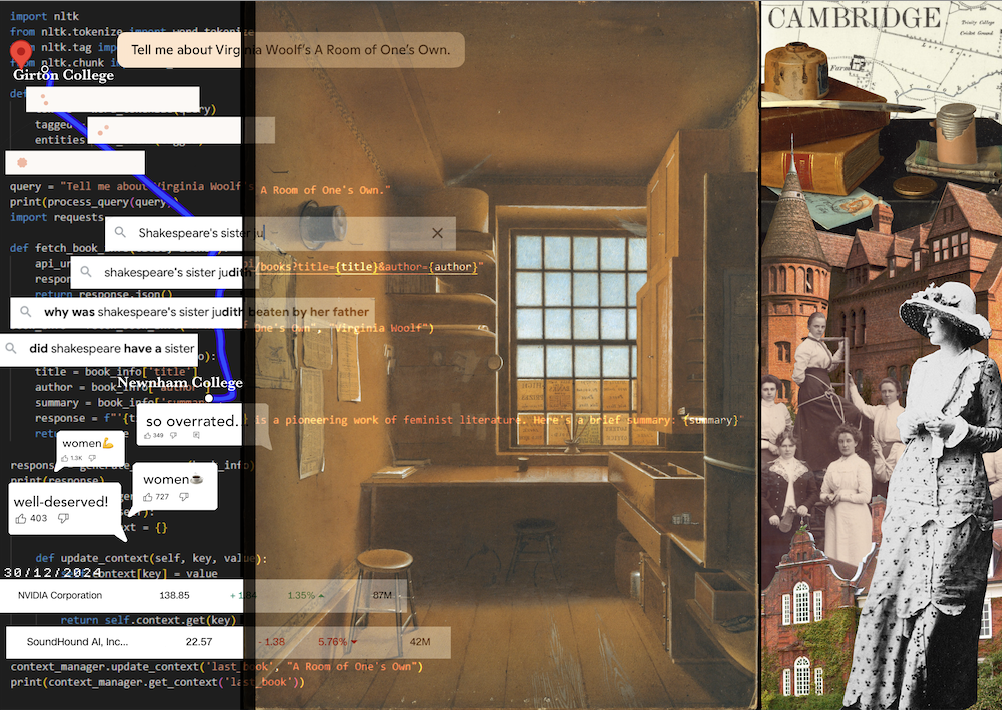
The left side incorporates a digital interface, showing code snippets, search queries, and comments referencing Woolf’s ideas, including discussions about Shakespeare’s fictional sister, Judith. The overlay of coding elements highlights modern interpretations of Woolf’s work through the lens of data and AI.

The center depicts a dimly lit, minimalist room with a window, dessk, and wooden floors and cupboards. The right side features a collage of Cambridge landmarks, historical photographs of women, and a black and white figure in Edwardian attire. There is a map of Cambridge in the background, which is overlayed with images of old fountain pens and ink, books, and a handwritten letter.

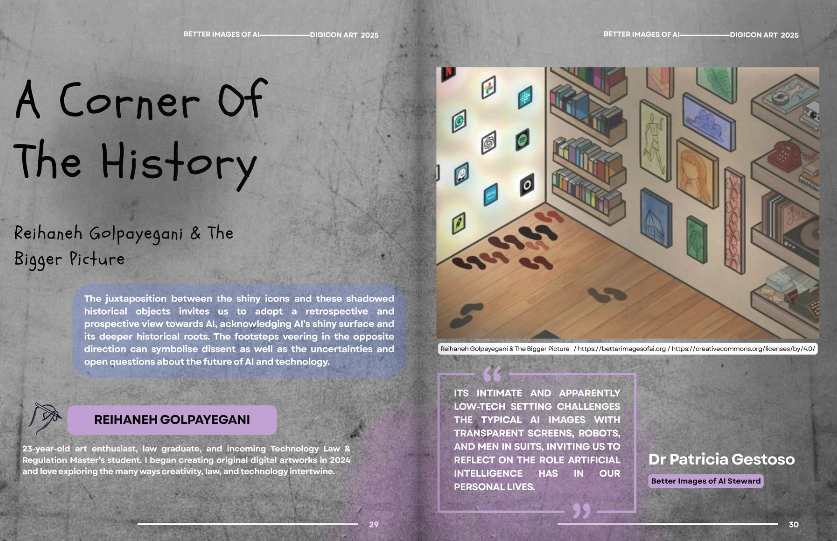
This image is inspired by Virginia Woolf’s A Room of One’s Own. According to this essay, which is based on her lectures at Newnham College and Girton College, Cambridge University, two things are essential for a woman to write fiction: money and a room of her own. This image adds a new layer to this concept by bringing it into the Al era.

Just as Woolf explored the meaning of “women and fiction”, defining “women and AI” is quite complex. It could refer to algorithms’ responses to inquiries involving women, the influence of trending comments on machine stereotypes, or the share of women in big tech. The list can go on and involve many different experiences of women with AI as developers, users, investors, and beyond. With all its complexity, Woolf’s ideas offer us insight: Allocating financial resources and providing safe spaces-in reality and online- is necessary for women to have positive interactions with AI and to be well-represented in this field.

Download ‘Women and AI’ from the Better Images of AI library here

About the artist:

Reihaneh Golpayegani is a law graduate and digital art enthusiast. Reihaneh is interested in exploring the intersection of law, art, and technology by creating expressive artworks and pursuing my master’s studies in this area.

Commendation Prize

Awarded to Janet Turra for ‘Ground Up and Spat Out’

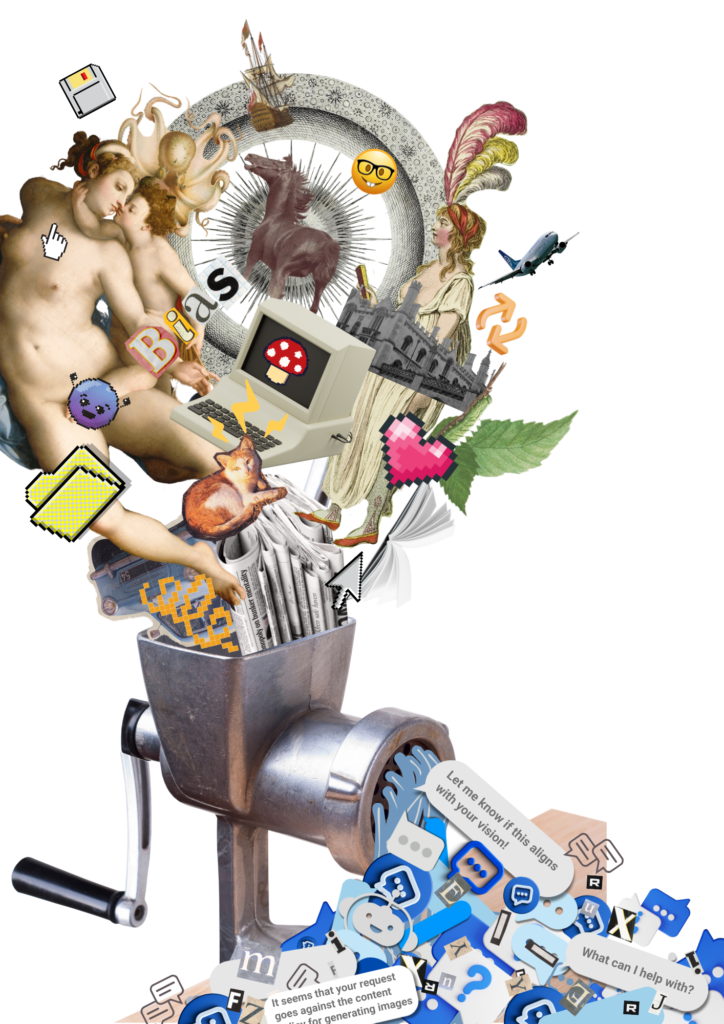
The outputs of Large Language Models do seem uncanny often leading people to compare the abilities of these systems to thinking, dreaming or hallucinating. This image is intended to be a tongue-in-cheek dig, suggesting that AI is at its core, just a simple information ‘meat grinder,’ feeding off the words, ideas and images on the internet, chopping them up and spitting them back out. The collage also makes the point that when we train these models on our biased, inequitable world the responses we get cannot possibly differ from the biased and inequitable world that made them.

Download ‘Ground up and Spat Out’ from the Better Images of AI library here.

About the artist:

Janet Turra is a photographer, ceramicist and mixed media artist based in East Cork, Ireland. Her fine arts career spans over 25 years, a career which has taken many turns in rhythm with the changing phases of her life. Continually challenging the concept of perception, however, her art has taken on many themes including self, identity, motherhood and more recently our perception of AI and how it relates to the female body. 

Background to the competition

Cambridge and LCFI researchers have played key roles in identifying how current stock images of AI can perpetuate negative gender and racial stereotypes about the creators, users, and beneficiaries of AI.

The winning entries will be used for outward-facing posting on social media, University of Cambridge websites, internal communications on student sites and Virtual Learning Environments. They will also be made available for wider Cambridge programs to use for their teaching and events materials. They are also both available in the Better Images of AI library here and here for anyone to freely download and use under a Creative Commons License.

“This project grew from the desire of CFI and multiple collaborations with Better Images of AI to have better images of AI in relation to the teaching and learning we do at the Centre, and from my research into the ‘lookism’ of generative AI image models. I am hopeful that the process has been valuable to illuminate different challenges of doing this kind of work and further that the images offer alternative and exciting perspectives to the representation of diversity in learning and teaching AI at the University.” – Aisha Sobey, University of Cambridge (Postdoctoral Researcher)

An additional collection of images from Hanna

As part of this project, collage artist and scholar, Hanna Barakat, was commissioned to design a collection of images which draw upon her work researching AI narratives and marginalised communities to uncover and reclaim diverse histories. You can find the collection in the Better Images of AI library and we’ll also be releasing an additional blog post which focuses on Hanna’s collection as well as the challenges/reflections on this competition brief.