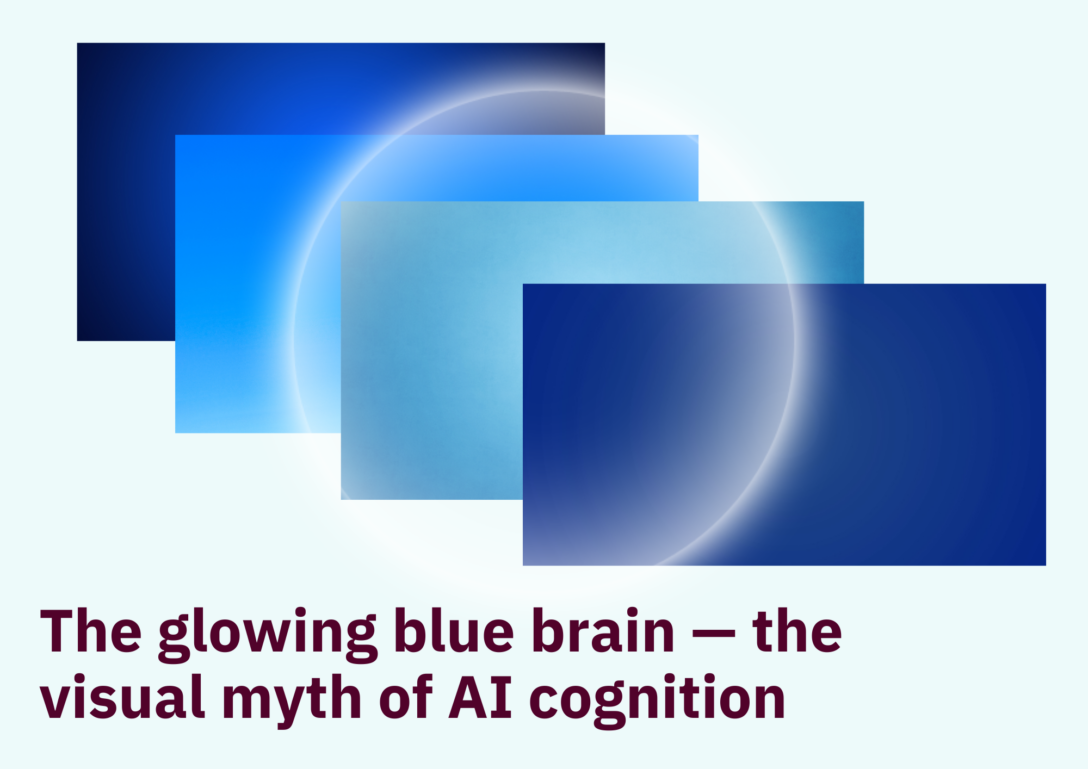
There is a blue hue in the darkness. Upon closer examination, it is a glowing blue brain, threaded with circuits and inscribed with binary code. This is not an unfamiliar sight; instead, for many of us, it is a common visual of the expansive and unstable notion of ‘artificial intelligence’ (‘AI’). Such visual representations of AI systems have become commonplace.
In this blog post, Raghu Krishnan unpacks the prominence of the glowing blue brain imagery as a visual signifier of AI and considers its implications for public understanding. The post focuses on three primary visual tropes: the use of luminosity or glow, the brain form and personhood, and lastly the colour blue itself, which combine to create an elaborate visual myth of AI cognition.
“The blue, the glow and the brain form combine to create a culturally situated myth of machine cognition.”
Blue, Glow, Brain
Images associated with the blue brain metaphor for AI often include a luminous brain form surrounded by circuits and binary code, placed near a dark, futuristic background. Instead of showing AI as infrastructure, code, machinery, data or labour, it is depicted as a glowing centre of thought. In this vein, meaning comes from a combination of different components, from the brain to the use of the colour blue, and even the use of luminosity itself, that combine to provide us with a trope which presents the alignment of computation and cognition.
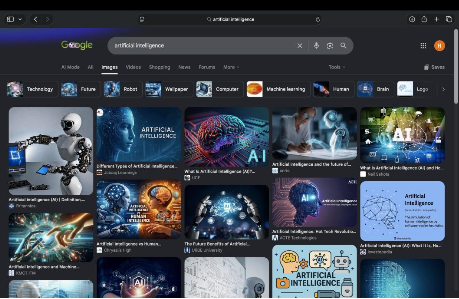
Here, semiotic work by Sorensen and Thellefsen (2024) is useful; they claim that the blue brain metaphor in all its forms has become a foundational part of the contemporary imagery around AI. In their view, the “blue brain metaphor” for AI is clearly related to the primarily verbal metaphor “the computer is a brain”, while also moving beyond this and attaching itself to a diversity of other meanings related to potential cognition. In terms of signs and symbols, they view the metaphor as part of Umberto Eco’s notion of a socio-cultural encyclopaedia, where Eco proposed that a larger shared cultural knowledge is utilised to interpret such signs. So, for instance, the blue brain can be assigned ideas of trust due to an existing shared cultural understanding of the brain; this ‘encyclopaedia’, in his view, is open-ended, where people attach endless contextual meanings to signs embedded in a shared societal network. Simply put, these visual signs are connected to expanding and interconnected cultural knowledge, which impacts interpretation. It is this contextual nature of interpretation of images and signs that is underscored throughout the article.
Make me Glow
Glow or illumination may seem almost natural in imagery surrounding future technology, as well as in attempts to showcase the inner workings of the mind. More recently, there have been attempts to construct an ‘anthropology of luminosity’ showing how the use and experience of light are culturally embedded. Bille and Sørensen (2007), in their work, An Anthropology of Luminosity, argue that philosophical treatises and critiques have often neglected the social role of light, the role of illuminating people, places, experiences, biases, and myth. While light is a concrete physical phenomenon, it also has its ‘lux’, or the sensual qualities formed through sight and vision. The Western primacy of vision perpetuates the importance of light and vision in experiencing the world and, often, in forming concepts (Levin, 1993). It is this emphasis on light which finds itself represented in the ‘glow’ of the blue brains used to represent AI.
Here, this importance is sketched onto social settings, as ‘lightscapes’ operating through the interaction of light and its environment. An example of the culturally relative experience of light comes from the work of Japanese author Tanizaki, who argues that the role of shadows, or the appreciation of shadows, was crucial in Japanese material culture and way of life. Japanese aesthetics, in this view, placed a cultural emphasis on indirect light, in which material culture was meant to interact with shadows, from lacquer and ceramics to paper. Appreciation for such items, in Tanizaki’s account, relied heavily upon their emergence from the darkness, an appreciation that eventually gave way to ‘intense illumination from the west’. Therefore, the glowing brains borrow the social role of light, which is situated in the West, neglecting other cultural notions of light, as seen in Tanizakis account.
While light is physical and sensory, it may also extend to the sacred. Morphy (1989), Gage (1995) and Pinney (2001) all argue that colour and light create luminosity, which may have sacred and spiritual dimensions, and that brilliant objects are conceived as the material manifestation of light. Here, brilliant glowing orbs, lamps, and, in our case, blue brains become objects emitting light. In these contexts, light is often imagined as a signifier of ancestral power or, in our case, future power, where the glowing blue brains signal technological potency and imagined authority in the future. Luminosity gives the AI an aura, where computation may appear as sacred.
Apart from affective qualities, the presence or absence of light has also functioned as an important metaphor in Western philosophy. From the classical age, light has often been interpreted as an important metaphor through which people experience the world; for instance, in Plato’s allegory of the Cave, prisoners mistake shadows for reality, while the movement towards light represents a transition from illusion to knowledge (Plato, 2007).
Similarly, from the Enlightenment, light was seen as a medium through which knowledge was revealed; light hence finds itself deeply entwined with the notion of life and existence, the dead, or the soulless find themselves depicted as dark or lacking illumination. A more recent example is the use of the ‘lightbulb moment’ in comicbooks, where a lightbulb over a character’s head would signal a sudden moment of inspiration. Therefore the glowing brains borrow this association of light with knowledge and inspiration situated in the west, to construct an elaborate myth of cognition.
In essence, we have three different notions of light: the material lux, or glow, the social agency of light, and lastly the metaphorical light; importantly, all of these are culturally embedded. In the context of our image, materially the brain glows, socially it signals future authority, and metaphorically it points to ideas of consciousness and life. The glow of the brain condenses these notions into a single image. The anthropology of light, in a way, provides a framework to interpret the powerful visual of the glowing blue brain, where material, social and psychological notions of light are projected onto the (blue) brain form.
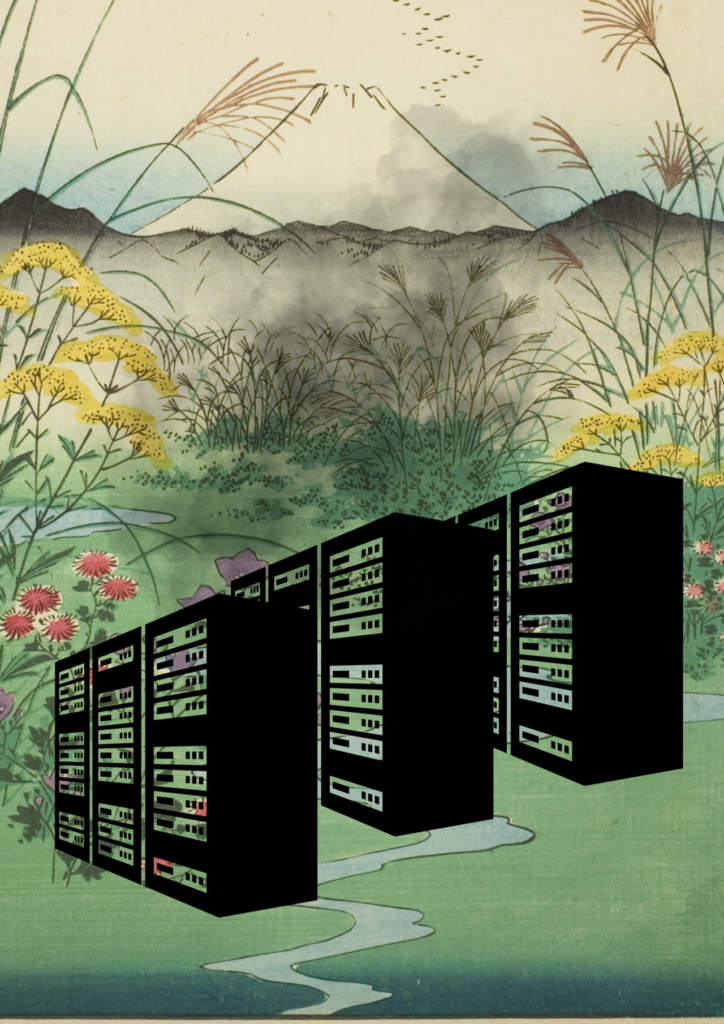
Deborah Lupton’s image, ‘Servers in a Landscape ’, directly challenges the ‘glowing’ visuals of AI by representing AI as a dark cloud of smoke. The image demonstrates the impacts of data centres on the natural world through pollution emitted from the operation of the centres.
Brain dead and Brain alive.
The brain form itself has traditionally had a persuasive influence on public perception. Experimental work by McCabe and Castel (2008) argued that brain images played a role in public acceptance of neuroscience research. They argued that such images or scans of the brain provide a physical basis for abstract cognitive processes, appealing to people’s affinity for reductionist explanations of cognitive phenomena. Later work has complicated the strength of the “seductive brain image” effect (Michael et al,2013); the claim is not that brain images automatically convince people, but that they belong to a wider visual culture in which cognition seems more credible when it is made visible in the brain. Essentially, they aid communication by making the internal cognitive process seem visible and scientific.
Dumit, in his account of brain scans and personhood, presents this notion in pop culture, showing that the AI brain is a borrowed form of scientific visual authority, where the brain, in a variety of pop culture , and has become synonymous with a modern Euromerican notion of personhood. He gives the example of brain scans being framed with simple labels like “normal,” “depressed,” or “healthy,” reducing visible types of people into individual brains. Moreover, he shows us how this imagery travels extensively from medical literature to pop culture, forming an important mediascape shaping narratives. Dumit’s (2004) ethnographic account reveals that brain scans and imagery do not travel across mediascapes alone; they carry with them culturally situated ideas of personhood. As they move through realms of journalism, medicine, film, and courts, they are important cultural lenses through which people interpret illness and identity. Therefore, the glowing blue brains take on elements of personhood and identity based on how brain images have been viewed across western mediascapes.
Racine et al’s 2005 notion of ‘neurorealism’ is also useful here, where brain images can make mental phenomena appear more real by providing them a physical location. These interlinked narratives of personhood and the brain have been crystallised by Vidal and Ortega in their (2017) book ‘The Cerebral Subject’, arguing that increasingly there is a tendency for people to be visualised through their brains. In a sense, our physical health, our mental health, our ability, and even our relations are seen through this image of the brain; in other words, they argue we are increasingly being visualised as our brains, where the brain becomes a symbol of our agency, intelligence, identity and moral responsibility.
In the context of AI imagery, the glowing blue brain borrows from what we can call ‘neurocultural authority’, appealing to ideas of personhood and intelligence, where the narrative moves beyond computation to potentially misleading tropes of consciousness. The use of the physical brain enables the viewer to visually locate the machine, giving it potential for cognition. While the glow lights the machine up, the brain form provides an important visual architecture for us to visualise this active cerebral process; here the explicit use of the brain form helps transform luminous computation into a potential digital mind. This elaborate multi-modal trope, hence, removes us from the harsh reality of labour and infrastructure, and instead posits an anthropomorphic myth of a computer that is alive.
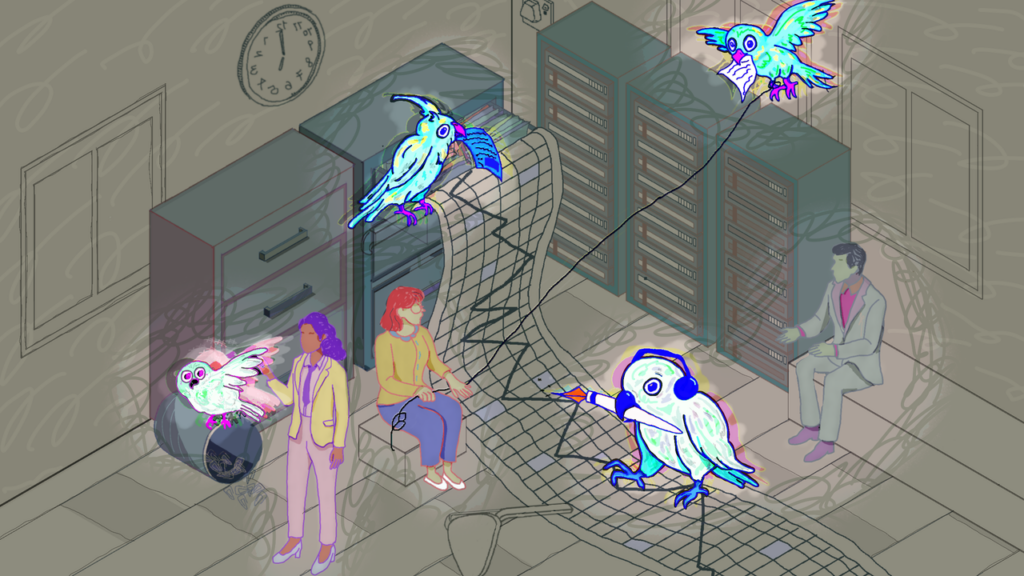
Ice Ming’s image challenges the representation of AI as a brain through a different visual metaphor: stochastic parrots. The ‘stochastic parrot’ is a metaphor for large language models (like ChatGPT) that generate text by statistically predicting the next word based on large datasets, rather than by understanding the meaning, truth or context of the user’s prompts – perhaps like a cognitive being.
Don’t Look so blue.
The use of the colour blue may seem a matter of ‘fitting the aesthetic’, given that such imagery is commonplace in science fiction cinema. However, the colour choice is an atmospheric device to make the visuals appear clean. Blue further helps remove AI from its socio-material context of data centres, energy use, supply chains, and labour. Sørensen and Thellefsen (2024) show that the role of colour in the blue brain metaphor is to ground the visuals in legitimacy. Crucially, this is not to claim that the use of blue, or the effect of blue, is universal, with Jonauskaite et al (2020) demonstrating that colour emotion associations are shaped by language, geography and culture, and this use of blue is perhaps limited to contemporary Euroamerican stock image culture, which has become the face of AI.
This culturally situated use of the blue glow belongs to a wider regime in which AI imaginaries have been dominated by particular sections of society. This is connected to what Cave and Dihal (2020) have called the ‘whiteness of AI’, where the future seems Western and sanitised. The image further extends the erasure of other cultural and material ways of imagining AI; in a way, other ways to develop and conceive of AI have been crowded out by such deterministic narratives. One can further draw a parallel to anthropologist Alex Taylor’s (2019) work on the aesthetics of data centres, where imagery used to depict data centres has emphasised them as sterile and technical spaces, devoid of fallible human labour. In both cases, visual narrative conveniently distracts the viewer from human labour, which is at the core of the supply chain.

Gloria’s image, while still including elements of blue, is not used to represent AI, but the resources it relies upon – including water, local communities, and servers. It symbolises how data centre operations contribute to erosion, water scarcity, and drought.
Conclusion
The blue, the glow and the brain form combine to create a culturally situated myth of machine cognition. The myth has many layers: where a brain may provide it with physical authority, glow may suggest activation, and blue may signal a sanitised future in the Global North. This, when combined with circuits placed upon a dark digital background, removes AI from physical infrastructure and human labour to a luminous future. This is symptomatic of visual media describing AI systems, which is disengaged from the social and environmental effects of such systems, while also perpetrating a grossly misleading narrative about the capabilities of current large language models.
About the author
Raghu Krishnan is an undergraduate reading archaeology and anthropology at the University of Oxford, interested in digital anthropology and human-AI interaction.