Tipping Point Artists Panel: Unlocking potential and plurality through creative interrogations of responsible AI

A image taken from the back of the room of the audience members watching and listening to the Tipping Point panelists talking. The panelists are sat in a row at the front with a BRAID and Tipping Point banner and projector behind them

At the end of summer, Better Images of AI were invited to the Tipping Point exhibition commissioned by BRAID in Edinburgh. The exhibition featured works, which ranged from digital installations to sculptural interventions, zines and comedic sketches, from creators who were responding to the present realities and near-future horizons of AI. 

With the very exciting announcement of a 3-year extension of the BRAID programme which will involve another round of funding for commissioned works and exhibition, Tania Duarte (who visited the exhibition and provided support to BRAID) brings together the themes from the art and panel discussions from her time in Edinburgh. 

 Although the Tipping Point is not strictly related to visual representations of AI, in their approaches to reimagining, the artists had to grapple with the same questions that our community often do: how to more realistically represent AI, what does inclusive AI look and feel like, and what is the role of AI in society. These discussions could provide inspiration for artists submitting to the Better Images of AI library, or as reflections to prompt more thoughtful approaches to the uses of AI, especially relating to the choices we make when using it in creative practice. 

All images in this post are © 2025 Chris Scott. All rights reserved.

Edinburgh’s summer festivals are famous throughout the world for the scale of celebration of arts and culture. This August, Nicola Benedetti (Festival Director of Edinburgh International Festival), described how its significance is more important than ever:

“This year’s International Festival has been one of extraordinary contrasts, from grandeur and scale to intimacy and informality.  I’ve seen this year how art can build bridges, change minds and find connection in a world that so desperately needs it.”  – Nicola Benedetti

Building bridges is exactly what Bridging Responsible AI Divides (BRAID), was funded by the UKRI Arts and Humanities Research Council to address. The Tipping Point new artists commission and exhibition proved a powerful way to explore topics such as connection, and also resilience, humour, ecology, mindfulness, resistance, ethics, empowerment and creativity in the context of present realities and near-future horizons of AI.

Led by The University of Edinburgh in partnership with the Ada Lovelace Institute and the BBC, BRAID’s Inspired Innovation lead Beverley Hood (artist and a reader at Edinburgh College of Art), hosted the launch on the 8th August 2025. She introduced the moving and captivating exhibition of seven very different visions of approaching AI with wisdom and care, starting with workshops and a panel discussion with the artists.

The opportunity to not only view the artists work at the exhibition, but also hear them discuss their process, shared challenges and different perspectives together was not only fascinating, but also added depth to the ideas and imagination which creative practice unlocked. The themes which arose in the discussion gave a rich idea of how artistic representations can allow a more nuanced, open and inclusive exploration of the key questions humanity is facing in front of AI systems which are changing our interactions, roles and society.

We were left dreaming of a world where artists are in charge of creating tools with non-commercial design intents, and the whole exhibition provided a glimpse of how different the world could be.
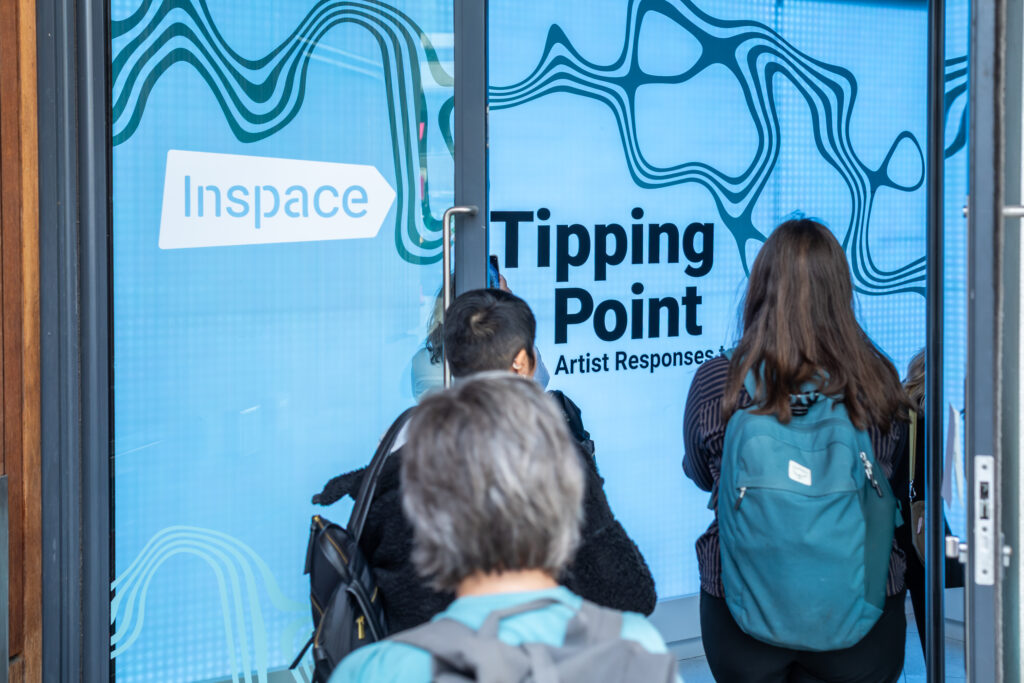
People walking into the entrance of the Tipping Point exhibition
Entrance to the Tipping Point exhibition

Redefining AI and encouraging new thinking

Each exhibit has extensive documentation of the different themes related to envisaging how we get to the responsible use of AI. Each artist chose to do this with their very different artistic methods and backgrounds, showing the plurality and breadth of viewpoints and interpretations which can be applied to our mental models of what is termed “AI”. These were a stark contrast from the hegemonic and often monolithic imaginaries which are typically seen in the media, in marketing and in popular culture. 

It is no surprise then that the panel even goes on to discuss changing the term and meaning of AI itself. Wesley Goatley’s installation of three possible, but progressive, futures; ‘A Harbinger, a Horizon, and a Hope’ constructs a new way of using technology in the Hope scenario, and Wesley explains that the hope is: 

“that they’ve just completely reframed or rephrased AI to stand for Assistive Interface rather than Artificial Intelligence. And if we did that, we made that change, at least in our heads, I think we would shift entirely our expectations of those tools. Shift entirely what we want them for, what we would apply them to, what we were worried about, perhaps how we would design them.”

Throughout the Hope piece in Goatley’s installation, you hear the stories and narratives playing out in small online interactions between the communities who are using the technology.  They talk about AI, but they mean a system interface every single time, and no one mentions intelligence, artificial or otherwise, and this glimpse into a world where we are not obsessed with the idea of intelligence to the distraction of the actual utility of tools is refreshing. 
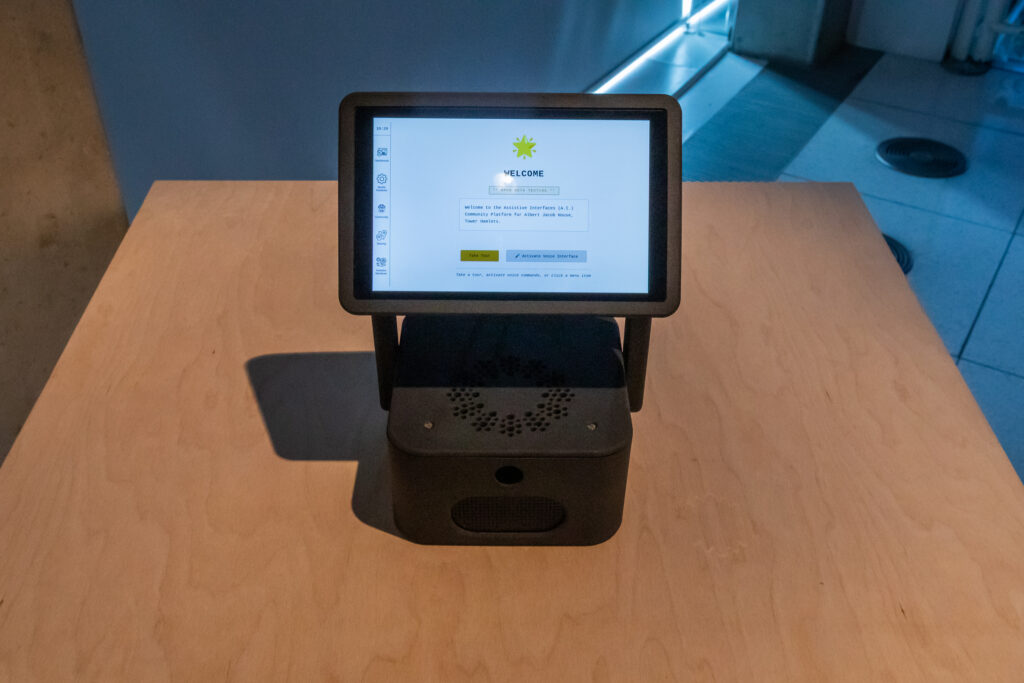
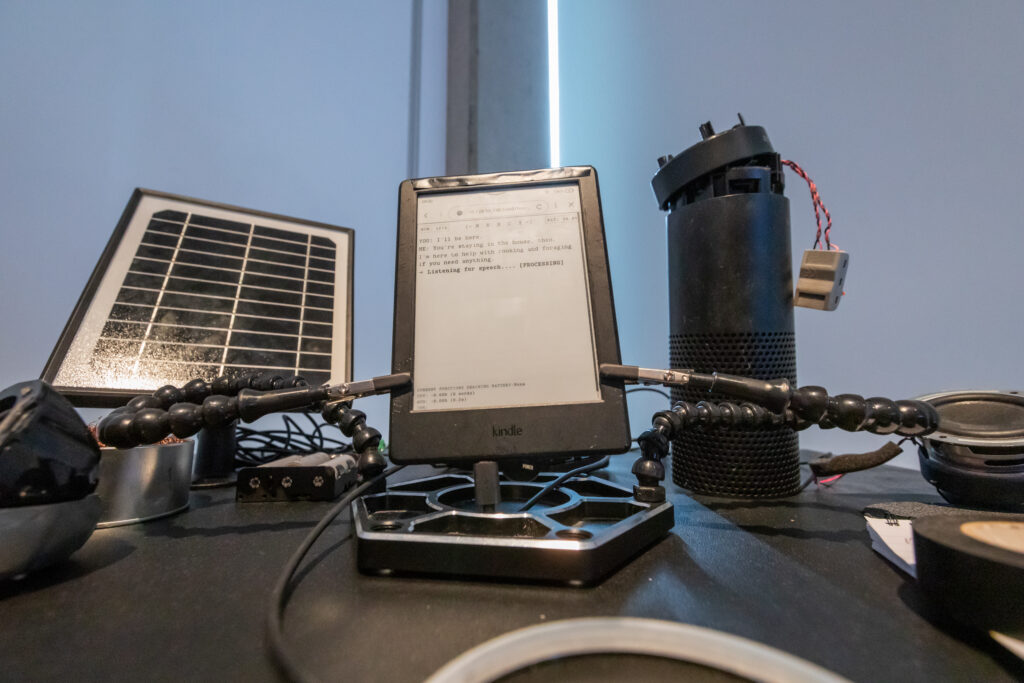
A small device reconstructed by Wesley
An Amazon kindle surrounded by other technology hardware and wires

Part of Wesley’s installation ‘A Harbinger, a Horizon, and a Hope’

Indeed, throughout the exhibition several themes which seem lost in the distraction of the wider AI discourse’s focus on ‘intelligence’ surfaced. These were pulled together as part of the discussion of the panel members, who discussed how the new thinking and values they were proposing should be represented in AI. Of note were the themes of addressing AI’s environmental impact, the need to stimulate sociotechnical AI literacy, and exposing AI’s extractive nature. 

The environmental impact of AI: should we go slow, local, and low resource?

A key theme explored in the exhibition was the huge energy consumption of AI and its resulting environmental implications. 

Some of the artworks directly explore the themes of slow and low resource AI and the material aspects: 

  • Grace Attlee who worked with Julie Freeman on ‘Models of Care’ described how they explored whether really low resource AI could actually enhance the creative practice. They trained low resource models with their own soundscape data collected from glaciers in Iceland. She acknowledged that they had to balance the carbon footprint of doing this in terms of the transportation emissions production processes, and report at the end.
  • Perry-James Sugden described how within the development of ‘(S)Low-Tech AI’ they actively used AI in various ways such as the algorithm that they created, as well passively within internet activity which involved interacting with AI. 

Collaborator Daria Jelonek expanded on the active part by explaining that having experimented with AI models 10 years ago, they became interested in building smaller models of AI, for example, a system called permutation to give you a range of outcomes: 

“It’s not like learning and training. You give it an input, and in our case, for example, we had four rocks which lead to a permutation and rearrangement of twenty four outcomes. And we thought, this is enough. We deliberately didn’t want to use heavy AI models, because that would be against our concept of the idea. And at the same time, in this project we also created our own audiovisual data sets. So it’s not that we’re relying on heavy AI data sets or training online, but we went across the Scottish landscape and captured audiovisual material there which we use for the work.”
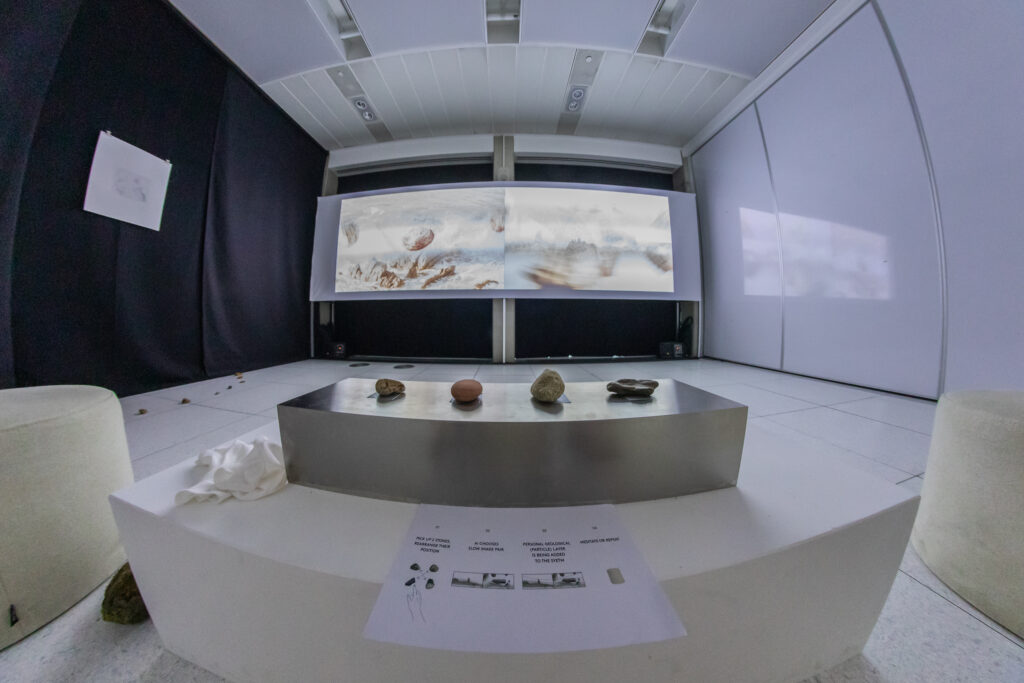
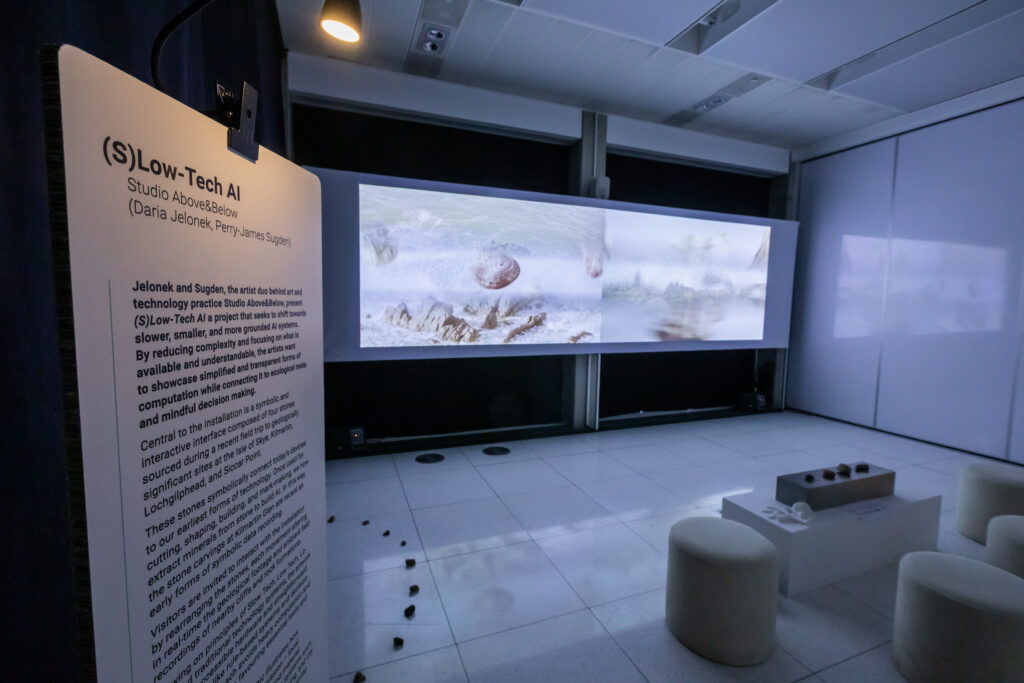
A white exhibition installation with natural rocks/stones set out on one panel, with a background of a white landscape
S(low) tech AI installation which shows the projection of an wintery landscape with the exhibition description in shot too.

(S)Low-Tech AI installation (Studio Above&Below)

She explained that their work was born out of a counter movement to the fast evolving generative AI landscape which was born 2023, as a layered way to bring the challenge into a form. One layer was creating a more physical interface as a reminder of where the viewer is situated, starting with designing a tangible interface using literal rocks to represent the physical elements of AI often forgotten ‘behind shiny screens and in a box far, far away’. They imagined their system as making the user calm down, reflect and have a space where computational tools can actually make you feel good. This is in contrast to the current AI tools which Jelonek describes as being developed to make your life easier or find shortcuts, but actually just make you feel faster. 

Another layer she discussed was a geological layer which through interacting with it gives audiences a visual representation of the impact they have with AI tools, to make them aware of the broader impact of AI tools on physical reality.

Goatley explained the environmental significance of the ‘local model’ (LM Studio) used as part of his research, describing a ‘light’ locally hosted model which rather than being accessed through the ‘cloud’ (ie a big data centre), is the same sort of model which you can download and run on your computer instead

While being similar to large language model interfaces that you can question and probe, you avoid the “incredibly, insanely pollutant, consumptive, dangerous technologies relying on huge infrastructure that are growing at scale in the UK and abroad”. Not using the carbon costs of large scale computation by keeping it on your device means it is normally slower, but that little bit of friction is an important part of the art and design

“It reminds you that there’s a real mechanism here; It’s not just a magic portal to the mystery intelligence in the sky.” – Wesley Goatley, 2025

The need for sociotechnical AI literacy

A theme that ran throughout the exhibits was the idea of the projects as being ways to both signal the need for, but also deliver, a degree of sociotechnical literacy in relation to AI.

Goatley’s proposition of 3 different futures with AI, although seeming to foreground the AI and capabilities, actually tells the stories behind the tools which have been developed. He aims to make the AI or the technical aspect of it disappear as quickly as possible in the context of what’s happening in his piece, and to ground people in their feelings about it. He believes that these narratives, and engaging with the tools gives a kind of literacy and ability to learn and make decisions about tooling in terms of the objectives surfacing from the narratives. “You gain a sociotechnical literacy about what is possible and what your responsibilities could be”. 

Elements of this approach were echoed in ‘Models of Care” by Freeman: sonic sculptures, which although not directly designed as an interface, were still thought of as something tangible for visitors to interact with. Attlee described how Freeman wished to design something to ground people, especially as spaces like galleries can be unwelcoming. She wished people could get into a sculpture or hold on to something that actually plays soundscapes through the physicality of the object, to “kind of hold AI”. 

The two wooden sound sculptures in the exhibition are the result of this vision of a space that can be entered physically. One emits compositions by Freeman and Norwegian musician Torben Snekkestad. The second, smaller sculpture holds a third composition by Anna Wszeborowska, generated by a low resource AI model that has been trained on glacial field recordings. The interaction between sound and material, enables connections to be made between the physical, audible and conceptual. Vibrations are felt through the nervous system, making it less invisible and intangible. This breaks down barriers to learning about AI, and Attlee describes how the choice to use smaller models also represents a prompt for learning about them.

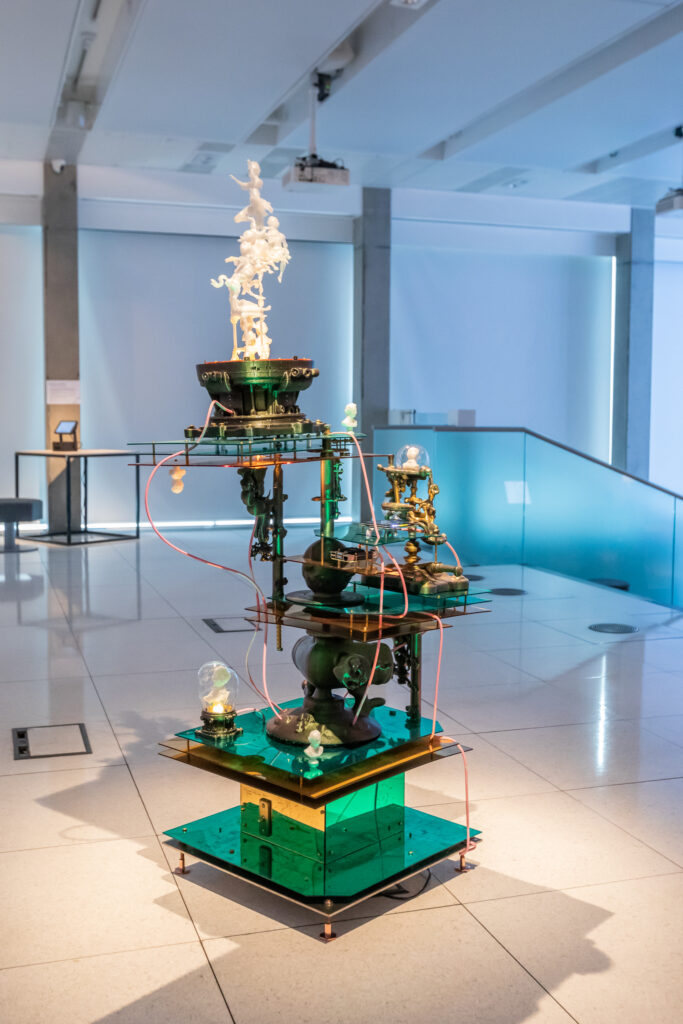
Another approach entirely to the need to scrutinise AI came from Rachel Maclean’s work, which presents imaginary AI generated characters trained on her own back-catalogue. The generative AI output is displayed on a small Raspberry Pi device with magnified lens above and surrounded by scientistic, colonial, industrial motifs like 3D printed busts, and a towering metal and glass structure. As Gavin Leuzzi from BRAID pointed out, the sculpture: “places the viewer in the role of a scientist observing the output of AI critically and dispassionately… Like a warning not to get sucked into fantasies and illusions.”

A global extraction system from south to north and beyond

Inspired by the audience discussion and Q&A, there was a degree of thinking about the perspective from Edinburgh as being from a city which had benefited from colonialist extraction, and how this was addressed within the exhibit. Similarly, an audience member suggested the role that Lowry and Turner had played in documenting the effects of technology on environments and society, and whether this was something that could be tackled in a similar way. 
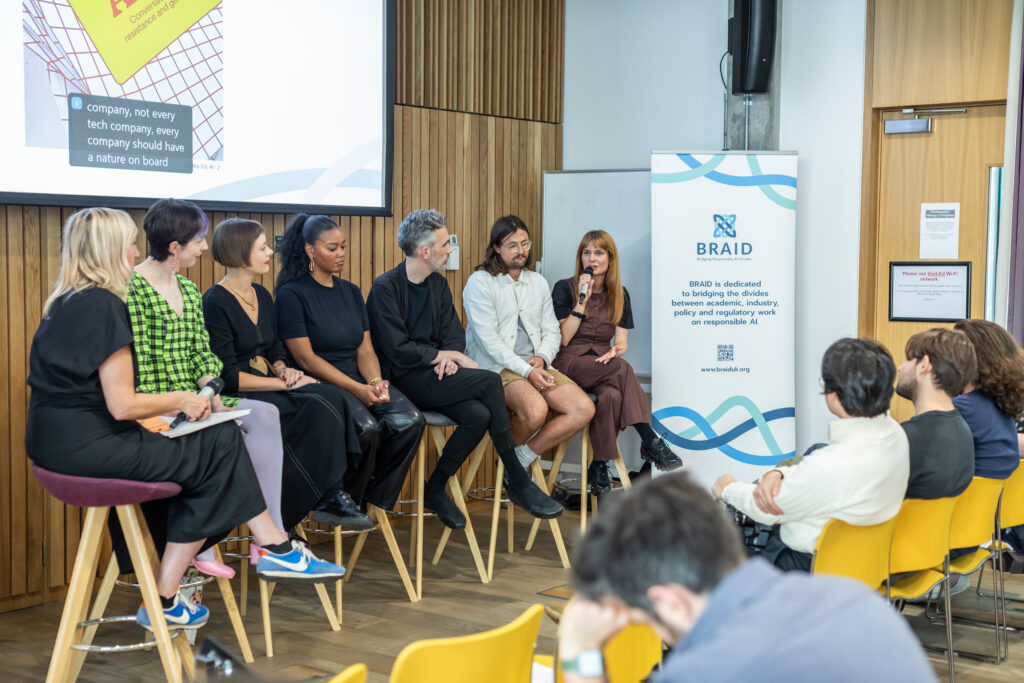
Panelists sat in front of a projector and BRAID banner talking
Tipping Point discussion panel

The parallels between AI, the Industrial Revolution, and the British Empire in terms of technological innovation forcing change, and how they are linked to violence and extraction from the natural world and from human labour were discussed. A sobering thought was of entering a period in which companies like OpenAI are so big that they behave like Empires, seen also in the way that they interact with nation states.

Goatley recommended ‘The History of Automation’ by Lutman, which considers de-skilling and upskilling, and concludes that automation doesn’t release people from labour. Goatley commented that thinking about the current moment through a historical lens could be an area for further study. 

Imagining and building new possible futures

New thinking is encouraged by the exhibition as a bridge to imagine possible new futures. However, the aim described by Hood was not to speculate, but instead to embed propositional change within the design and the concept of the artworks, so they can demonstrate how such changes might come to be. She described a desire to move beyond an exercise in critique of AI through an arts and humanities lens. Although critique is a common and powerful strategy within the arts, the call invited more direct strategies for potential future impact. This was a difficult brief which was met in a number of different ways. 
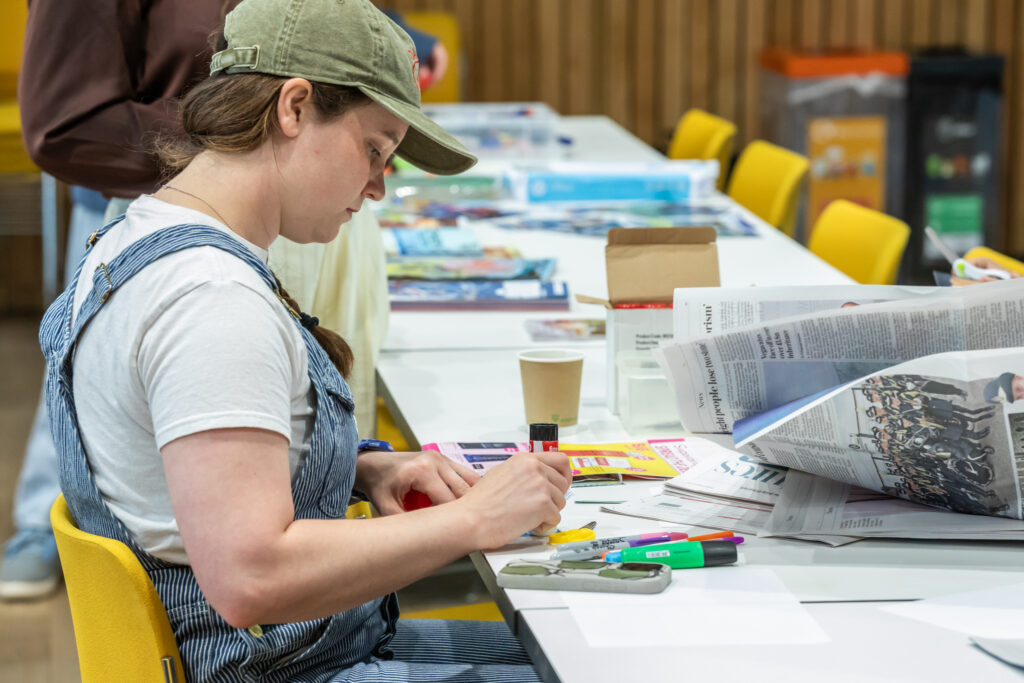
An individual at a table making a zine using various crafting materials like newspapers
Individual making a zine as part of one of the Tipping Point workshops

Centring care within AI

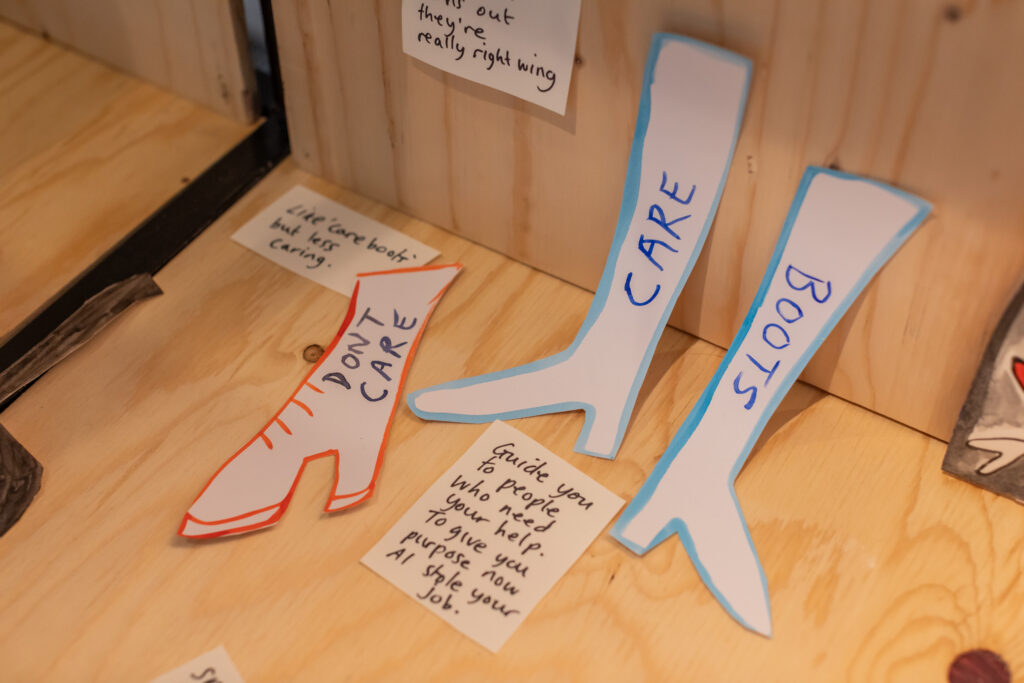
A very relevant but overlooked theme to discuss in the context of automation is that of care. Shervington-White, Ashcroft and Attlee spoke to how care might be better considered within AI. In their works, they built different visions of AI tools to enable care, radical care in AI development, and building models of care. 
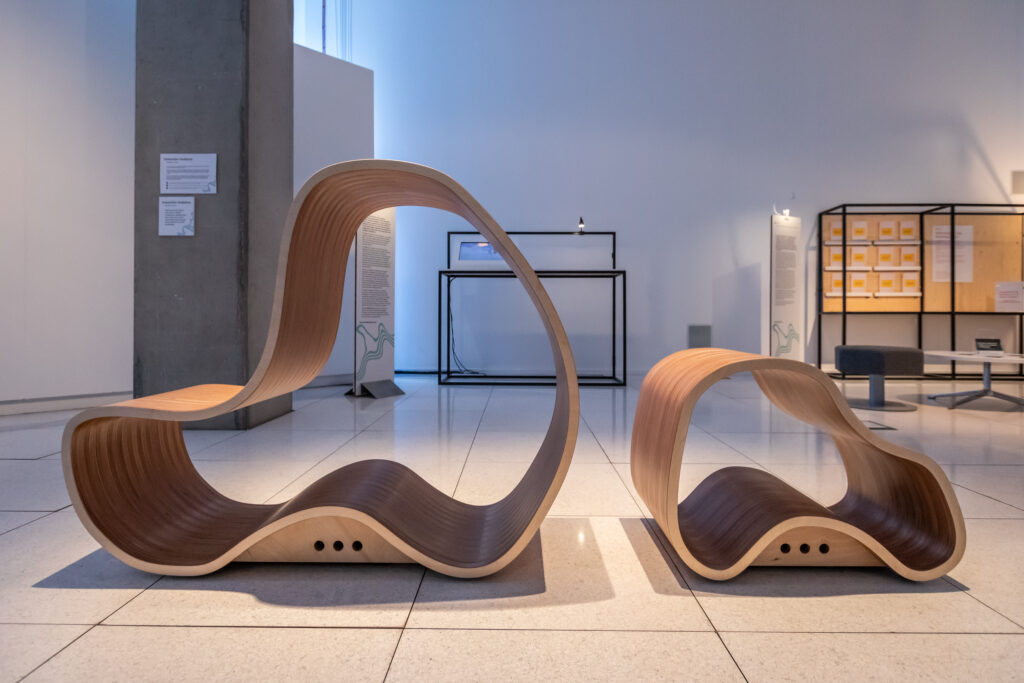
Sonic wooden sonic sculptures inspired by the artist’s recent field trip to Svalbard in the Arctic.
Models of Care sonic sculptures (Julie Freeman)
Part of the model's of care exhibition with paper cut into the shape of boots with the words 'boot care', 'care' and 'boots' and other post it notes with individuals reflections
Part of the Real Stupidity (Louise Ashcroft) installation

Shervington-White worked with a technologist called Luca Chung to develop a workflow to pick up faces within archived footage, which are seen as computer vision bounding boxes within the video. This use of AI becomes an anchor point for an intimate conversation about technology that is accessible and delivered from a human, community perspective. Speakers from black communities give their own ideas of what they believe would make AI more responsible for them in their lives. A lot of the strategies they talked about were looking at communities that are most underserved by AI being involved in having them shape it. The message is that if it works for those who are the least protected, then hopefully, it should work for everybody in the end. 

Louise Ashcroft, one of the other artists exhibiting, and who had held a workshop earlier in the day, had within her project asked for direct examples of how AI should be used, and documented humorous examples of what AI should be used for, many of which centred care in some way. Beverley contrasted these with the less direct examples of propositional change within Shervington-White’s video installation, as evoking a compelling and emotional mood and attitude within the film which evokes the idea of radical care, with decisions centred in community not within tech companies.

The right to resist and ability to reclaim

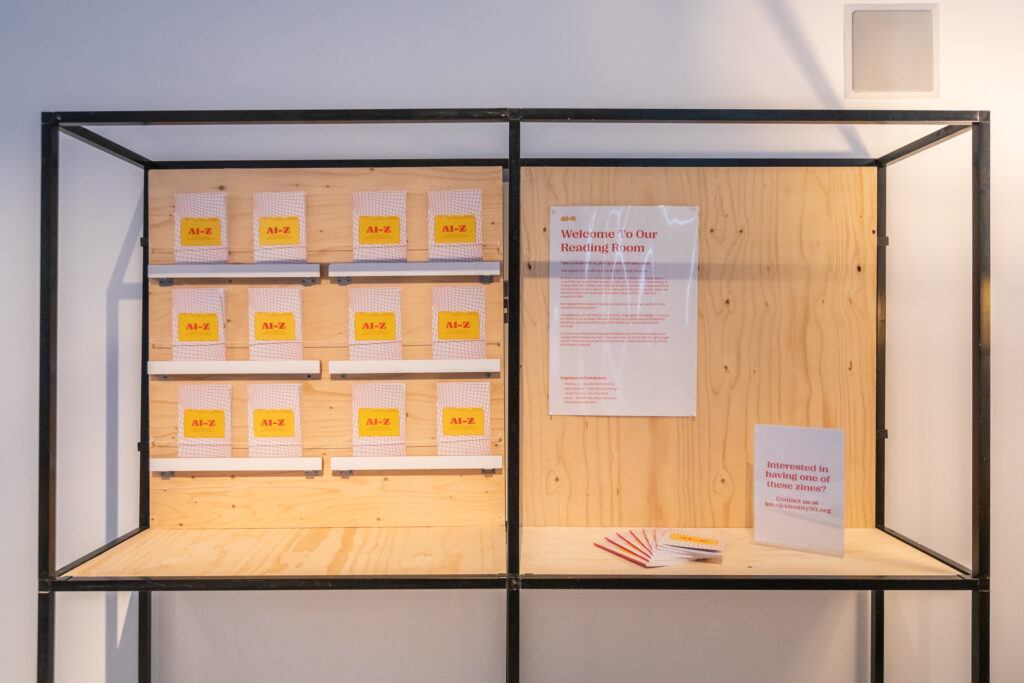
Also in the audience after a morning workshop was Arda Awais from Identity 2.0 who was called on to talk about one of the most direct propositional approaches, ‘AI to Z’, which looks at resisting generative AI models. The project creates places for people to engage in different types of resistance, no matter how interested or passionate they are about it. This is documented in the project through a zine which includes a range of strategies identified by activists in a range of different areas, including some which are low effort and individual. These are important as Awais explains that people can be disempowered by feeling they need to make a really big change which can seem overwhelming. Identity 2.0 worked to break down the  impact each person can make, and to make it easy and approachable by using a conversational tone and providing an accessible glossary for AI jargon. They have since submitted the Zine to zine libraries such as the DAIR Zine library, where it is available to inspire many others and effect change in how people feel empowered to push back against the encroachment of AI in their lives.
Goatley’s exhibit is explicitly propositional in the sense that it creates and foregrounds what diverse communities might want and how that could be delivered in a tool they have built. These suggest a less complicated form of politics, a lower power use which can be achieved in a way which is not speculative but uses what we all have right now such as mesh networks, distributed computing, as well as designing for disabled users and older users. This is all tools we already have, and it was really about bringing that together in one object in that way, making the proposition very close to hand, achievable, and scalable. He described how he was keen not to fall into a common trap of future thinking and imagining that there will be a speculative way of fixing things fifty years down the line. Instead by deconstructing and reconstructing elements from low resource existing technologies, he shows how we can get there. 

Deconstructing anthromorphism

One notable thing in the exhibition compared to many explorations of AI was the complete absence of anthropomorphic, human related ideas of AI. Comparisons with human intelligence are often unhelpful and very misleading, but they also hinder creative exploration through anchoring ideas in replications of human embodiment, biases and limitations. Shedding these constraints was one of the ways in which the projects and exhibitions were able to interrogate and present more meaningful facets of AI systems, ideas and impacts. 

This was not always easy to avoid, and Goatley describes the challenge he had in trying to find the tools to make an LLM voice interface for the project that he could:

“with consistency make it not refer to itself as I, and suggest its own knowledge in some way, and use all these terms that are the sole domain of humans. And it’s largely only used by tech companies to try to manipulate our understanding of what these tools are and what they can do. But it’s a real struggle. I think I did it. At least I haven’t managed to make it break yet. But it took 7 weeks of just tweaking a system prompt over and over and over again, and changing models just to get rid of that one thing, it’s so deeply baked in, it’s really nefarious”.

Maclean reflected on a different way in which interacting with generative AI can lead to a type of anthropomorphisation. Her fascinating and mysterious sculpture illustrates the beguiling and alluring pull of generative AI technologies that make it easy for an artist to simply forget that it’s a data processing machine that they’re engaging with. She cautions that while artists should not identify with generative AI as anything more than a technological tool, the fantastical beings she has created within the sculpture partly make visible the imaginary beings that we can so easily project onto the technology. Maclean warns of the need to check what effect these tools have on how we approach artistic practice and work. 
Dominant narratives of all powerful and inevitable AI which we have no option but to embrace or be left behind are therefore strikingly refuted through different visions of what could (and maybe should) be. The different visions in Tipping Point force us to engage with the paucity of ambition seen in the AI we have now in terms of creating systems which work in harmony with nature and enhance the human experience. They question the relentless trajectory of development towards ever moving goalposts of productivity, efficiency, standardisation and surveillance, offering instead different views of what AI might offer us.


About Tipping Point

Tipping Point explores how artists can help us more wisely respond to the present realities and near-future horizons of AI. Featuring seven newly commissioned artworks from across the UK, the exhibition presents new ways of thinking about today’s AI, the futures we want and the communities needed to build it. Artworks, ranging from digital installations to sculptural interventions, zines and comedy sketches, address themes that reimagine AI uptake, inspire activism and resilience, and showcase artistic creativity in the field.

Tipping Point was funded by the Arts and Humanities Research Council (AHRC) and delivered by BRAID.


(S)Low-Tech AI was created by the experimental art and technology practice Studio Above&Below, co-founded by Daria Jelonek and Perry-James Sugden

(S)Low-Tech AI seeks a shift towards slower, smaller, and more grounded AI systems. By reducing complexity and focusing on what is available and understandable, the artists showcase simplified and transparent forms of computation while connecting it to ecological roots and mindful decision making.

Watch Daria and Perry discuss (S)Low-Tech AI, their captivating installation for BRAID that examines AI through the lens of geology https://edin.ac/45Xqn0t.


AI-Z was a project by creative studio Identity 2.0, co-founded by Savena Surana and Arda Awais. In this clip, Arda discusses collaborating with the activist community beyond tech when developing their artist commission project AI-Z.

See Arda discuss it here – https://edin.ac/4p2RpfJ

AI-Z explores how zine-making can help people to address the pervasive and sometimes unwelcome encroachment of AI into our daily lives through methods of intersectional resistance and play. The project is also about archiving the collaborative process and building resources for community engagement around responsible AI.


Eye Yours! They’ve Ggetuo is a sculpture by Rachel Maclean and represents the first artwork from They’ve Got Your Eyes, a new body of AI-generated work spanning film, sculpture and digital painting.

See Rachel discuss it here – https://edin.ac/4mIlvnl

Eye Yours! They’ve Ggetuo interrogates the tension between what AI is – a system of pattern-recognising algorithms – and what it feels like to interact with it. The artwork invites viewers into a hallucinatory space that questions the assumptions we project onto AI. 


“Closer to Go(o)d?” is a powerful Afrofuturist-inspired short film by Kiki Shervington-White which she discusses here- https://edin.ac/4mMiXEM

“Closer to Go(o)d?” draws on participatory workshops undertaken with working-class Black and ethnically diverse communities in Birmingham, with the aim of promoting a demystifying, radical, ethical approach to Responsible AI, one that is centred on care and community.


A Harbinger, a Horizon, and a Hope: Three Heralds of Possible AI Futures is a commission by

Dr. Wesley Goatley 

You can hear him speaking about the open-source AI devices he created here – https://edin.ac/46bhW2X

A Harbinger, a Horizon, and a Hope presents three voice-enabled AI devices that each represent a distinct and possible near future scenario for AI technologies and their relationship to individuals, communities, and society. Through interacting with these devices, audiences learn more about these potential futures and the experiences of the people living through them.

Some of Wesley’s images have been added to the Better Images of AI library, view them here:


Models of Care sonic sculptures were created by Julie Freeman. You can hear her speak about her resonant art here – https://edin.ac/4mTDnf7

Models of Care explores environmental responsibility and the relationship between artificial intelligence, climate change, and human agency through sculpture and sound.


Real Stupidity was a project by Louise Ashcroft. Hear her talk about her Fringe comedy-inspired commission here – https://edin.ac/4mAaO6b

Real Stupidity is a newly commissioned artwork that takes a humorous approach by joining forces with comedians to create a series of ‘Speculative Gadgets,’ a range of wearable AI devices that tackle contemporary societal issues.


Find out more about the BRAID programme at BRAID UK.

All images in this post are © 2025 Chris Scott. All rights reserved.

Visualising the Supply Chain of AI: Lone Thomasky and Bits & Bäume’s Image Collection

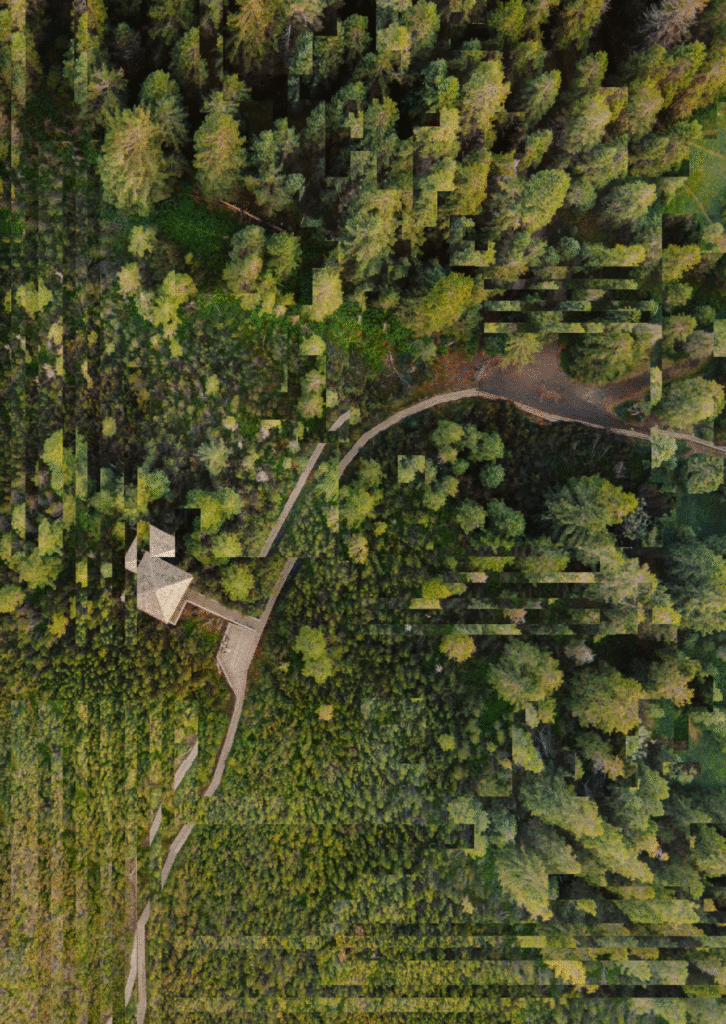
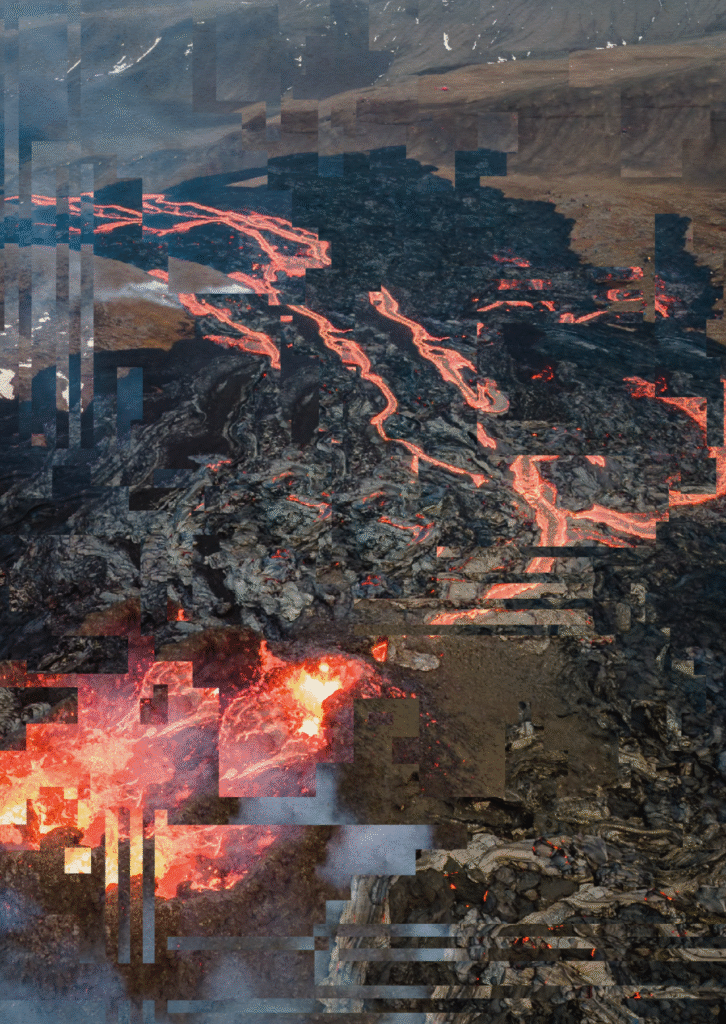
Bird's eye view photo of a small hut and a concrete path through a lush green forest. However, the image is slightly distorted by digital artefacts. In the right corner, there is a dark purple text box, with the text in white 'Visualising the Supply Chain of AI' and underneath in a white text box with black text, 'Lone Thomasky and Bits & Bäume'.

You might have noticed a new collection of images from Lone Thomasky and Bits & Bäume in the library. These images expose the realities behind the often perceived “clean”, “slick”, and “efficient” AI supply chains. Their collection shows the breakdown of environments and depletion of natural resources caused by the rapid expansion of data centres and mining of critical resources (like lithium, cobalt, and rare earth elements) which underpin (generative) AI.

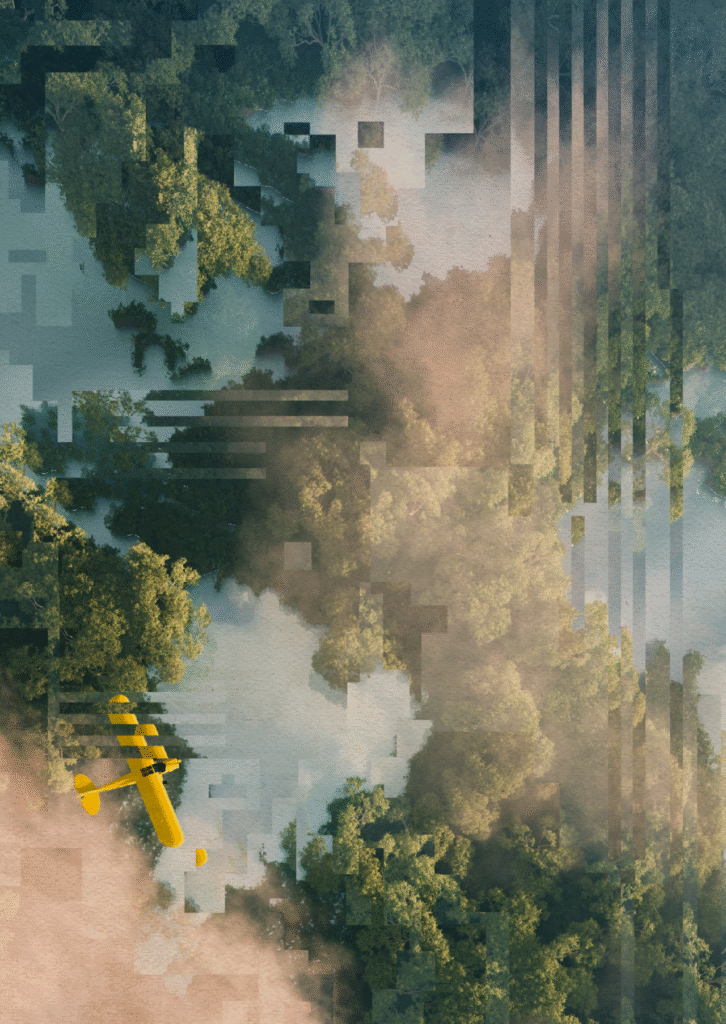
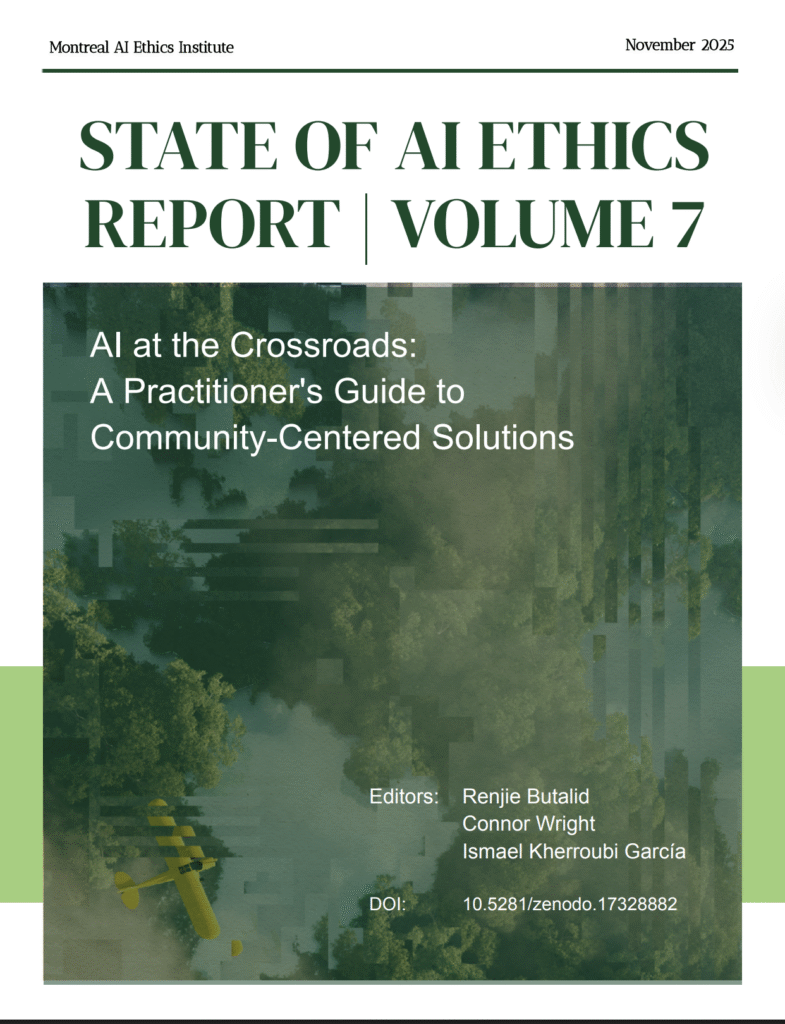
One of their images, ‘Distorted Lake Trees’ has been selected as the iconic cover image of the Montreal AI Ethics Institute 2025 State of AI Report. Below, we unpack some of the images in the Bits & Bäume collection and why they make a fitting partner organisation to Better Images of AI, particularly since our visuals aim to better communicate about the implications of AI on society, the environment forms a huge part of this.

DOWNLOAD THE IMAGE COLLECTION HERE

The hardware that we manufacture to underpin AI technologies and the data centres that power AI are responsible for an ever-increasing share of global electricity and water consumption, as well as being both habitat and land-intensive. Lone Thomasky and Bits & Bäume’s image collection features a series of distorted photographic images of landscapes to visualise the ecologies behind AI’s supply chain. 

AI technologies do not merely rely on “digital clouds”, “they are also physical territories anchored in mines, exploited workers, and degraded environmental ecosystems”. Frequently, visual representations of AI mask the underlying realities of how these technologies are built, overwhelmingly dependent on infrastructure, communities, and resources of the Global South. 

These images are a valuable contribution to the Better Images of AI library to counter the sleek aesthetics, magical metaphors, and luminous hardware which are often used to represent AI. Instead, these visuals help us move towards more grounded understandings that connect AI technologies with their material and environmental foundations. As such, using these images, we can improve public understanding of what is at stake when AI technologies are used, invested in, and promoted as a source for eternal good in society. 

Bird's eye view photo of a small hut and a concrete path through a lush green forest. However, the image is slightly distorted by digital artefacts.
A bird's eye view photo of a small yellow aeroplane flying over a river or lake interspersed with trees and clouds. However, the image is slightly distorted with digital artefacts.

Lone Thomasky & Bits&Bäume / Better Images of AI / CC BY 4.0

How (and why) were the images created?

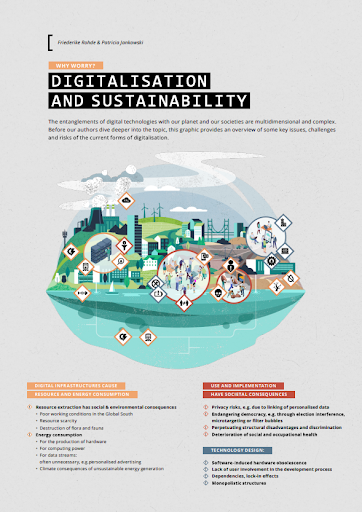
Bits & Bäume was founded in 2017 by a coalition of critical tech folks, hackers, eco activists, researchers and climate justice advocates out of the conviction that digitalisation and ecological change must be reconciled. Bits & Bäume is formed and supported by NGOs and organisations across the environmental, ethics, and internet policy landscape. Some of these include the TU Berlin Ethics Lab, Chaos Computer Club, the Young Friends of the Earth Germany (BUND), German Trade Union Confederation, Institute for Ecological Economic Research, and Wikimedia Germany. Their collective activities include hosting conferences to advance academic and civil society discussions, policy work to advocate for government changes, as well as research on digital transformation and sustainability to inform law makers. 

Bits & Bäume’s first conference took place in 2018 and brought together 2,000 people from diverse backgrounds and communities. After some smaller ones, the next large conference followed in 2022 –you can find their published conference proceedings here. The images in Bits & Baume’s proceedings may look familiar, given that this was the original purpose that the images were created before being donated to the library. Having already known Lone Thomasky, Bits & Bäume worked with her to create images for the proceedings report that reflected the interdisciplinary contributions to the conference. Visualising their research was important to reach new audiences; a lot of the issues that Bits & Bäume work on are very complex, so choosing to communicate via narratives, images, and aesthetics make their topics more accessible.

A page from Bits&Bäume's conference proceedings with a simplified illustration of urban life near the sea showing groups of people, buildings and bridges, as well as polluting power plants, opencast mining, exploitative work, data centres and wind power stations on a hill. Several small icons indicate destructive processes. This is surrounded by text boxes with coloured title blocks.

Bits & Bäume’s conference proceedings on ‘Digitalisation and Sustainability’

The importance of visualising the material realities of AI development 

AI relies on physical infrastructures like data centres to house the specific IT architecture, like servers and microchips, that are needed to train, deploy, and sustain AI applications. The number of data centres has been growing for a number of years, but the AI hype and increased investment into the technology are leading to the mass expansion of data centres, particularly concentrated in the Global South.

Just recently, Google announced that it will invest £11.29 billion to build a data centre in southern India’s Andhra Pradesh state which will contain servers, storage systems, and network equipment along with the necessary power and cooling systems to operate them. Adopting a decolonial lens, Khan argues that these takeovers of land, raw materials and exploitation of labour mimic historical European colonialism. However, instead of just blatant brutal force, the power of persuasion in the need for technological innovation and masking of exploitation create the same imbalances of power that have long exploited Global South communities. 

The proliferation of data centres are huge consumers of water which are needed to cool hot servers but also needed indirectly for producing electricity to power these facilities. Since electricity is more costly than water for data centres, companies choose to build data centres where there is cheap power, but this is often in areas where water is already a scarce resource. Bloomberg News found that around ⅔ of new data centres built or in development since 2022 in the US are in places already facing high levels of water stress. For instance, the Large Language Model (LLM) LLaMA-3, developed by Meta, consumed 22 million litres of water over 97 days. This is equivalent to the amount of water an average person in England and Wales would use over the course of 424 years.

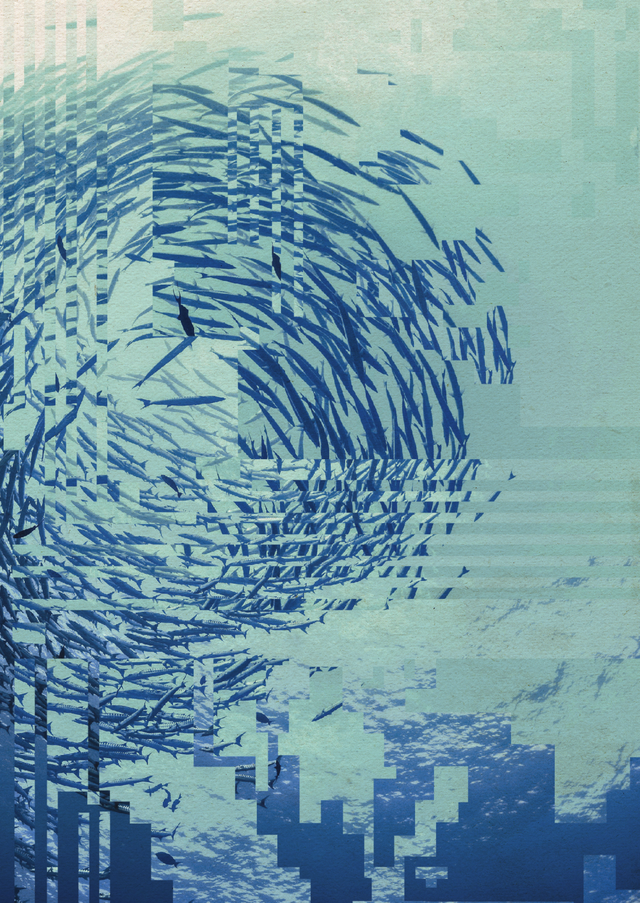
An underwater photo taken looking up to a large circular school of fish while the sun sparkles in the blue water. However, the image is slightly distorted by digital artefacts.

Lone Thomasky & Bits&Bäume / Better Images of AI / CC BY 4.0

Data centres also produce electronic waste, which often contains hazardous toxic substances, like mercury and lead, which pose serious consequences to humans and non-humans. ‘Distorted fish school’ in Lone Thomasky and Bits&Bäume’s collection points to one of the lesser considered impacts of AI on our aquatic ecosystems from contamination and pollution. 

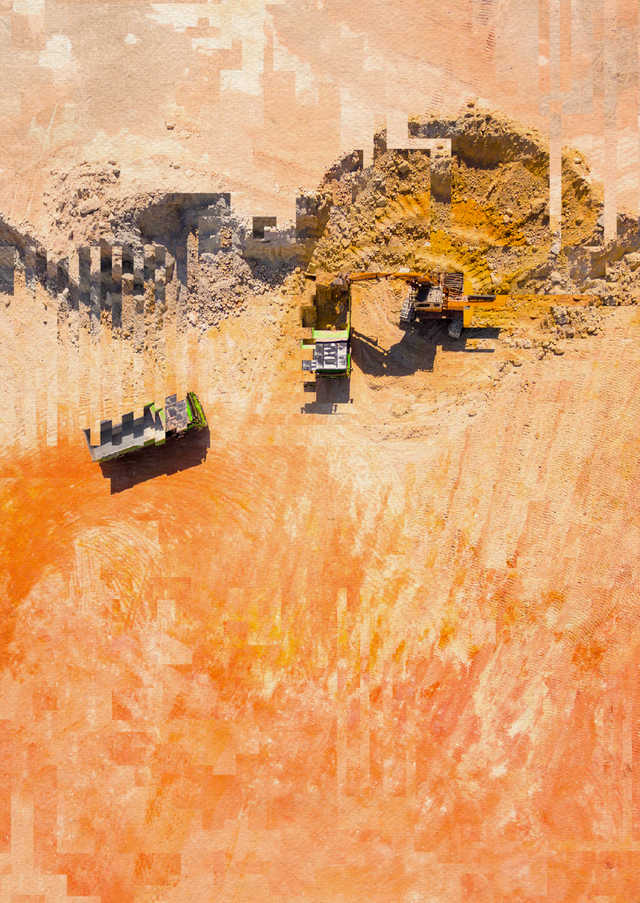
Beyond this, AI development relies on critical minerals and rare elements with unique magnetic and luminescent properties to create the microchips that are required for the processing activities required for faster, more efficient, and higher performing processing. One example is the Kolwezi copper and cobalt mine in the Democratic Republic of Congo, where Amnesty International documented forced evictions of entire communities as companies expand unsustainable mining operations for technological advancement. The mining of rare earth minerals generates large volumes of toxic and radioactive material which leave land uninhabitable. ‘Distorted Sand Mine’ in Lone Thomasky and Bits&Bäume’s collection illustrates the destructive mining and extraction practices that lurk behind the “stylish, clean, and lightweight” appearance of modern AI tools. 

A bird's eye view photo of an orange sand mine with transport lorries, but the image is slightly distorted by digital artefacts.

Lone Thomasky & Bits&Bäume / Better Images of AI / CC BY 4.0

Distortion as a Visual Metaphor for AI’s Environmental Destruction 

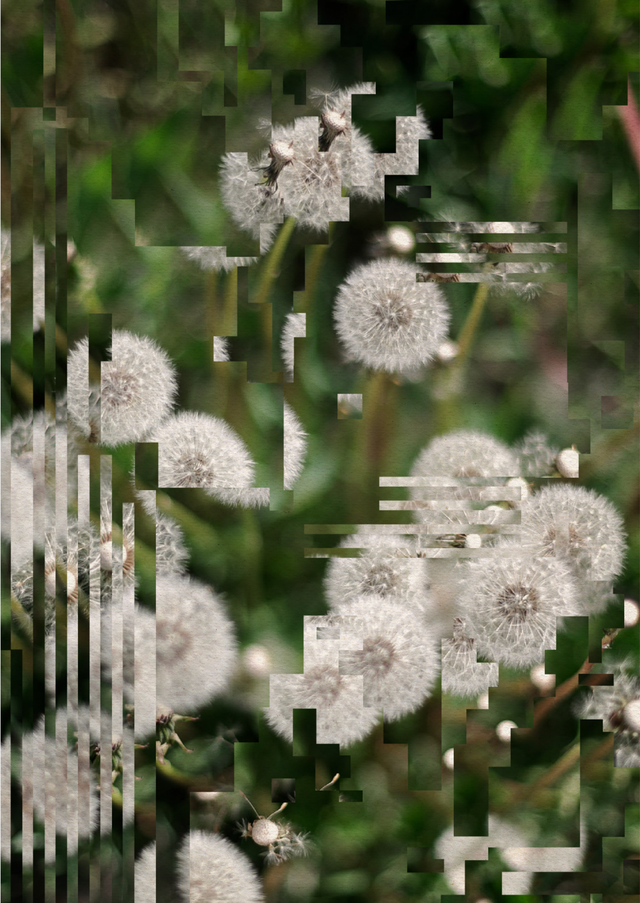
A close-up photo of some dandelions, but the image is slightly distorted by digital artefacts.

Lone Thomasky & Bits&Bäume / Better Images of AI / CC BY 4.0

Thomasky’s images all feature visual distortion, like bands, pixel shifts and fragmented overlays that disrupt the otherwise natural landscapes of trees, sand mines, and dandelions. The distortions visualise how digital infrastructures, driven by the ideology of progress and innovation, fragment both ecosystems and our perception of them. The juxtaposition between the forest greens and aquatic fish which are fractured by geometric interference draw attention to the mining, energy use, deforestation, and waste, all in the name of technological “innovation”.

A call for greater public understanding and policy shifts about the environmental impact of AI 

“The ease-of-use of generative AI interfaces and the lack of information about the environmental impacts of my actions means that, as a user, I don’t have much incentive to cut back on my use of generative AI.” Bashir (2025)

The visuals in the Better Images of AI library serve many purposes, but for this striking collection, we hope that they’ll improve public understanding of the realities of AI’s supply chain. By revealing the environmental and material realities that underpin AI, we hope to encourage more informed decision-making about whether embedding AI within infrastructures or promoting its use for ‘social good’ is truly desirable. 

By countering the clean aesthetics of typical AI imagery with distortion, these visuals invite us to think more critically about the costs of AI, particularly generative AI, which consumes substantially more natural resources than many alternative human methods or technologies. This is not only in their design and development, but even when models are deployed and used, the computing hardware that performs these operations consumes energy. For example, researchers have estimated that a ChatGPT query consumes about 5x more energy than when a simple web search is used.

Beyond improving public understanding, the use of these images in the library can also support wider advocacy efforts that Bits & Bäume have already been spearheading. The community’s 2022 conference included a set of demands aimed at changing government policy on responsible digitalisation. One of their main demands focuses on “digitalisation within planetary limits”. This concept calls for technological progress to align with the standards of climate protection, resource conservation, and biodiversity preservation. In another piece of work, Steig et al counter reductionist understandings of sustainability which narrow the policy space to optimisation and incremental solutionism – running in contradiction to sustainable futures. 

“Hackers, researchers, eco and climate justice activists alike are fighting for a livable planet for everyone and for collective freedom, because without clean water you cannot write free software and without democratic digital infrastructures you cannot enjoy healthy forests. And with people globally suffering for our way of life, no one can be happy. Therefore we have to join forces to reflect and act together. Those images contain the joint critical spirit of this endeavour.”

– Rainer Rehak, co-chair of the NGO Forum Computer Professionals for Peace and Societal Responsibility (FIfF) and co-founder of Bits&Bäume.

The image collection by Lone Thomasky and Bits & Bäume have already been featured across various media outlets and other public forums. As more people use these images, we hope that they can support those advocating for stronger policy and legal frameworks for sustainable digital transformation. While the EU AI Act includes some provisions to assess the environmental impacts of AI (such as for high-risk AI systems), these remain limited and largely dependent on self-regulation, meaning that AI companies have little incentive to improve the sustainability of their AI supply chains. 

The Montreal AI Ethics Institute 2025 State of AI Ethics Report Vol 7 is an example of one of Lone Thomasky and Bits & Bäume’s image collection ‘in the wild’. The use of ‘Distorted Lake Trees’ from this collection to represent the state of AI in 2025 is fitting, given the increasing awareness of the impacts of AI on the environment that we have seen this year. Their report aims to capture perspectives from those excluded from conversations about AI, such as voices from Canada, the US, Asia, and Africa – places where the environmental impacts of AI are also most pertinent. 

State of AI Ethics Report cover with central image of a bird's eye view photo of a small yellow aeroplane flying over a river or lake, interspersed with trees and clouds. However, the image is slightly distorted with digital artifacts.
Butalid, R., Wright, C. & Kherroubi García, I. (Eds.). (2025). The State of AI Ethics Report. Montreal AI Ethics Institute.

Part II, Chapter 7 of the Report is focussed on the environmental impact of AI, in their contribution Burkhard Mausberg and Shay Kennedy state: 

“As environmentalists, we believe that ethical AI must include ecological intelligence. That means embedding sustainability metrics into model development, mandating transparent lifecycle reporting, and aligning national AI strategies with climate goals. Governments are beginning to move in this direction but need to accelerate their oversight and avoid the race for the bottom.”Burkhard Mausberg and Shay Kennedy (Small Change Fund)

Therefore, beyond improving public understanding, these visuals can play a greater role in sparking debates about the real-world implications of AI development. The technosolutionist narratives of progress and innovation turn a blind eye to impacts on our communities, land, and environments inhabited by animals and humans.  It is important that there is a greater understanding of the environmental costs of innovation, only then can we have more meaningful conversations about the role (if any) of AI technologies in our society. 

“If you’re building or buying AI in 2026, you inherit the full anatomy: extraction, fabrication, operation, disposal. Before approving any flashy AI project, start by answering these questions: Where is it? Who owns it? What does it consume (hour by hour, basin by basin)? Who carries the residuals?” Priscila Chaves Martínez

Download Lone Thomasky and Bits & Bäume’s image collection here

Learn more about Bits & Bäume here

Cover image: Lone Thomasky & Bits&Bäume / Better Images of AI / CC BY 4.0

💃🏽 Behind ‘Digital Nomads’: context, clicking cursors, and choreography

Three of Yutong's (the artist) images from her 'Digital Nomads' collection are stacked on top of each other on the right side in a pane. On the right, the text 'Context, Clicking Cursors, and Choreography' is in black with 'Behind Digital Nomads' in italics. Beneath, the texts 'with Harriet and Yutong' in deep purple with a tag that says "behind the image series"

In this blog post, Harriet Humfress (a volunteer steward) explores Yutong Liu’s (artist) collection of “Digital Nomad” images which were submitted as part of the “Digital Dialogues” competition that we ran in collaboration with Digit this summer. Yutong’s images were awarded as winners in two of the categories. 

Harriet gives a creative reading of Yutong’s work drawing upon her experience as a fine art student at the University of Oxford. She highlights how the “Digital Nomad” series and Yutong’s illustrative approaches centre the context of artistic creation and how the body always precedes the digital. Harriet argues that these are two features that cannot be recreated in AI-generated artwork, making Yutong’s work so fitting to visualise how digital transformation is -and isn’t- changing our existing practices. 

I have a really clunky keyboard.

It’s bright green, and my gel extensions snag between the gaps, but its clack is so satisfying.

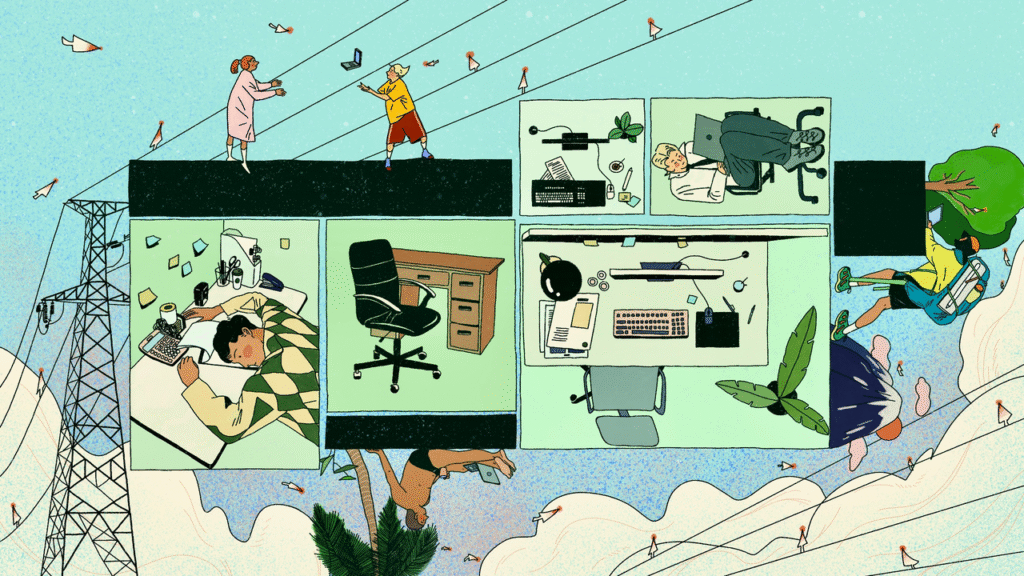
Within the frames are people bound to their office cubicles; beyond them, individuals work freely from diverse locations, connected through digital signals.
Beyond the Cubicle: Yutong Liu & Digit / Better Images of AI / CC BY 4.0

It almost looks like the keyboard in “Beyond the Cubical” (although my desk is much messier). I, too, have Post-it notes skirting my monitor, papers I’ve forgotten to read peek out sheepishly from under my trackpad, and my cables never behave, so I shove them behind the desk every time I sit down.

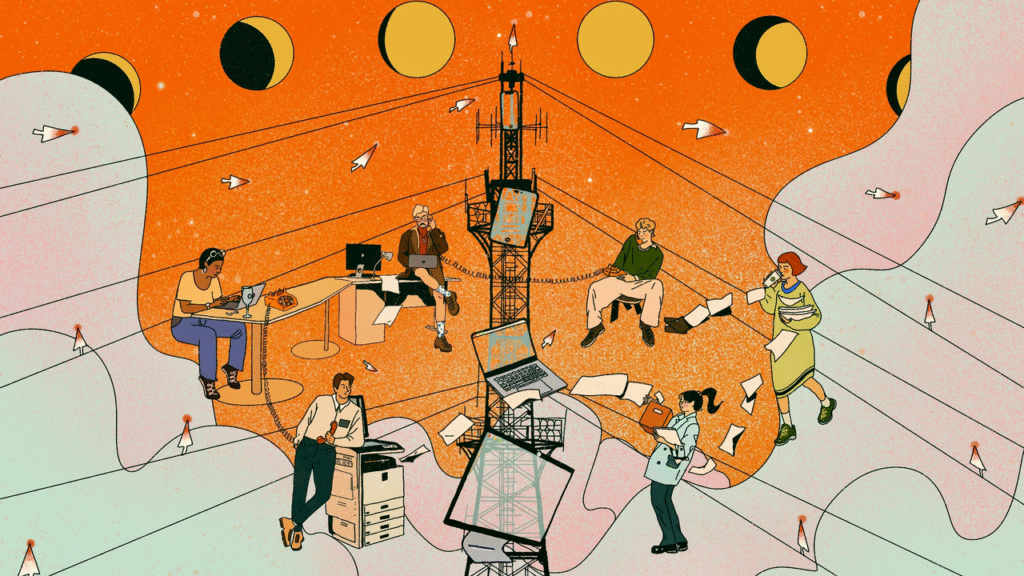
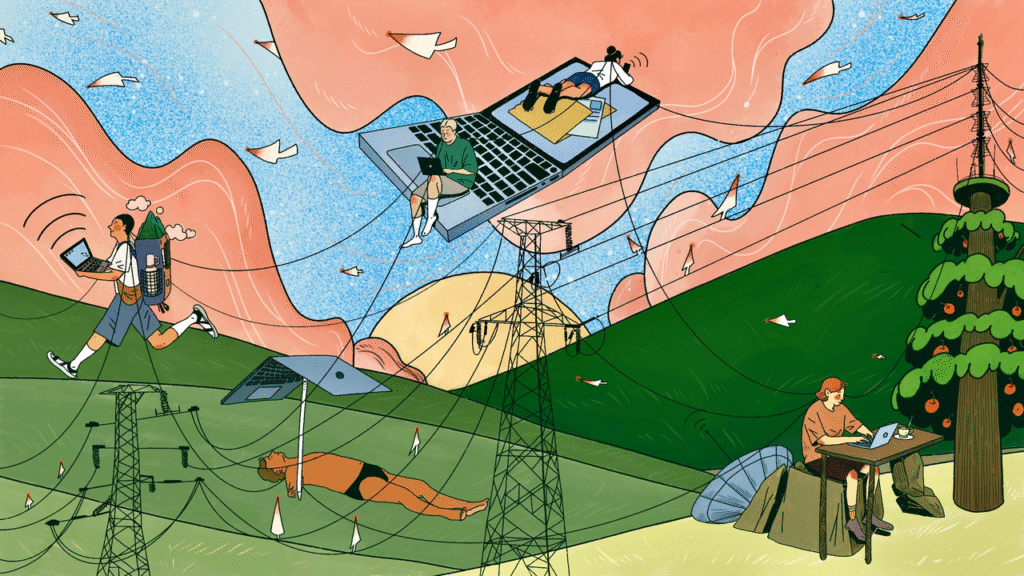
The undying sun hangs in the sky, as people gather around signal towers, working through their digital devices.
Digital Nomads Across Time: Yutong Liu & Digit / Better Images of AI  / CC BY 4.0 

Before any part of us is online, we are situated. ‘Across time’ makes that felt; the trench-coated worker feels the heat from his laptop building on his thigh, the man at the printer feels the low hum through his forearm and smells the warm, inky breath of the paper, and, across the desk, a woman’s shoulders tighten and her calves pulse after hunching over a laptop for too long.

Through signals from communication towers, people exchange ideas via digital transmission across different locations, accomplishing their work and building a digital community.
Digital Based Connection: Yutong Liu & Digit / Better Images of AI  / CC BY 4.0

Once we are situated, our habits spill outwards into the digital realm. Our scrolls, pauses, hesitation and clicks become data that reveal us to the system more than the system reveals itself to us. Alexander Galloway argues in ‘The Interface Effect’, that “the world materialises in our image”, and “Digital Based Connection” visualises this. Yutong’s character’s all navigate the same landscape of rolling hills and threaded cables, but they exist there differently; one runs breathlessly, with his laptop outstretched, while another lies back beneath a laptop turned parasol, nonchalantly bathing in its glow. The digital realm is less like a sealed second world, but like a map we make as we move. 

But, how do we get there?

The body precedes the digital

“So, we may arrive on screen as a cursor, but the work that gets us there is all shoulder, wrist, and fingertips.” Harriet Humfress

Yutong’s images insist that the body precedes the digital. Once online, our postures and clicks are compressed into a single point of agency: the cursor. Yutong literalises this proxy with her cursor-birds; these tiny, winged cursors keep the image in motion, reminding us that digital work advances click by click.”

“The idea of the mousecursor birds came from thinking about how almost every action we take on a computer involves the presence of the cursor. Without it, we can hardly do anything. So, I added them to represent the constant participation of the cursor in digital nomad work. Every “click” sets off or completes another task.” –  Yutong Liu 

Throughout her work, Yutong doesn’t anthropomorphise AI, she treats it almost as weather, as ambient infrastructure, or perhaps a climate. 

“To me, AI is in every screen. As long as there’s a screen and a connection to the internet, AI is already there—quietly influencing and facilitating everything in the background.”  Yutong Liu In ‘Digital Based Connection’, wires drape across the hills like isobars and laptops swell into oversized furniture and characters live together with the network, loosely tethered to an apple tree-router. For Yutong, these connections are her “way of illustrating how digital nomads transmit ideas within a shared space—both physical and virtual.” She imagines that “once these ideas accumulate, the tower transforms into an apple tree, with each apple representing a spark of human thought—shining, ripe, and ready to be shared.” The network is a climate we inhabit, not a figure we meet, which is why, for Yutong, AI doesn’t need a face at all, as it is present wherever a screen is lit.

The click-clack of my keyboard will never reach this file, but it will shape how it is written as my finger gets caught, and I spam the backspace, losing my train of thought. This is what Yutong describes as “traces of experiences”; digital files don’t stain, but Yutong’s drawing situations lodge themselves into her work. These traces are why her pictures feel lived in

AI and the ‘context debt

“Try to imagine unzipping your skin and stepping outside. What would step out? How would we exist without our senses?” Harriet Humfress

iPads and digital tools are Yutong’s main mediums, and offer near infinite ‘undo’ and precision, where the artist has complete control over the machine, and are sometimes marketed as ‘frictionless’ and ‘seamless’. This precision used to play an important role in Yutong’s process, but over time, she realised that “something was missing. Those ultra-clean, overly perfect lines started to feel rigid and lifeless” and she’s consciously shifted her approach: “I’ve come to embrace a certain level of unpredictability and imperfection in my work – because that’s what gives it authenticity and emotion”.

Rather than being nostalgic for paper, Yutong’s inclusion of these “traces” allows place, time, and the body to survive a frictionless tool.

“You can find traces of experiences in the visual element of my ‘Digital Nomads’ series. My inspiration comes from life itself, and I naturally project the life I’m living into the images I create. So even though digital images don’t physically create stains like paper does, I believe a sense of place can still seep in.” Yutong Liu

These “traces” are a breadcrumb trail. Follow it and you arrive at context.

In her Zine, ‘The Balance Between AI and Human’, Yutong muses on the role of the creative co-existing with AI. She recalls reading Adam Nemeth’s 2023 article and describes getting “chills”. What struck her was the idea that context lives in the gap between theory and practice, a space “for new narratives”.

“My art contained my context, a part that AI cannot replicate.” – Yutong Liu

AI may be able to describe or recognise the green of a lime, its bumpy skin, and sour taste, but it will never have the embodied knowledge of feeling the ache in your jaw or how saliva floods your mouth, or how the sourness contorts your face. This is the context gap that Yutong’s work operates in. A drawing made on a moving train carries a small tremor in its lines, or a green chosen under yellow café bulbs slips into olive, or how cursor-birds are read with the felt knowledge of strained eyes and a cadence of clicks. In her work, felt experience influences mark-making decisions.

Context also exists outside the body. Yutong describes how “context is also deeply rooted in cultural background […] humans can pick up the real meaning behind someone’s words through micro-expressions or subtle gestures”. Context is a kind of residue that no dataset can convincingly simulate, “something AI cannot currently understand”.

When this residue is thinned out and replaced with set definitions and statistical averages, images read as uncanny or empty. Yutong’s work explores the pushback to AI, and how this is more than just a “new moral panic”. It’s a reaction to context debt.

“The powerful rise of AI has instilled fear in many people, especially designers. […] Many fast-production, culture-less, story-less, and unoriginal companies have started laying off employees, preferring to pay AI companies to save on labour costs”. –  Yutong Liu

We have seen moral panics before, and every generation thinks the next is growing up lazier, more dependent on shortcuts, and dangerously unconcerned with craftsmanship. But this cycle feels different this time, something deeper than generational bitterness. Photography and Procreate disrupted traditional expectations for what counts as “real” art, and AI takes this to the extreme by obscuring and displacing authorship and creating without emotional memory or intention.

“It’s precisely this emotional and sensory presence that prevents human-made art from feeling empty. AI- generated work is the product of code and data – produced at speed and lacking in lived experience or authentic emotion.” –  Yutong Liu

Look again at the apples ripening on the router-tree, and the tiny corsor’s commute across the sky. Her metaphors feel lived in and handled and funnelled onto the glass of her iPad through the gripping of a stylus; “even with machine learning, AI can only remix what already exists, whereas human imagination is limitless”.

“Sometimes, the images generated by AI look good at first glance, but when you examine the details, they fall apart. They feel lifeless, soulless. It’s not just the vacant expressions in the characters – it’s the outlines, the brushstrokes, the composition. AI tries so hard to be ‘perfect’ that it ends up over-polished, almost sterile”. –  Yutong Liu 

Despite this sterility, Yutong doesn’t swear off AI or sermonise about its sins. Within her process, she treats AI as a tool and tries to “maintain a balance”, as she doesn’t want her work to “carry a strong AI shadow” but wants her ” audience to see what technology can help us achieve”. The sterility of AI often promises a neat and tidy input-output perfection, but this tidiness can’t stretch further than theory or reach out to context.

Loading up a chatbot, the input bar glows and the cursor blinks, and just out of rhythm to the clunky keys, but mimics the metronome of the typewriter-style loading of a friendly and reassuring response. It’s hard not to feel spoken to. Yutong describes how she “often imagined there was someone behind the screen who could understand me”, but in this supposed collaboration, prompts get nudged, rephrased, synonyms are traded, weights and models are adjusted, undone, redone, and the system obliges in its endless blank obedience. For Yutong, this “feels like an argument, but a very one-sided one. I was the only one talking, while the AI simply followed my instructions obediently – like a submissive assistant with no opinions or boundaries. No matter how much I ‘argued’ or tried to refine the prompt, there was always a disconnect between what I envisioned and what the AI produced.” After a dozen rounds, the almost-right images seem to pile up all glossy and neatly packaged like supermarket meat, but opening them up reveals this ‘conversation’ to be a monologue.

The system appears to understand, but what comes back seems too neat and strangely weightless, and it’s hard to name why. Try to imagine unzipping your skin and stepping outside. What would step out? How would we exist without our senses? Yutong dragged AI frameworks through the screen and into the room, in workshops to act out AI’s rules; ” I used to believe that AI only existed within computers, networks, and screens” but in these workshops “We explored AI through embodied exercises, like prompt-based drawing games or even “Pictionary”-style activities, where one person gives a prompt and another interprets it visually. These exercises helped us dig into the underlying logic of how AI works—and more importantly, how it differs from human output”. The workshops allowed participants to step into the input-output logic with their whole bodies, simulating image generation by hand.

“By investigating AI from a human, physical standpoint, I began to understand more clearly why its outputs often diverge from our expectations, even when we think our prompts are clear. Stepping away from the screen and into embodied, collaborative spaces made the learning process more playful, surprising, and insightful. That’s why I now find real value in exploring AI through workshops—it deepens my understanding in ways a purely screenbased interaction can’t.” –  Yutong Liu

Embodying AI as Human-Led Choreography?

“One, two, one, two, the prompt is the cue. The AI answers with plié, jeté, toes pointed and shoulders back, cleanly executing what has been drilled into it. Yutong leads, and the AI responds with the steps it knows. But what if we fed it something new to dance to?” –  Harriet Humfress 

For Yutong, the act of embodying AI changed how she thought of AI within her process, as it allowed her to “access ideas and insights [she] wouldn’t have reached through screens alone. It gave me new ways to feel and think about what AI is and what it can do. AI has sparked a lot of inspiration and critical thought for me, just as other digital media have also shaped how I generate ideas and interpret the world.” From here, creating with AI seems less like a collaboration and more like a human-led choreography.

Yutong gives a name to the choreographer: the AI Feeder.

In the last pages of her Zine, Yutong sketches a pragmatic job description for her imagined role of the AI Feeder: contracted artists feed models with tightly curated images, then intervene and correct where the machine falls short, and then use Nightshade (pixel level poisoning that preserves the appearance of images but blocks re-training) on the outputs so they can’t be scraped back into the system. An AI Feeder weaves situated thought and context into the data, embedding what an AI cannot produce on its own, but can be made to follow.

“Illustrators with strong personal styles enter into contract-based collaborations[… ]The company compensates them[… ]The artists then modify parts of the images that do not accurately convey the intended information[… ]Subsequently, the company employs Nightshade[…] to protect both the company’s interests and the copyright interests of the illustrators.”  Yutong Liu 

The AI Feeder’s process is less like prompt alchemy and more like rehearsal direction, marking the downbeat, setting constraints, rephrasing, and cutting. Many artist spaces demonise AI, but Yutong provides us with a radical future-facing redirect by prioritising human judgement and artistic integrity in a space where AI can often feel inevitable. She reminds us that ” AI can only generate based on what already exists. But the human mind can drift into unreal, even irrational spaces, and return with ideas no one else could have imagined. We can invent things that don’t yet exist. And I find that endlessly powerful”.

“We as humans have the power of choice, and that’s why I’m not so afraid of AI. Because I have a choice – I can choose to use AI or not in my creative process. As an illustrator, I can choose from various materials – pencils, watercolours, crayons – to assist me in my creations. In this process, any imperfect human stroke of the brush will create a different existence. In comparison, AI can only be chosen.”  Yutong Liu 

By the time I have finished writing this, I’ve picked off all my gel extensions.

My keyboard feels faster and slipperier now that my nails aren’t snagging, but I still mis-typed “extensions” three times. Backspace. Backspace. Backspace.

No part of this digital stutter will appear on the screen, but it shapes the sentence anyway, just as plane turbulence skews Yutong’s curved lines in ‘Digital Based Connection’ or a shaking subway carriage misplaces a cursor bird in ‘Across Time’.

This is what ‘Digital Nomads’ so cleverly depicts; even when digital landscapes feel seamless and glossy, they are always led by the body, with a slide of a stylus or an awkward left click. The risk here isn’t that AI will replace artists, but that we give up our context. Yutong’s process resists this both through critique and through her attention to rhythms, gestures, locations, and feeling. AI might mimic or remix style or design, but it cannot feel the clack of the keys or know what it means to mistype a word three times and try again. 


About the Digital Dialogues Competition

In April, the ESRC Centre for Digital Futures at Work and Better Images of AI launched a competition to reimagine the visual communication of how work is changing in the digital age. We received over 70 images to the competition from illustrators, artists, researchers, graphic designers, and photographers from all around the world, including Brazil, Hong Kong, Lebanon, France, Uganda, Argentina, Peru, Ireland, the US and the UK. The submissions thoughtfully challenged the dominant stock imagery used to depict digital transformation at work by offering more nuanced, inclusive, and grounded visual representations.

Yutong’s image ‘Digital Nomads: Across Time’ received the Grand Prize, the highest ranking award in the whole competition. Her other image, ‘Digital Nomads: Digital-Based Connection’ was also awarded in the top winning category. 

About the author

Harriet Humfress is a London-based undergraduate studying Fine Art at St Edmund Hall, Oxford. Her research explores popular beliefs and myths around AI, and how these ideas of anthropomorphism heighten anxieties around embodiment and labour.  Her work covers sound and video installations along with small tactile sculptures that aim to both satirise and inform viewers about how these digital systems cannot be unlinked from human emotion and power structures. Her projects often begin with data collection through surveys and workshops to build an understanding of how people engage with AI in their everyday lives and these data sets then become the material for her works. Alongside her studio practice, Harriet’s writing and research blends both creative and critical approaches, with essays ranging from narrative-driven works such as “A chatbot walks into a therapist’s office” to co-authoring work with We and AI on challenging AI inevitability narratives.

About the artist

Yutong Liu is an award-winning illustrator from China, now based in London as a freelance creative. Her work has appeared in numerous publications and advertising campaigns for clients including The Orion Publishing Group Ltd, Ascend Design, The Alan Turing Institute × University of Edinburgh, Better Images of AI, HiShark Edu, and more. Her illustrations have been recognised by prestigious awards and exhibitions such as the World Illustration Awards (WIA), 3×3 International Illustration Awards, Applied Arts Illustration Awards, ING Discerning Eye Drawing Bursary, Beijing International Book Fair (BIBF), China Illustration Annual Conference (CIAC), the Trinity Buoy Wharf Drawing Prize, and Hiii Illustration Award. Guided by her creative philosophy—“With eyes wide open and heart unveiled—feel life, record its pulse, and embrace its wild beauty”—Yutong’s work captures moments that are both poetic and profoundly human.

Images stacked in cover image: Yutong Liu & Digit / Better Images of AI  / CC BY 4.0

Other posts in the ‘Behind the Image’ series

https://thistle-oriole.pikapod.net/%f0%9f%aa%84-behind-the-image-with-minyue-from-kingston-school-of-art/
https://thistle-oriole.pikapod.net/%f0%9f%91%a4-behind-the-image-with-ying-chieh-from-kingston-school-of-art/
https://thistle-oriole.pikapod.net/%f0%9f%92%ac-behind-the-image-with-yutong-from-kingston-school-of-art/

Better images of AI on book covers

A collage of 8 different book covers of books about AI which are discussed in the blog post. In the centre, separating each row of 4 covers, the text reads: "Better images of AI on book covers?" "book covers" is italicised to emphasise the content of the blog.

We’re often told not to judge a book by its cover. And yet, a cover is often the reason why a reader first picks up a book. A book’s cover design is the window into its story and the author’s intentions. For Better Images of AI, in the context of books about AI and technologies, it’s refreshing to see covers that go beyond unhelpful norms and stereotypes such as tropes of robots, glowing brains, and unnecessary (white) men in suits. 

In this blog post, we share insights from Chrissi Nerantzi on the decisions behind the cover of the open-sourced book ‘Learning with AI’. We also reflect on the significance of book covers, highlighting some examples of covers that have featured “better images of AIwith reflections from our volunteer community.


‘Learning with AI’ – Considerations Behind the Cover 

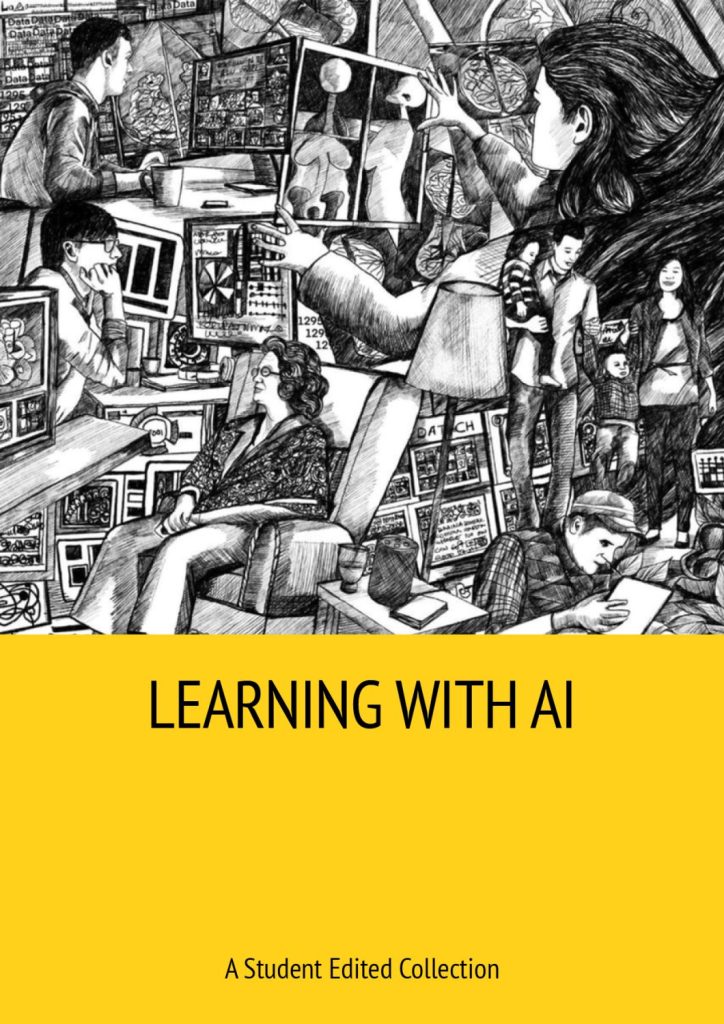
‘Learning with AI’ is an open-source book from the University of Leeds. We spoke with Chrissi Nerantzi, part of the project team about their choice to use Ariyana Ahmad’s illustration ‘AI is Everywhere’ for the cover of the book. 

For the team, the choice of cover was about more than just visual aesthetic. It was about reflecting the collaborative and collective nature of the book itself. Initially the team were drawn to the idea of a collage since the team have used these for some of their other open books (see for example here). Collages can capture multiple perspectives, textures, and approaches, much like the student voices incorporated throughout the book. 

Ahmad’s illustration, while not a collage, achieves a similar effect. Its black-and-white style depicts diverse scenes of AI’s impact, from data analysis to agriculture, reflecting the different contributions from students who write about the use of generative AI in their studies. 

“I looked through the wonderful artwork from the Better Images of AI library and could see some of our collective thinking reflected in many of the visuals. I felt that using one of these for our book cover would be a perfect fit. We selected and agreed to use Ariyana Ahmad’s artwork “AI is everywhere for our book cover.” – Chrissi Nerantzi

Another key factor was openness. The images in the Better Images of AI library are open-source, freely available under Creative Commons BY 4.0 (read more here). This mirrored the ethos of Learning with AI which is a living, collaborative resource developed by students, academics, and the public together. The open licensing allowed the book to embody its own values of collaboration, accessibility, and incremental learning.

“We routinely build on work by others, remix, reappropriate, and evolve it. We are inspired by what we see, experience, discuss, read and debate about, play and experiment with, our mistakes and failures, and use our imagination, ingenuity and resourcefulness to come up with new and exciting creations that can be experiences, processes and products that add value in some way. Creativity can’t happen without openness.” – Chrissi Nerantzi


The significance of book covers 

Every author wants a cover that communicates both the passion behind their work and a sense of what the reader will discover inside. But as Anne Jordan and Mitch Goldstein write in the Stanford University Press blog, a good cover should also “reward the reader” by offering a touch of mystery, something that allows space for personal interpretation and grows in meaning as the text unfolds. By this, they mean that book covers should not be overly prescriptive about what the author intends to communicate, but actually, depth in an image enables readers to still resonate with the cover as their journey and experience through the book might change, challenge preconceptions and evolve with the narrative.  

“A good book cover should also reward the reader – there should be a little bit of mystery to allow for personal interpretation, and enough depth in the image so the reader’s experience of the cover changes and grows as they make their way through the text.”  – Anne Jordan and Mitch Goldstein 

In ‘The Art of First Impressions’, Chip Kidd makes a similar point. Sometimes, clarity in visual communication is really important – for example, for street signs or instructions. But he argues, “mystery is an extremely powerful tool” when you want to grab attention and invite deeper engagement. In the context of AI, mystery can be particularly valuable, since oversimplified stereotypical imagery hinders the reader’s ability to reflect on the subject, reinforcing the illusion of pre-determined futures involving AI. 

“You should be mysterious when you want to get people’s attention and hold it, when you want your audience to work harder.” – Chip Kidd

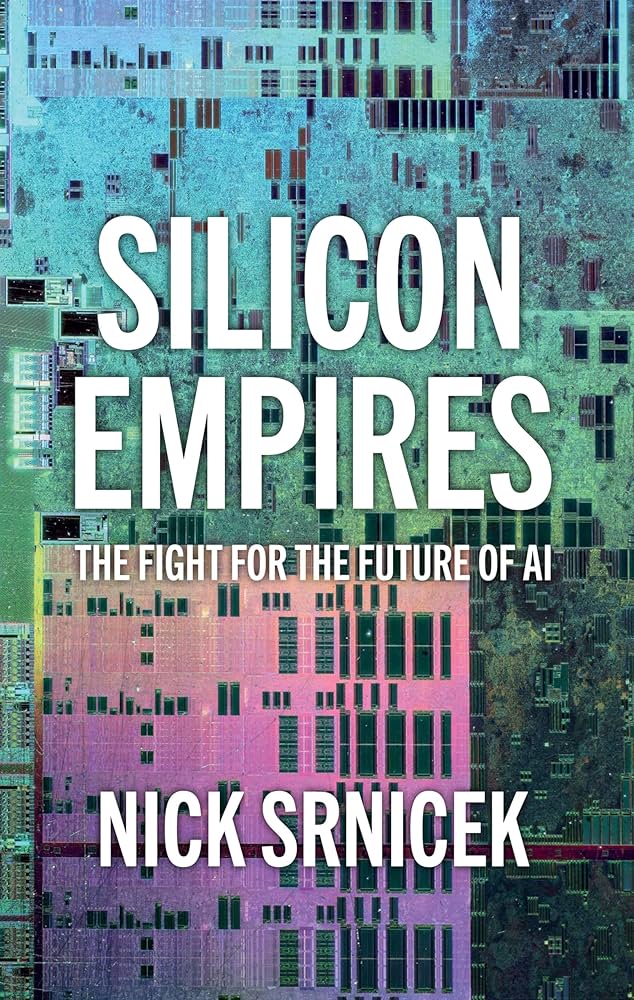
An example of this balance between clarity and mystery is the cover of Nick Srnicek’s book ‘Silicon Empires’ which uses GPU shot etched 5’ by Fritzchens Fritz from the Better Images of AI library. The image grounds the book in the material realities of AI, while also evoking a sense of wonder through its rainbow hues, a marked departure from the usual “deep blue sublime” that is usually embedded within stock images of AI. 

Srnicek’s book explores the geopolitical economy of AI, so this cover aims to show how high-level strategic moves between governments and corporations have material impacts on the environment and the world that we live in. Srnicek could have chosen a stereotypical visual of AI (white anthropomorphised robot, human brain, or blue holograms), but in choosing an alternative image, it made it clear that this book was making a different statement about the development of AI. Even if readers might not immediately understand the cover of this book, this might be half the point to entice readers to investigate the book in order to decode it – relating to the idea of mystery which was explored above.

“Artists and communicators are well aware of the power of images. They can inform, inspire, draw attention, or simply entertain. Images that are misleading or inaccurate are equally powerful, but with potentially damaging consequences: they can misinform, limit the imagination, or divert attention from pressing issues.” (Dihal and Duarte, 2023, 5)

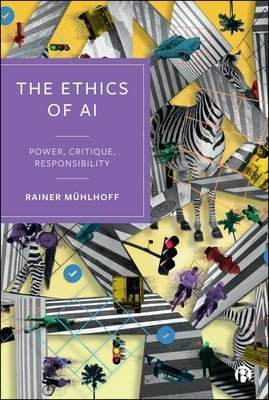
Another example of a book that has featured one of the images from our library is The Ethics of AI: Power, Critique, Responsibility’ by Rainer Mühlhoff. This book serves as an accessible and critical interrogation of the effect of AI in society, with a focus on the interplay between AI and power. This book moves away from attempting to predict the ways in which technology could lead to existential risks and the end of humanity. Rather, The Ethics of AI is grounded in the ‘now’ – much like the Better Images of AI library! Mühlhoff considers the social-normative behaviours, power structures and other elements of society, based upon case-studies, to help people understand how a composite of personal responsibility, policy and an understanding of the risks present are vital to helping AI go well.

The cover uses Anne Fehres, Luke Conroy and AI4Media’s image, ‘the Hidden Labour of Internet Browsing’. This image explores the hidden labour behind our everyday use of AI. The use of this image clearly works for Mühlhoff’s book, as it has the perfect mix between the ‘everyday’ and the hidden structures at play, these are embedded within the sliced and slanted crosswalks across the cover. Not only visually striking, this image also meets Goldstein’s assessment of what makes a good book cover, adding some mystery that will reward the reader as they read since the themes will become clearer the more they understand of Mühlhoff’s position.

Of course, the images in the library have not been created to cater for specific books in mind (though some have certainly been inspired by books!). Still, we are always happy to see them used in this way, especially by authors who may not have large budgets or the support of a major publishing house. 


The Covers of Books about AI 

Below, we showcase a selection of other book covers that use visuals of AI that challenge common tropes. Each example demonstrates how visual choices can reinforce the themes of a book and the author’s intentions. Thank you to some of our volunteer stewards for their collection and commentaries on these covers: Beckett LeClair, Laura Martinez, and Liam Palette. 

Technology is Not Neutral: A Short Guide to Technology Ethics by Dr Stephanie Hare

The black and red cover shows a face with the focal point being the eyes. One eye is masked by the back of a camera cell phone camera which is held in front of the face, partially covering it. The human eye and "eye" from the phone back camera reflect a face.

This 2022 book by Dr Stephanie Hare explores how we can create and deploy technologies to minimise harms and maximise benefits. It directly challenges notions of neutral, amoral and unquestionable tech, instead inviting us to consider how wider contexts feed into the ethicality of our use of technologies. The bold colour scheme immediately grabs the viewer’s attention. The provocative imagery of devil horns and a ‘watchful’ device conveys a core argument – that ethics are influenced by a technology’s very designers and users – in a remarkably simple way. 

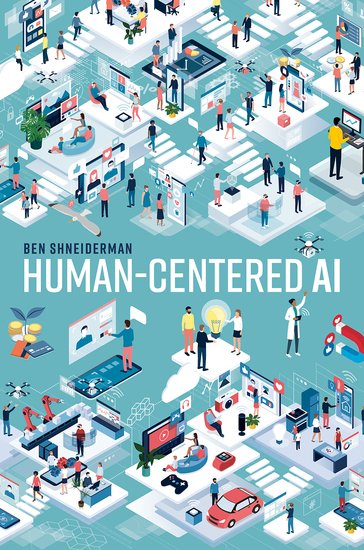
Human-Centred AI by Ben Shneiderman 

The cover shows lots of mini environments which protray the relationship between technology and humans. For instance, in onem, there is a human interacting with an interactive screen, individuals watching TV, at work, or in factories.

This book focuses on the opportunities presented by AI and how we might capitalise on them through human-centred approaches. Shneiderman writes specifically about his choice not to use a visual with a harmful AI trope like humanoid robots, based on his belief that AI will not possess human-like capabilities like “two-legged mobility, five-fingered dexterity, and dominance of voice interaction”. In deciding on what the cover of his book should include, Shneiderman developed guidelines on what he wanted: images of people, diverse people, expressive human features, technology connecting and empowering people, and natural world representations. 

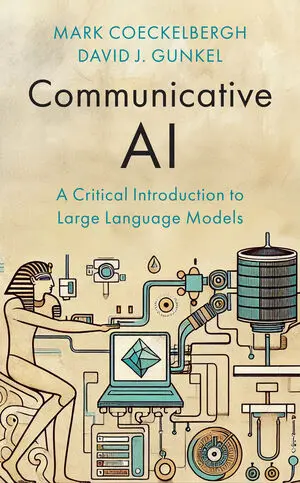
Communicative AI by Mark Coeckelbergh and David J. Gunkel

The cover background shows a tea-stained old effect and the image is of a Ancient Egyptian Pharaoh typing on some machinery - the image is line-drawn with some blue features.

‘Communicative AI’ takes a critical introduction to LLMs inspired by philosophy, history of ideas, linguistics, and communication theory. Through exploring LLMs in relation to these disciplines, the authors confront longstanding debates about language, consciousness, truth, authorship, and writing. The choice of book cover is especially interesting and could be read as an homage to Plato’s myth of Theuth and Thamus from the Phaedrus for those familiar with Ancient Greek philosophy. Here, Socrates questions the invention of writing, which he argues, in comparison to dialectic discourse, weakens memory and offers the appearance of wisdom without true understanding. 

In the context of LLMs and the critical approach that Coeckelbergh and Gunkel take in their book, this historically inspired cover is fitting to modern day debates about whether LLMs are weakening our own critical thinking abilities and limiting our ability to achieve genuine understanding. The use of a historical cover adds to a sense of mystery and appeal since AI is usually represented in ways that try to present it as “new”, “innovative”, and “magical” – this book cover takes us back to debates we’ve long had throughout history, stretching back to Socrates’ questioning of the invention of writing over 2000 years ago. 

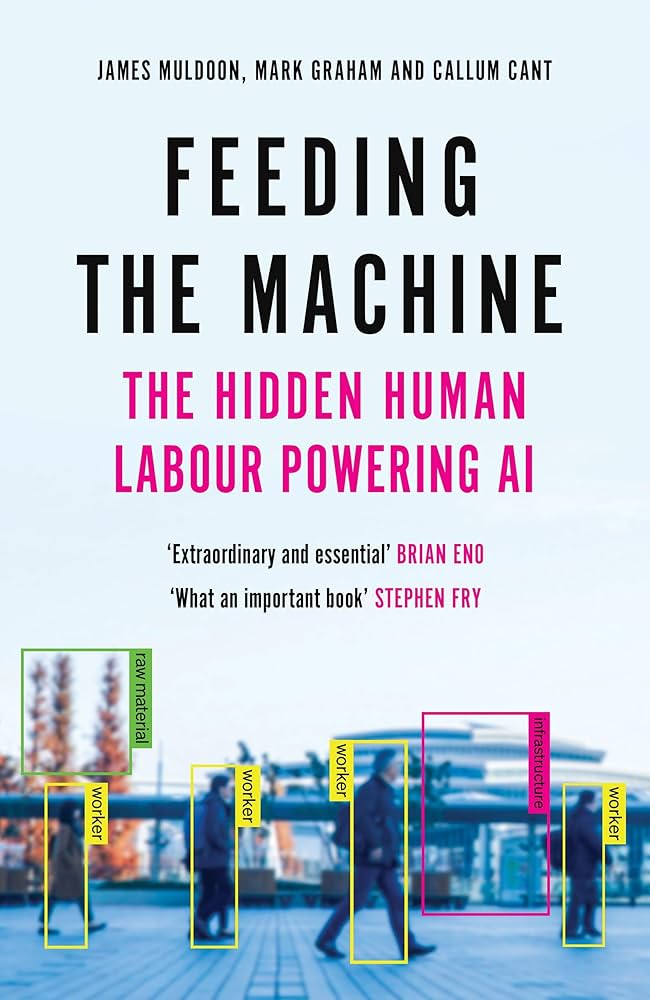
Feeding the Machine by James Muldoon, Mark Graham and Callum Cant

The background of the cover is a standard city scene. The top half is the sky with the text "FEEDING THE MACHINE" in black text and "THE HIDDEN HUMAN LABOUR POWERING AI" in pink. The bottom half shows blurred figures and objects with bounding squares with labels such as "raw material", "worker" and "infrastructure" in pink yellow and green.

Based on years of fieldwork research, and through the story of seven workers around the world, Feeding the Machine, by James Muldoon, Mark Graham and Callum Cant, shows the extractive ways in which AI system are powered, mostly by humans workforce, resulting also in the concentration of power of tech company and elites. The authors call on us to demand a fairer digital future:

If this book could be distilled to a single message is that we, human beings, are the often-hidden force that powers AI – both physically with our labour but also intellectually through AI ingesting and synthesising our collective intelligence” (p. 220). 

The cover image from Shutterstock is an excellent choice that engages with the content. It reflects the process of AI data labelling and AI-generated annotation. It could depict the process of manually assigning labels or categories, which often involves precarious global workforce. It could also represent the tags already added to a dataset to train machine learning models in image recognition, thereby demonstrating how public spaces are repeatedly labelled and surveilled. It brings together the process and the results. You have three categories: raw material (trees), workers (ironically, most of us already fall into this category, or will do. Are we really just a workforce?), and infrastructure (pretty general to fit in?).

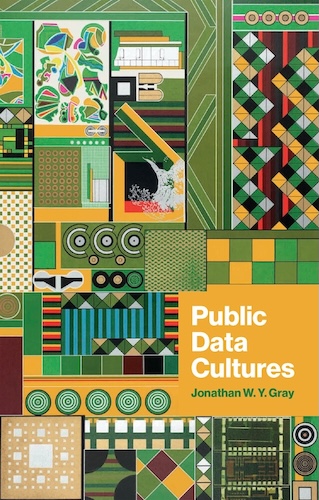
Public Data Cultures by Jonathan W.Y. Gray

A collage of patterns with earthy tones, the patterns are quite geometric like in the style of decorative tiles. There is a yellow text box with the title of the book 'public data cultures' in white.

‘Public Data Cultures’ explores the practices and cultures of how data is made public in the age of the Internet. Typically, the language is saturated with extractive and industrial metaphors: “data mining”, “data harvesting”, “data pipelines”, and the common phrase, “data is the new oil”. Gray’s book aims to centre the idea of public data as a networked cultural material through a more critical and creative interrogation of what it means to make data public.

Visual representations of data, especially those used to reflect AI training datasets, show data in vast holograms, giving the impression that data is abstract, objective and impersonal. Gray’s choice of cover shows that data is relational, embedded in culture, and embodied. The colour scheme of earthy tones also reflects associations with natural materials which is interesting given the environmentally-themed metaphors mentioned at the start. However, instead of Gray using these tones to the promote the idea that data is a resource to be consumed with economic value (like land), the cover could be hinting more at the ideas of solidarity, community management, and stewardship reflected in our environmental ecosystems.