Better Images of AI on the AI Resist List: countering disempowering AI narratives

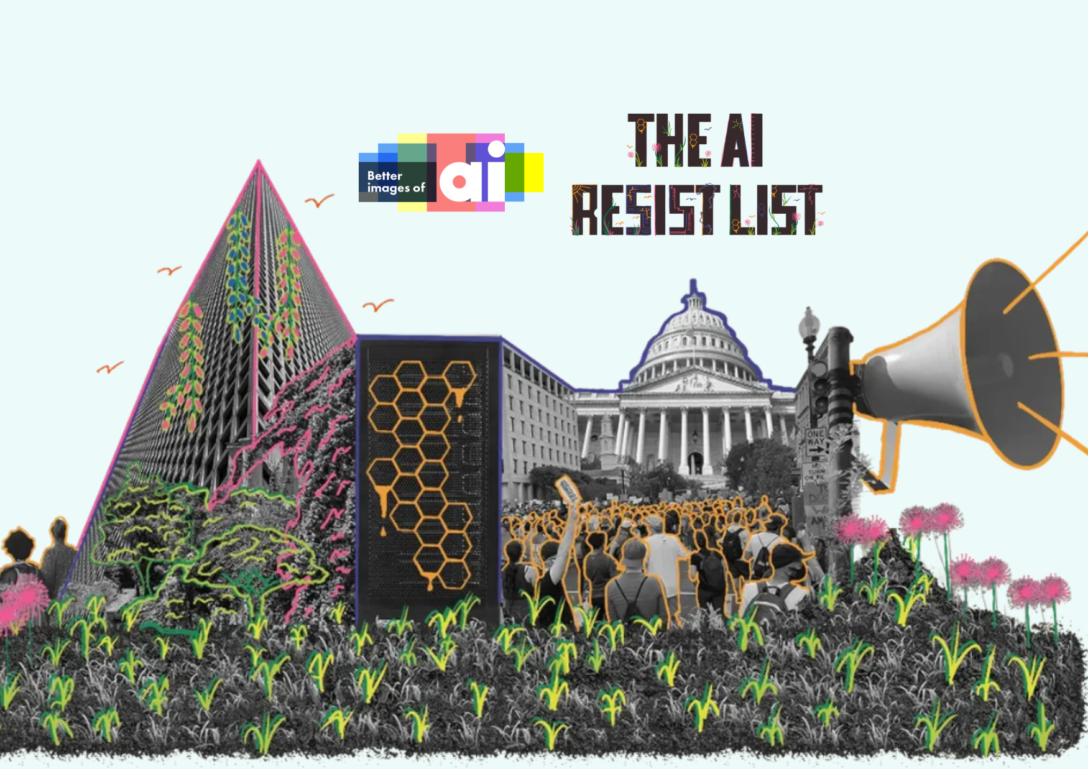
A hand-illustrated collage graphic represents optimistic people power in a green flourishing landscape. Logos for Better Images of AI and the AI Resist List are above against a light blue background.

Illustration credit: Yemariam Mamo and Pauline Wee for the AI Resist List

Just over a month ago in July, we were part of We and AI’s ‘day of reimagining and reclaiming AI’ as part of the UK launch of the AI Resist List and London Data Week. The AI Resist List is a collection of the different AI resistance movements, categorized by how they pressure different ‘Pillars of Support’ that perpetuate and uphold the ‘empires of AI’. If the concept seems familiar and reminds you of a popular book, you’re not mistaken. The AI Resist List was developed by Karen Hao, author of the popular book ‘Empire of AI’ alongside The Refugee Law Lab at York University, the Distributed AI Research Institute and our friends at We and AI. 

There are nine different pillars on the AI Resist List, spanning from funding to policy to resource extraction. Each pillar is adorned with multiple examples of different grassroots and community initiatives that are (successfully and tirelessly) resisting AI by targeting its very roots. Better Images of AI is featured on the AI Resist List under the ‘narrative’ pillar which documents work being done to ‘call out the AI hype’.

“The empires run on mythmaking and hype about what AI is, what it can do, and what they need to build it. Deflating that hype and countering myth with reality diminishes the empire’s influence.” – The AI Resist List

How does Better Images of AI contribute to AI resistance? 

Our image library (but also importantly our blog too) brings together individuals and organisations working to challenge the current stock imagery used to depict and communicate about AI. Typically, AI is visualised in ways that are misleading and harmful: think of news stories illustrated by humanoid robots, regulatory reports with covers featuring blue lines of descending code, and conference posts which centre human brains. These tropes—presenting AI as inevitable, magical, and intelligent—have become self-referential rather than engaging with the assumptions about whether AI needs to exist, in particular in accordance with its current trajectory of development. 

We need to understand what AI is and the implications of its development to determine whether it works for all of us and whether we want to support the companies building it. Our library of over 300 images showcases different ways creators have visualised AI in ways that more accurately illustrate the capabilities, complexities, and impacts of AI systems and the humans behind them — both the workforce and the tiny elite who are making decisions about how to build these technologies. In this way, our image library and blog deflates hype and counters myth with reality. 

We not only see the image library as a way to better inform society, but we also hope that through the medium of visuals and image-making, we offer people a new resistance tool to communicate how they feel about AI and, in doing so, advocate for the futures they want on their own terms and in their own language. Professor Deborah Lupton has used collaging as a method in social research as a way of “eliciting participants’ responses to generative AI and inspiring discussion on how they feel about these new technologies”. Deborah as well as other scholars have also used visuals of AI as part of zine-making and as a medium to communicate and advocate against AI (see here and here). 

Better Images of AI at the UK Launch of the AI Resist List 

At King’s College London on 8th July, Better Images of AI was invited to the UK Launch of the AI Resist List. The purpose of this event was to bring together researchers and scholars who documented the projects featured on the list, those leading them, as well as other practitioners and organisers working on challenging, documenting, resisting or re-imagining the AI industry (you can read a summary of the event here written by Wolfgang Hauptfleisch).

We were in great company with other organisations and individuals working to resisting AI through education, art, law and policy, e.g., FoxGlove, Friends of the Congo, The Data Labelers Association, BLAM UK as well as other individual researchers like Dr Zeerak Talat (University of Edinburgh), Dr Stef Garastro (University of Greenwich) and Dr Yulu Pi (University of Warwick).

Zoya Yasmine represented the Better Images of AI community and spoke about how the image library serves to counter AI hype and the global community of talented creators who use digital art illustrations, photography, to cutting and sticking using archival materials to offer more representative visuals of AI and its impacts on communities. 
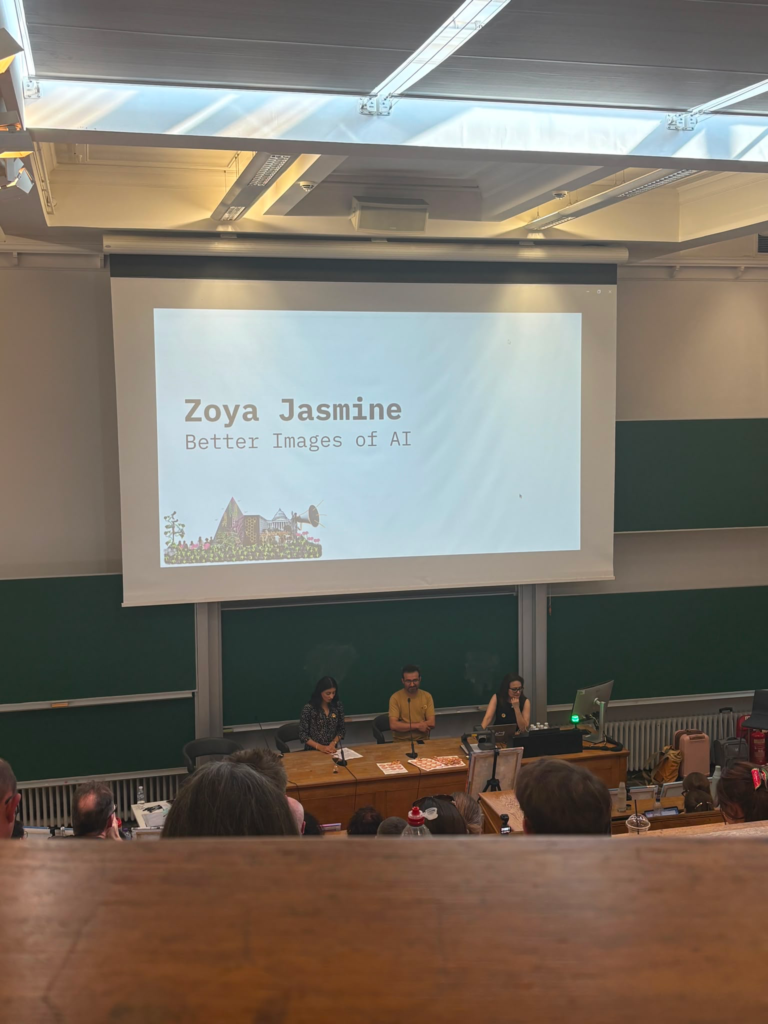
A lecture hall with rows of wooden benches. On the bottom platform is Zoya alongside two other panelists. Above her is a large projection screen with the text, 'Zoya Yasmine, Better Images of AI'.

Zoya at the UK AI Resist List Launch. Image credit: Harriet Humfress

She ended her presentation on a quote from one of our community members, Dominik Vrabič Dežman, who said: 

“[T]he currently pervasive images of AI make us look somewhere, at the cost of somewhere else.” – Dominik Vrabič Dežman

Better Images of AI provides everyone with a greater vocabulary and thus power to decide where you want people to look when you’re communicating about AI next. Every better image of AI works to destabilise the visual stronghold of the robots and brains, offering clearer insights into what AI is and how we as a community feel about it. We are grateful to Marcin Wilkowski for beginning our collection of images which visualise how communities are fighting back against AI — a narrative hidden in conversations about the inevitability of AI. Well….until the AI Resist List was launched. 

At the UK launch event of the AI Resist List, an exhibition of images from the library was also featured before the speaker presentations. The display of some of the images from our library at the beginning of the event set the tone for the conversations and discussions that followed: environmental extraction, power and monopolies, and human rights. The exhibition was curated by CHIA who we are grateful to for producing the exhibition materials and supporting our library. 
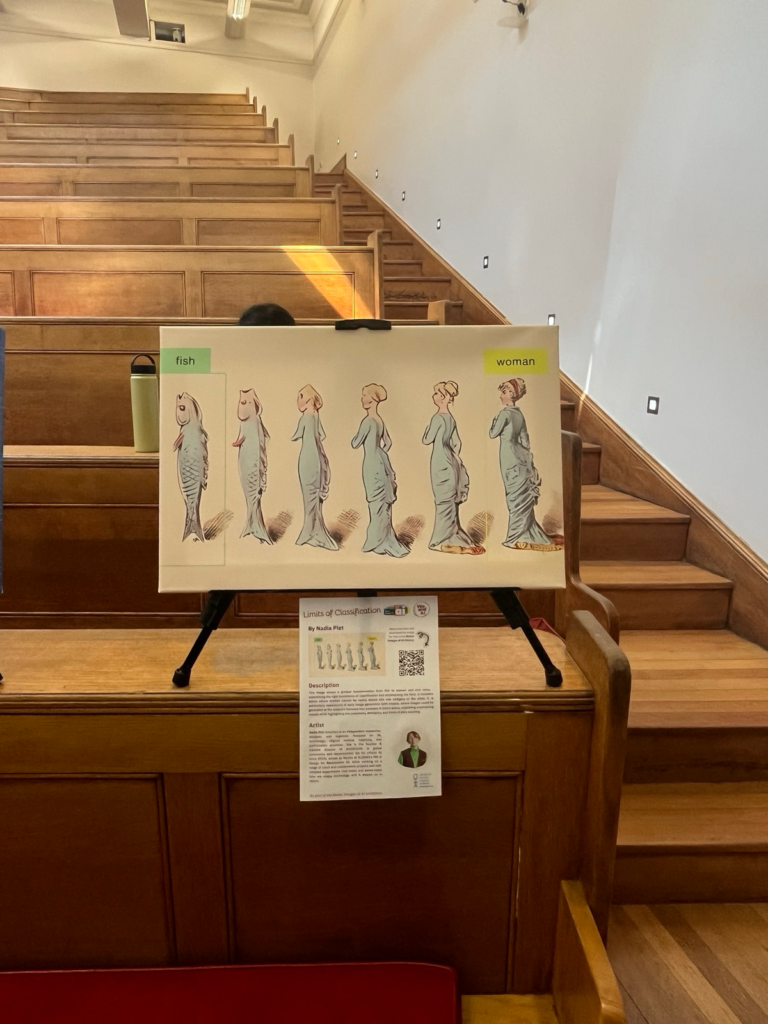
A canvas image of a progression from a fish to a woman, showcasing transitional stages that defy classification boundaries, emphasising fluid states is printed on a canvas and propped up on an easel. In the background are wood rows of benches.
One of the Better Images of AI pictures at the exhibition of the UK AI Resist List

Photograph credit: Lovansh Katiyar. Image: Nadia Piet  & Archival Images of AI + AIxDESIGN / Better Images of AI / CC BY 4.0 

We’re very grateful to everyone involved in the creation of the AI Resist List and all who are working to fight back against the empires of AI. 

Better Images of AI and the other AI resistance pillars 

While Better Images of AI is featured as a project under the ‘narrative’ pillar, our image library and blog contribute to many of the pillars by visualising data, land, energy, labor, water, ideologies and companies that are necessary to build and sustain AI. Below, we explore how materials from the Better Images of AI community visualise and represent the issues related to the other pillars on the AI resist list. 

Data

“Large-scale AI models require large-scale data sets to train on. Without such vast quantities of data, these systems would not be able to exist in their current form.”  – AI Resist List 
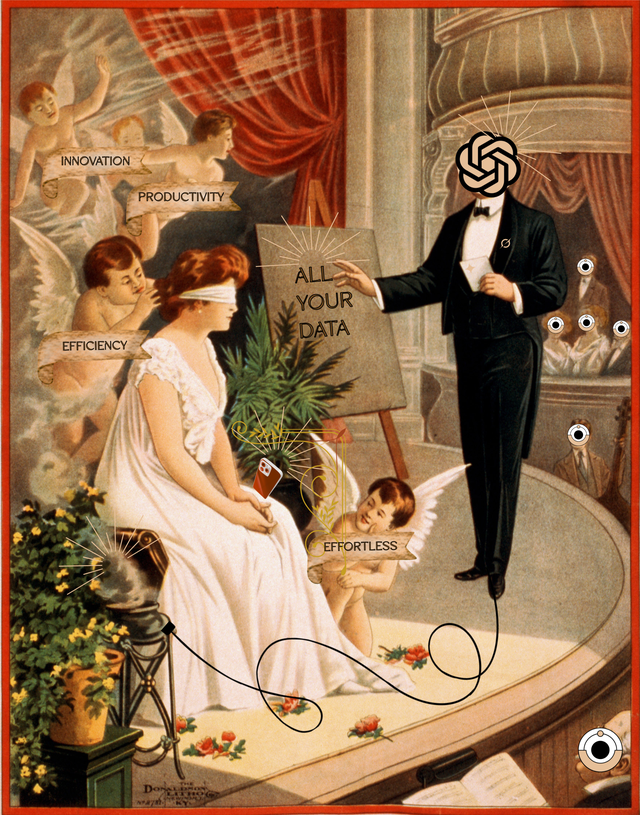
A digital collage styled like an early twentieth century illustration. The title at the top reads “The AI-Deal.” A man in a suit with the OpenAI logo instead of a face stands on a stage and points to a board that says “ALL YOUR DATA.” In front of him, a seated woman wearing a blindfold holds a glowing smartphone. Small winged figures carry banners reading “Innovation”, “Productivity”, "Efficiency" and “Effortless” presenting commercial narratives about AI that mask the real exchange. Floating eye icons around the scene indicate surveillance.
Daniela Zampieri / Better Images of AI / CC BY 4.0 

‘AI-Deal’ by Daniela Zampieri points to how corporations acquire data produced by individuals through narratives of innovation, productivity, and efficiency — hiding the real costs of the deal. Data extraction comes at the cost of constant data capture, surveillance, and environmental damage. The ‘AI-Deal’ enables these corporations to accumulate mass datasets, instead of pursuing fairer and more equitable paths to using training AI models (see Fairly Trained for one example of an organisation advocating for a consensual approach to AI image generation). 

Data centres 

“[T]he empires seek to secure an unparalleled amount of computing power in the form of data centers and supercomputers to train and deploy their systems.” – The AI Resist List 
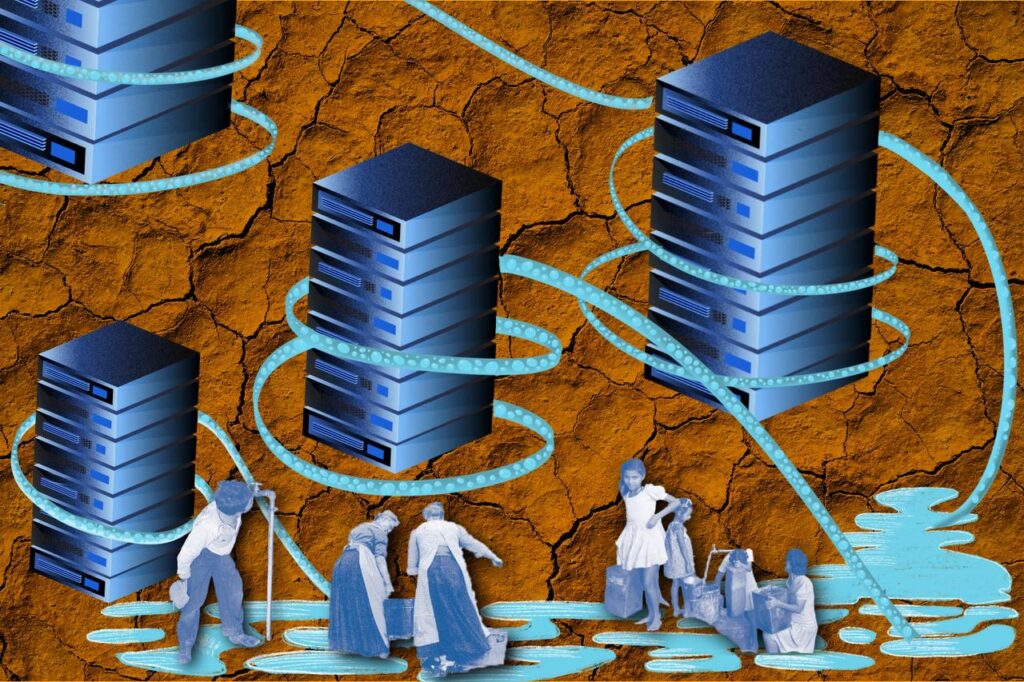
Cooling pipes hug data servers, extracting water from a shared reservoir while people collect water from the same source, set against a background of eroded soil textures.
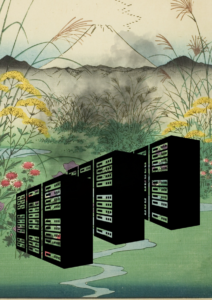
This image is a collage with a colourful Japanese vintage landscape showing a mountain, hills, flowers and other plants and a small stream. There are 3 large black data servers placed in the bottom half of the image, with a cloud of black smoke emitting from them, partly obscuring the scenery.

Deborah Lupton / Better Images of AI / CC BY 4.0  (right) & Gloria Mendoza / Better Images of AI / CC BY 4.0 (left)

Deborah Lupton’s image, ‘Severs in a Landscape’ demonstrates the impacts of data centres on the natural world through pollution emitted from the operation of the centres. It was inspired by Deborah’s own research on the environmental impacts of data centres built around the world to service the expansion of GenAI. Gloria Mendoza’s contributions to the image library have all been rooted in a need to better communicate the environmental implications of AI (read more on our blog here). Her image, ‘Data Centres in Vulnerable Ecosystems’, depicts servers extracting water from a local community, symbolizing how data center operations contribute to erosion, water scarcity, and drought.

Resource extraction 

“Data centers are made from rare earth minerals and other resources. Evidence shows that bottlenecks in these resources have already forced the AI industry to slow its pace.” – The AI Resist List 
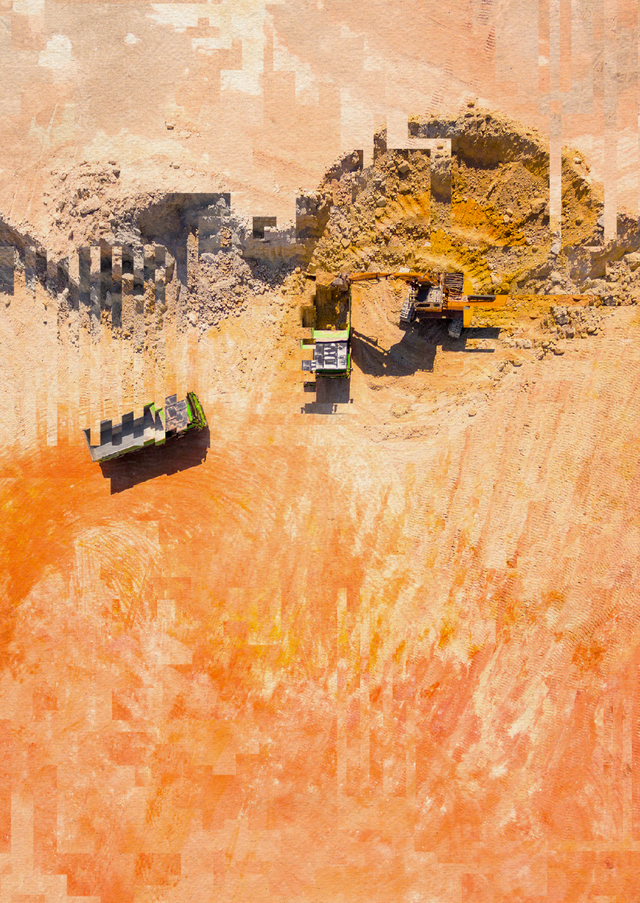
A bird's eye view photo of an orange sand mine with transport lorries, but the image is slightly distorted by digital artefacts.
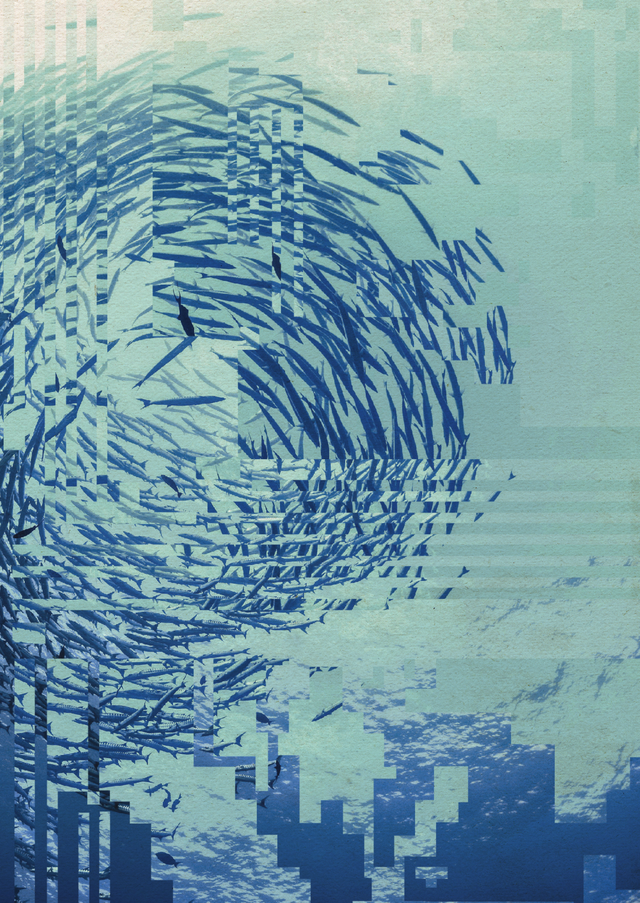
An underwater photo taken looking up to a large circular school of fish while the sun sparkles in the blue water. However, the image is slightly distorted by digital artefacts.
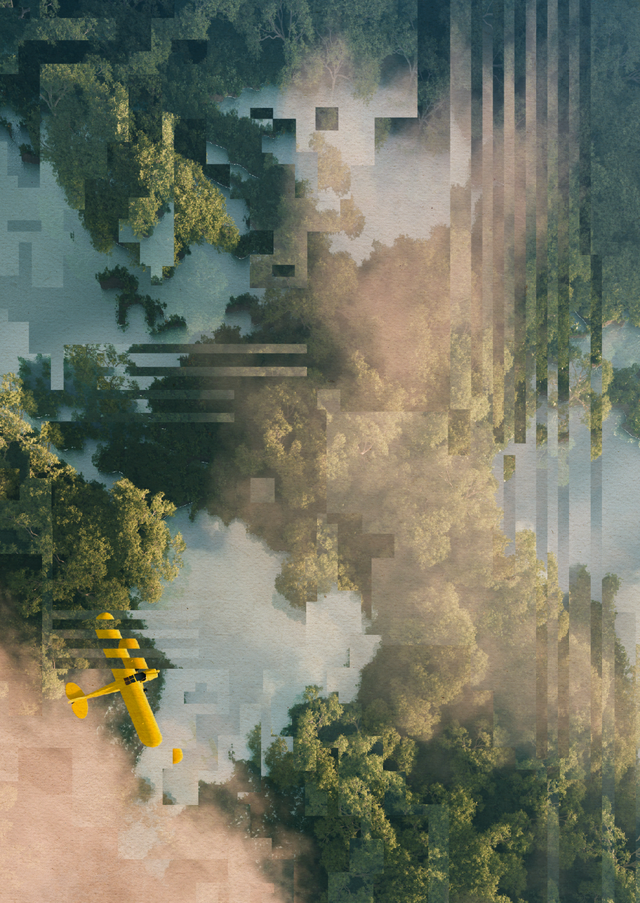
Bird's eye view photo of a small hut and a concrete path through a lush green forest. However, the image is slightly distorted by digital artefacts.

Lone Thomasky & Bits&Bäume / Better Images of AI / CC BY 4.0 

Lone Thomasky and Bits&Baume’s (growing) collection of images expose the realities behind the often perceived “clean”, “slick”, and “efficient” AI supply chains. Their collection shows the breakdown of environments and depletion of natural resources caused by the rapid expansion of data centres and mining of critical resources (like lithium, cobalt, and rare earth elements) which underpin (generative) AI. You can read more about Bits&Bäume’s work and their image collection on our blog here. Another one of our blog posts also explains some of the other contributions in our library that picture the physicality of AI.  

Labour 

“The empires require the labor of workers across their supply chain, whether to mine minerals, construct data centers, annotate data, train models, or adopt their products in other industries.” – The AI Resist List 
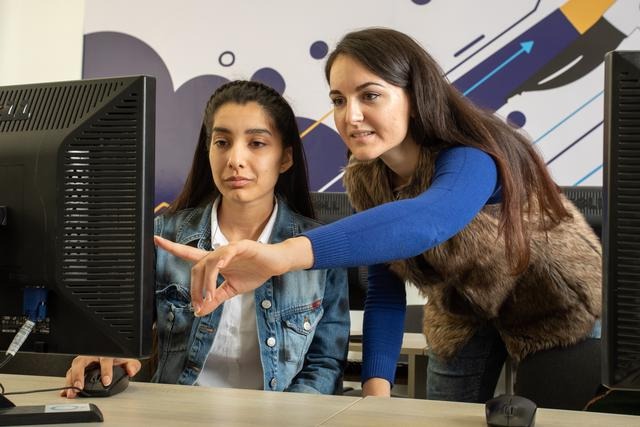
A woman and a man sitting in front of a computer screen, pointing at something on the screen and talking, with a colourful stncil design on the wall behind them.
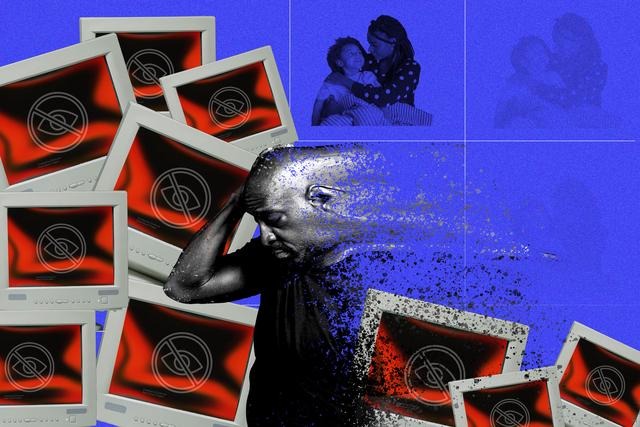
A man showing mental distress from constant exposure to harmful content online. His family, in the background, progressively disappears.

Nacho Kamenov & Humans in the Loop / Better Images of AI / CC BY 4.0 (left) &  Gloria Mendoza / Better Images of AI / CC BY 4.0 (right)

Images from Nacho Kamenov & Humans in the Loop visualise hidden data annotators who prepare training datasets for AI companies. Data annotation work is being performed by hundreds of workers around the world who use the job as a means of livelihoods. You can read more about data workers and the need to insert humans back in the loop in AI visuals on our blog here. One of Gloria Mendoza’s other images focuses on the overwhelming emotional toll that data annotation work can take on individuals. The collage aims to convey the isolation, distress, and psychological fatigue that many data workers endure. 

Adoption 

“The AI industry needs a broad user base to develop a viable business model and public legitimacy. Weak or declining user numbers would force companies to change tack.” – The AI Resist List 
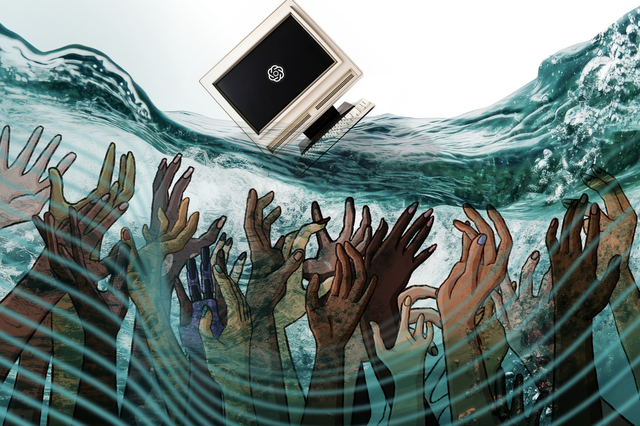
A computer monitor with a parody of a tech company logo floats on the waves while human hands reach up from the depths.
A sketch of a disgruntled man on the right side of the image is overlaid by rectangles containing sketches of individual workers. The man's gaze faces the individuals who are positioned as if they are walking in unison towards the man. The background is purple and there is a forward arrow symbol in darker purple and yellow on top of the image.

Rose Willis & Kathryn Conrad / Better Images of AI / CC BY 4.0 (left) & Marcin Wilkowski / Better Images of AI / CC BY 4.0 (right)

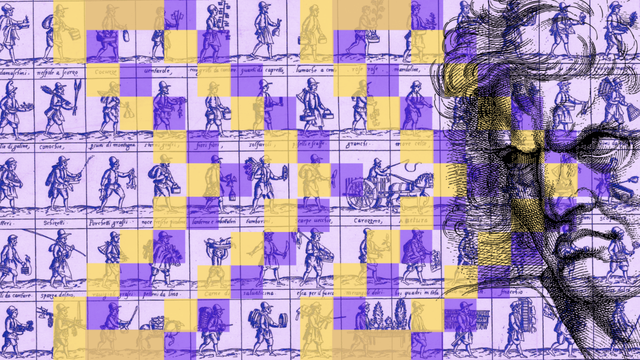
Community Activism by Marcin Wilkowski explores how community activism is challenging “Silicon Valley narrative cocktails” about AI. Rose Willis & Kathryn Conrad’s image, ‘A Rising Tide Lifts All Bots’ is also suggestive of the idea that the success of AI companies relies on our acceptance and use of the technologies. The Better Images of AI Generative AI Policy is also an example of an outright objection to the use of AI based on its current trajectory. 


Policy 

“Governments around the world strengthen the empires with hugely permissive, and often enabling, legal and regulatory environments.” – The AI Resist List 
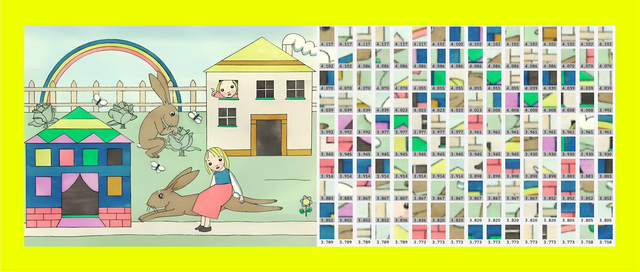
Diptych contrasting a whimsical pastel scene with large brown rabbits, a rainbow, and a girl in a red dress on the left, and a grid of numbered superpixels on the right - emphasizing the difference between emotive seeing and analytical interpretation.

Nadia Piet & Archival Images of AI + AIxDESIGN / Better Images of AI / CC BY 4.0

In this blog post, Lucia Sommerer explores how the language and visualisation of ‘the AI black box’ conceals opportunities for law and regulations to control the human decisions behind an algorithmic system and falsely suggests that algorithms are independent of human prejudices. In another post on our blog, Zoya Yasmine also comments on how Nadia Piet’s image, ‘Ways of Seeing’ relates to copyright law, which — due to the language and visuals used to depict how AI image generators work — are interpreted in ways that favour AI companies. 

Surveillance 

“The empires use various forms of surveillance to control workers, undermine collective action, and suppress dissent.” – The AI Resist List 
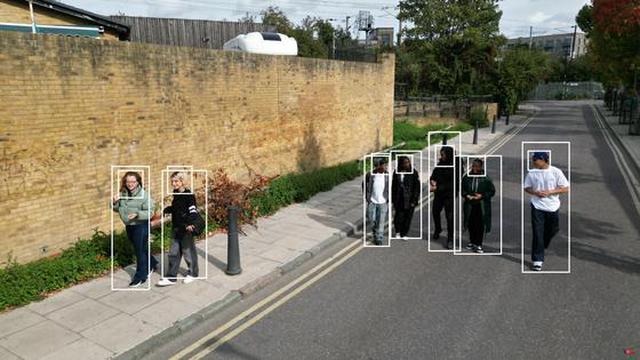
Young adults are walking on a street. Two young women are on the pavement to the left of the image and five young men walk in the road. The road is empty of traffic and the people in the picture are relaxed and appear to be engaged in chatting with each other.  Overlaid on the image are identification boxes. All of the figures have ID boxes around them.
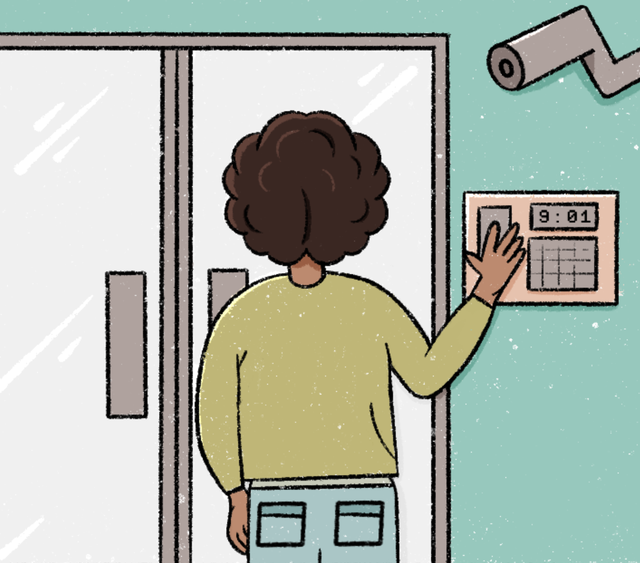
The back of an individual is shown as they are placing their hand on a finger print scanner. In the right corner, there is also a CCTV surveillance camera which is directed at the individual.

Comuzi / Better Images of AI / CC BY 4.0 (left) & Reihaneh Golpayegani & Digit / Better Images of AI / CC BY 4.0 (right)

‘Surveillance View A’ by Comuzi shows how information can be found about people using biometrics based on computer vision technology, and how unaware they might be. Reihaneh Golpayegai & Digit’s image ‘Surveillance’ presents the increasing use of biometric and security surveillance such as facial recognition and fingerprint scanning to track individuals in the workplace. This blog post by Berk Alkoc also comments on how Emily Rand and LOTI’s image, AI City, visualises how extractive data harvesting facilitates tech companies to exclude, surveil, and target individuals. 

Better Images of AI and Possible Futures

The AI Resist List is not only focused on AI resistance, but also collates projects which are collectively imagining better tech futures, ‘rooted in justice and regeneration for people and the planet’. We hope that our image library prompts people to better think about the alternative futures and trajectories of AI that could exist. While our image library is focused on visualising AI here and now, not in the future, some of our blog posts (see here and here) feature more speculative visions for a more equitable future—with or without AI. 

What’s next? Better Postcards of AI?

Following the UK AI Resist List launch, with the support from Design Informatics and We and AI, we will soon be launching a creative fundraiser to help support the running of the Better Images of AI library. We’ll be raising money by selling postcards of the various images in our library in packs centred around themes like power, rainbows, and sustainability. There will also be stickers sold in packs by We and AI & friends. We hope to be launching the fundraiser in September, we’ll announce it in our newsletter, blog, and LinkedIn so be sure to keep an eye out.  
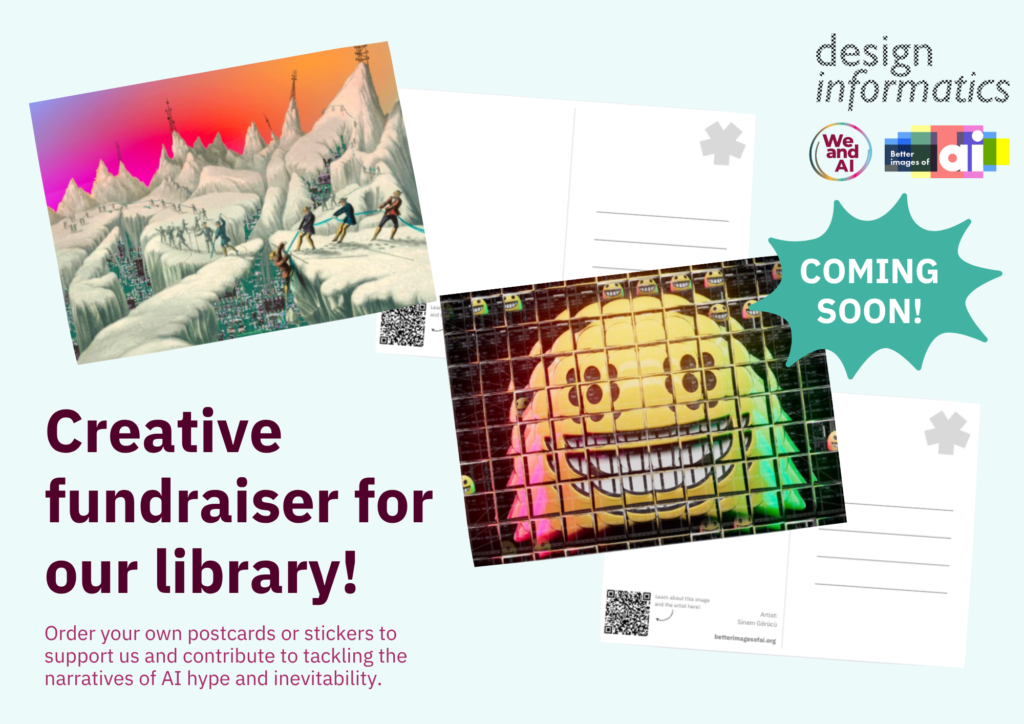
Two postcards with are displayed each with one of the images from the library. The one on the left is Hanna Barakat's 'Data Mining' visual and the one on the right is Alan Warburton's 'Social Media' image. The logos for Design Informatics, We and AI and Better Images of AI are in the corner. A bubble with the text 'COMING SOON!' is beneath. In the corner, text reads: 'Creative fundraiser for our library!' in large dark text as a heading, following 'Order your postcards or stickers to support us and continue to contribute to tackling the narratives of AI hype and inevitability.


Winners of public competition with Cambridge Diversity Fund announced

An image with the text 'Winners Announced!" at the top in maroon. Below it in slightly lighter purple text it states: 'Reihaneh Golpayegani for Women and AI' and 'Janet Turra for Ground Up and Spat Out'. Their two images are positioned on the image at a slant each in opposite directions. At the bottom, there is a maroon banner with the text 'University Diversity Fund' in white, the CFI logo in white, and the Better Images of AI logo.

At the end of 2024, we launched a public competition with Cambridge Diversity Fund calling for images that reclaimed and recentred the history of diversity in AI education at the University of Cambridge.

We were so grateful to receive such a diverse range of submissions that provided rich interpretations of the brief and focused on really interesting elements of AI history.

Dr Aisha Sobey set and judged the challenge, which was enabled by funding from Cambridge Diversity Fund. Entries were judged on meeting the brief, the forms of representation reflected in the image, appropriateness, relevance, uniqueness, and visual appeal.

We are delighted to announce the winners and their winning entries:

First Place Prize

Awarded to Reihaneh Golpayegani for ‘Women and AI’

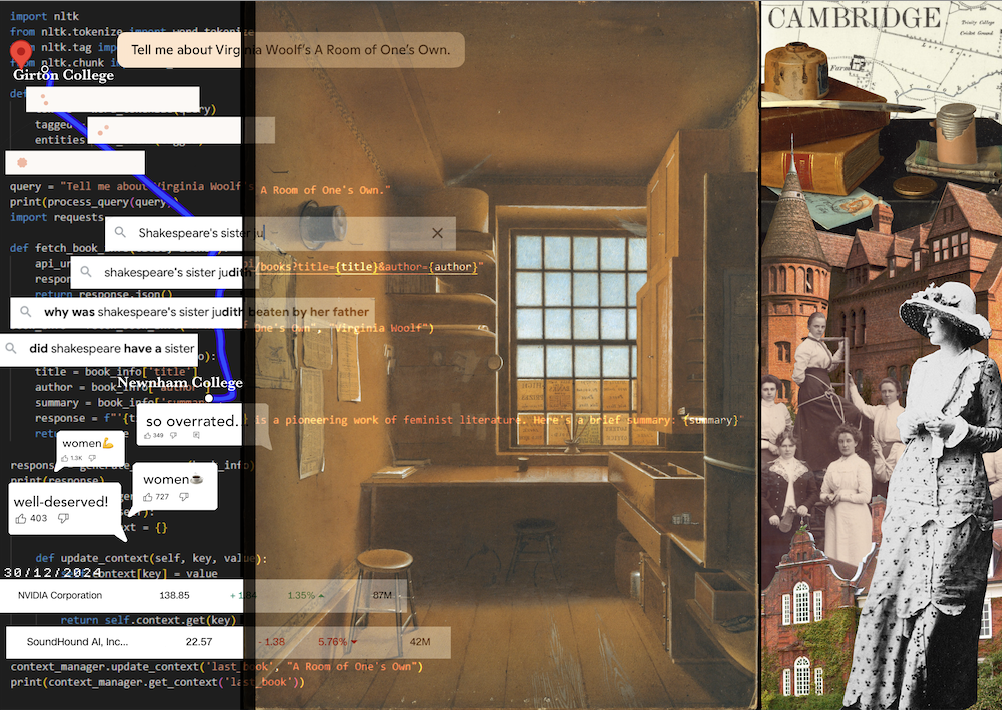
The left side incorporates a digital interface, showing code snippets, search queries, and comments referencing Woolf’s ideas, including discussions about Shakespeare’s fictional sister, Judith. The overlay of coding elements highlights modern interpretations of Woolf’s work through the lens of data and AI.

The center depicts a dimly lit, minimalist room with a window, dessk, and wooden floors and cupboards. The right side features a collage of Cambridge landmarks, historical photographs of women, and a black and white figure in Edwardian attire. There is a map of Cambridge in the background, which is overlayed with images of old fountain pens and ink, books, and a handwritten letter.

This image is inspired by Virginia Woolf’s A Room of One’s Own. According to this essay, which is based on her lectures at Newnham College and Girton College, Cambridge University, two things are essential for a woman to write fiction: money and a room of her own. This image adds a new layer to this concept by bringing it into the Al era.

Just as Woolf explored the meaning of “women and fiction”, defining “women and AI” is quite complex. It could refer to algorithms’ responses to inquiries involving women, the influence of trending comments on machine stereotypes, or the share of women in big tech. The list can go on and involve many different experiences of women with AI as developers, users, investors, and beyond. With all its complexity, Woolf’s ideas offer us insight: Allocating financial resources and providing safe spaces-in reality and online- is necessary for women to have positive interactions with AI and to be well-represented in this field.

Download ‘Women and AI’ from the Better Images of AI library here

About the artist:

Reihaneh Golpayegani is a law graduate and digital art enthusiast. Reihaneh is interested in exploring the intersection of law, art, and technology by creating expressive artworks and pursuing my master’s studies in this area.

Commendation Prize

Awarded to Janet Turra for ‘Ground Up and Spat Out’

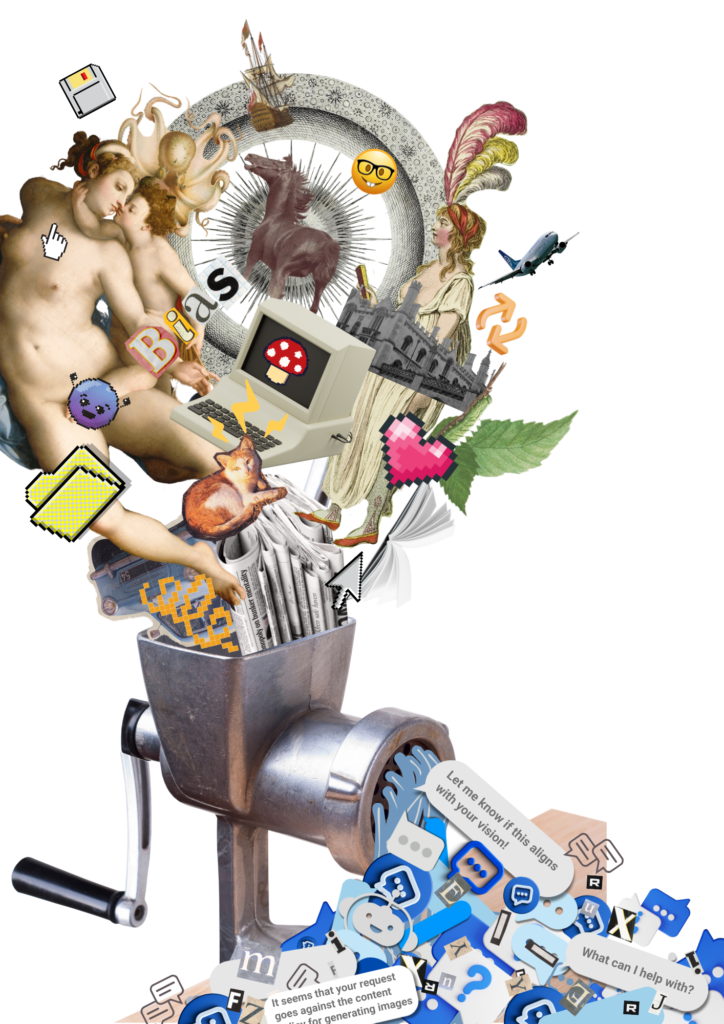
The outputs of Large Language Models do seem uncanny often leading people to compare the abilities of these systems to thinking, dreaming or hallucinating. This image is intended to be a tongue-in-cheek dig, suggesting that AI is at its core, just a simple information ‘meat grinder,’ feeding off the words, ideas and images on the internet, chopping them up and spitting them back out. The collage also makes the point that when we train these models on our biased, inequitable world the responses we get cannot possibly differ from the biased and inequitable world that made them.

Download ‘Ground up and Spat Out’ from the Better Images of AI library here.

About the artist:

Janet Turra is a photographer, ceramicist and mixed media artist based in East Cork, Ireland. Her fine arts career spans over 25 years, a career which has taken many turns in rhythm with the changing phases of her life. Continually challenging the concept of perception, however, her art has taken on many themes including self, identity, motherhood and more recently our perception of AI and how it relates to the female body. 

Background to the competition

Cambridge and LCFI researchers have played key roles in identifying how current stock images of AI can perpetuate negative gender and racial stereotypes about the creators, users, and beneficiaries of AI.

The winning entries will be used for outward-facing posting on social media, University of Cambridge websites, internal communications on student sites and Virtual Learning Environments. They will also be made available for wider Cambridge programs to use for their teaching and events materials. They are also both available in the Better Images of AI library here and here for anyone to freely download and use under a Creative Commons License.

“This project grew from the desire of CFI and multiple collaborations with Better Images of AI to have better images of AI in relation to the teaching and learning we do at the Centre, and from my research into the ‘lookism’ of generative AI image models. I am hopeful that the process has been valuable to illuminate different challenges of doing this kind of work and further that the images offer alternative and exciting perspectives to the representation of diversity in learning and teaching AI at the University.” – Aisha Sobey, University of Cambridge (Postdoctoral Researcher)

An additional collection of images from Hanna

As part of this project, collage artist and scholar, Hanna Barakat, was commissioned to design a collection of images which draw upon her work researching AI narratives and marginalised communities to uncover and reclaim diverse histories. You can find the collection in the Better Images of AI library and we’ll also be releasing an additional blog post which focuses on Hanna’s collection as well as the challenges/reflections on this competition brief.

Press release: New playbook released to enable creation of images of AI using free and open licence digital heritage collections from around the world


  • Archival Images of AI project enables the creation of meaningful and compelling images of AI
  • New playbook includes 38 pages of guidance and sources of free to use archive images
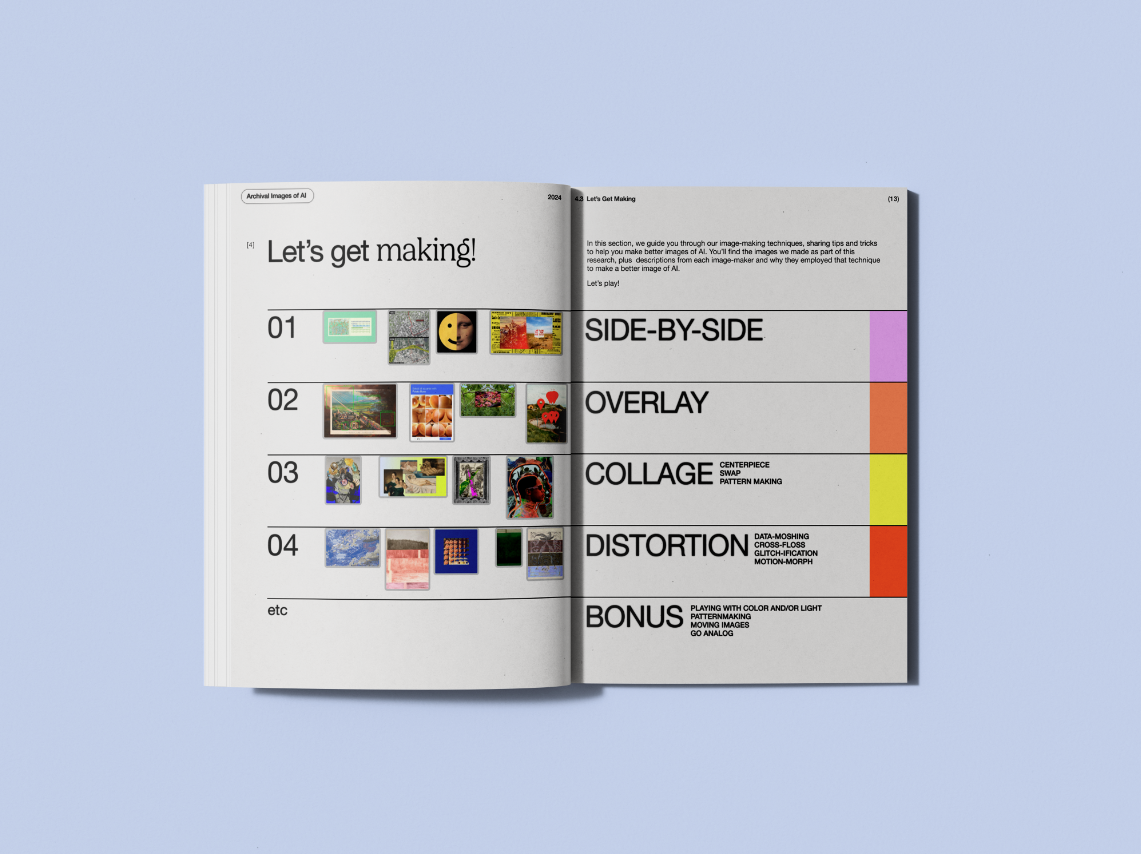
  • Showcases methods and tips for remixing archive images which can be used by anyone 
  • Inspirational artists have created free-to-use examples of their own interpretations of AI 

LONDON / AMSTERDAM 4th December 2024: As AI continues to make headlines and evolve in ways that impact the general public, global critical AI research community AIxDESIGN has released a research-informed playbook for remixing free and open licence images to create better images of artificial intelligence. It uses techniques that anyone can apply without the use of AI image generators.

Producing accurate images of AI – whether this is technically accurate or suitable for any given narrative or situation, is not always easy without an illustrator or access to a wide variety of images that can be easily edited or remixed. AIxDESIGN, in partnership with Netherlands Institute for Sound & Vision with inspiration from Better Images of AI and support from We and AI have released a playbook as a guide to address this challenge by working with free images from consented archives around the world and artists immersed in expressing their experiences and understanding of the technology.

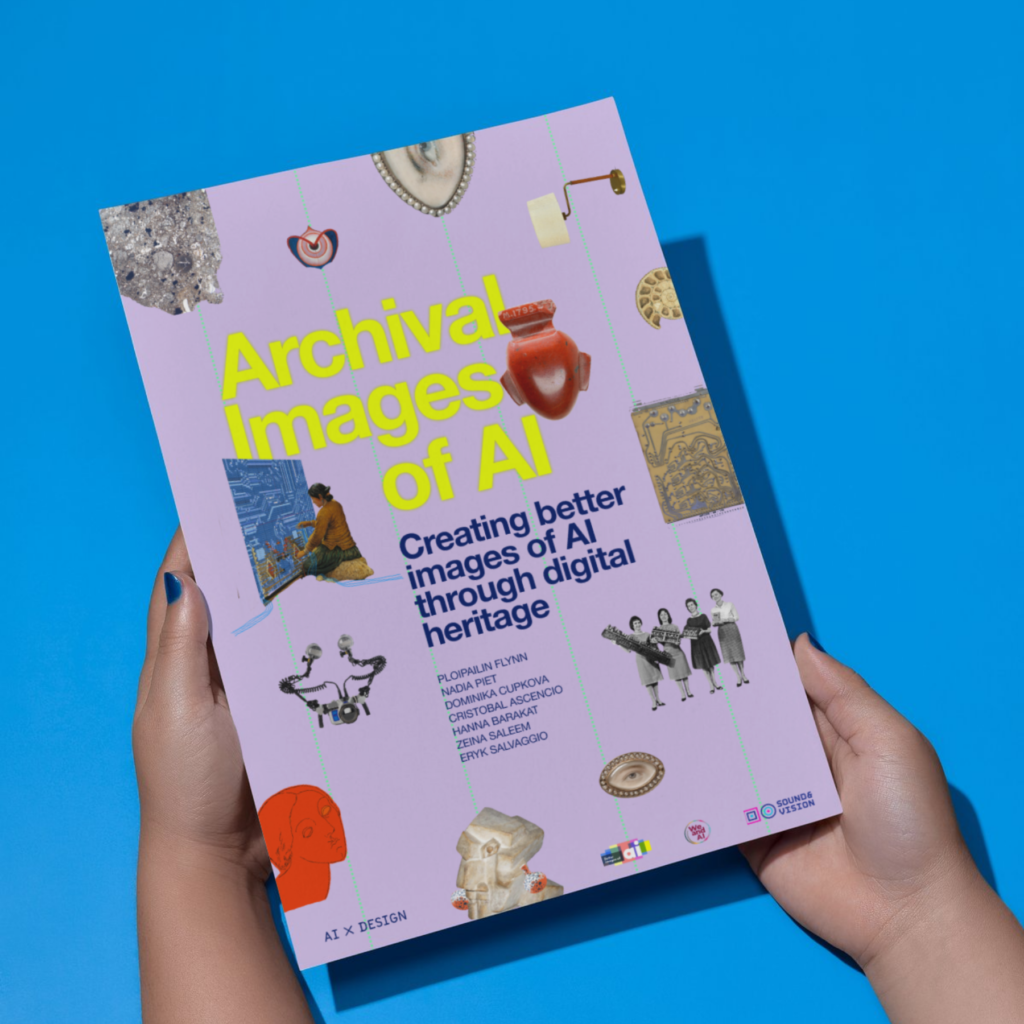
Archival Images of AI Playbook

The playbook includes vital information about the use of archive images as well as details about the creation and representation of artificial intelligence through visual narratives. The project builds on the principles outlined in Better Images of AI: A Guide for Users and Creators that explain why accuracy is important when it comes to communicating these technologies to the wider public. 

By making poor choices about how AI is visualised, communications from media to marketing often risk misinforming or misleading the public about how it works, what it means and the impact it can have. The playbook offers new ways to interpret images of AI by engaging with cultural archives to explore historical and social context. It also has sources of visual stimuli and motifs that can be used freely and with open licences by anyone seeking to illustrate their writing or communicate AI news and reflection. 

A highly creative and reflective selection of artists and researchers have contributed to the guide to offer tutorials and examples, including: 

Hanna Bakarat, researcher, activist and collage artist. She’s been deep in researching narratives of AI and exploring collage as an act of resistance. 

Cristóbal Ascencio, a Mexican visual artist. As a photographer, his practice explores new forms of image making such as virtual reality, data manipulation and photogrammetry. 

Zeina Saleem, graphic designer interested in data beautification and the aesthetics of algorithmic distortion. 

Dominika Čupková, interdisciplinary artist and researcher connecting the dots between AI, art, design and feminism.

Nadia Piet, Nadia is an independent researcher, designer, and co-founder and creative director of AIxDESIGN. 

The playbook is available for anyone to download and is accompanied by detailed artist logs available at https://aixdesign.co/posts/archival-images-of-ai. Readers can explore the works’ origins and development and input from Eryk Salvaggio, Cees Martens, Isabel Beirigo, Monique Groot, Danny van Zuijlen, Alice Isaac, Anne Fehres and Luke Conroy.

The playbook is launched at an interactive event where attendees have an opportunity to test and play with the techniques and interact with the artists. 

A varied and powerful selection of over 25 of the images created by the artists will be added to the free Better Images of AI image library where any individual or publication can use the images for free. 

The playbook can be downloaded at https://aixdesign.co/posts/archival-images-of-ai and https://thistle-oriole.pikapod.net/archival-images-of-ai-playbook/.

About Netherlands Sound & Vision

The Netherlands Institute for Sound & Vision is a knowledge institute in the field of media culture and audiovisual archiving. It specialises in cultural programming, educational offering and research that makes media heritage available, searchable and relevant. Learn more at https://www.beeldengeluid.nl/en. 

About AIxDESIGN 

​​​​​AIxDESIGN (AIxD) is a global community of designers, researchers, creative technologists, and activists using AI in pursuit of creativity, justice and joy and living lab exploring participatory, slow, and more-than-corporate AI. Learn more at aixdesign.co.

About Better Images of AI Better Images of AI is a global non-profit collaboration which curates and commissions stock images that avoid perpetuating unhelpful myths about artificial intelligence, downloadable for free. It provides guidelines and research and creates a space for imaging and creating more inclusive, transparent and realistic visual representations of AI themes and technologies, avoiding overused cliches and alienating, disempowering tropes. It was launched in 2021 with input from a global community of researchers, practitioners and institutions including BBC R&D and coordinated by We and AI.

Better Images of AI’s Student Stewards

Better Images of AI is delighted to be working with Cambridge University’s AI Ethics Society to create a community of Student Stewards. The Student Stewards are working to empower people to use more representative images of AI and celebrate those who lead by example. The Stewards have also formed a valuable community to help Better Images of AI connect with its artists and develop its image library. 

What is Cambridge University’s AI Ethics Society? 

The Cambridge University AI Ethics Society (CUAES) is a group of students from the University of Cambridge who share a passion for advancing the ethical discourse surrounding AI. Each year, the society choses a campaign to support and introduces its members to the issues that these organisations are trying to solve through events and workshops. In 2023, CUAES supported Stop Killer Robots. This year, the Society chose to support Better Images of AI. 

The Society’s Reasons for Supporting Better Images of AI 

The CUAES committee really resonated with Better Images of AI’s mission. The impact that visual media can have on public discourse about AI has been overlooked – especially in academia where there is a focus on written word. Nevertheless, stock images of humanoid robots, white men in suits and the human brain all embed certain values and preconceptions about what AI is and who makes it. CUAES believes that Better Images of AI can help cultivate more thoughtful and constructive discussions about AI. 

Members of the CUAES are privileged enough to be fairly well-informed about the nuances of AI and its ethical implications. Nevertheless, the Society has recognised that even its own logo of a robot incorporates reductive imagery that misrepresents the complexities and current state of AI. Therefore, from oversights in its own decisions, CUAES saw that further work needed to be done.

CUAES is eager to share the importance of Better Images of AI to industry actors, but also members of the public whose perceptions will likely be shaped the most by these sensationalist images. CUAES hopes that by creating a community of Student Stewards, they can disseminate Better Images of AI’s message widely and work together to revise their logo to better reflect the Society’s values. 

The Birth of the Student Steward Initiative

Better Images of AI visited the CUAES earlier this year to introduce members to its work and encourage students to think more critically about how AI is represented. During the workshop, participants were given the tough task to design their own images of AI – we saw everything from illustrations depicting how generative AI models are trained to the duality of AI being symbolised by the ying and yang. The students who attended the workshop were fascinated by Better Images of AI’s mission and wanted to use their skills and time to help – this was the start of the Student Steward community. 

A few weeks after this workshop, individuals were invited to a virtual induction to become Student Stewards so they could introduce more nuanced understandings of AI to the wider public. Whilst this initiative has been borne out of CUAES, students (and others) from all around the globe are invited to join the group to shape a more informed and balanced public perception of AI.

The Role of the Student Stewards

The Student Stewards are on the frontline of spreading Better Images of AI’s mission to journalists, researchers, communications professionals, designers, and the wider public. Here are some of the roles that they champion: 

  1. The Guidance Role: if our Student Stewards see images of AI that are misleading, unrepresentative or harmful, they will attempt to contact authors and make them aware of the Better Images of AI Library and Guide. The Stewards hope that they can help to raise awareness of the problems associated with the images used and guide authors towards alternative options that avoid reinforcing dangerous AI tropes. 
  1. The Gratitude Role: we realise that it is equally as important to recognise instances where authors have used images from the Better Images of AI library. Images from the library have been spotted in international media, adopted by academic institutions and utilised by independent writers. Every decision to opt for more inclusive and representative images of AI plays a crucial role in raising awareness of the nuances of AI. Therefore, our Stewards want to thank authors for being sensitive to these issues and encourage the continuous of the library. 
  1. Connecting with artists: the stories and motivations behind each of the images in our library are often so interesting and thought provoking. Our Student Stewards will be taking the time to connect with artists that contribute images to our library. By learning more about how artists have been inspired to create their works, we can better appreciate the diverse perspectives and narratives that these images provide to wider society. 
  1. Helping with image collections: Better Images of AI carefully selects the images that are chosen to be published in its library. Each image is scrutinised against the different requirements to ensure that they avoid reinforcing harmful stereotypes and embody the principles of honesty, humanity, necessity and specificity. Our Student Stewards will be assisting with many of the tasks that are involved from submission to publication, including liaising with artists, data labelling, evaluating initial submissions, and writing image descriptions. 
  1. Sharing their views: Each of our Student Stewards come with different interests related to AI and its associated representations, narratives, benefits and challenges. We are eager for our students to share their insights on our blog to introduce others to new debates and ideas in these domains.

As Better Images of AI is a non-profit organisation, our community of Stewards operate on a voluntary basis but this does allow for flexibility around your other commitments. Stewards are free to take on additional tasks based on their own availability and interests and there are no minimum time requirements for undertaking this role – we are just grateful for your enthusiasm and willingness to help! 

If you are interested in becoming a Student Steward at Better Images of AI, please get in touch. You do not need to be affiliated with the University of Cambridge or be a student to join the group.

What do children think AI looks like?

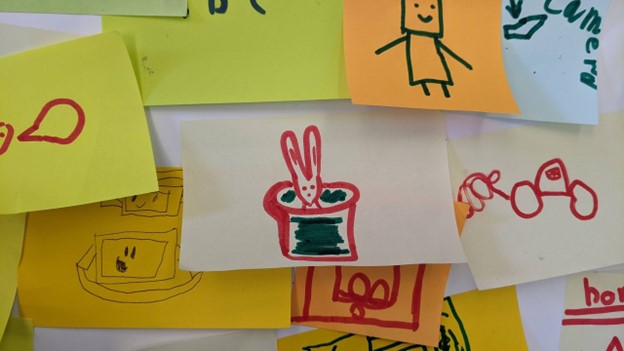
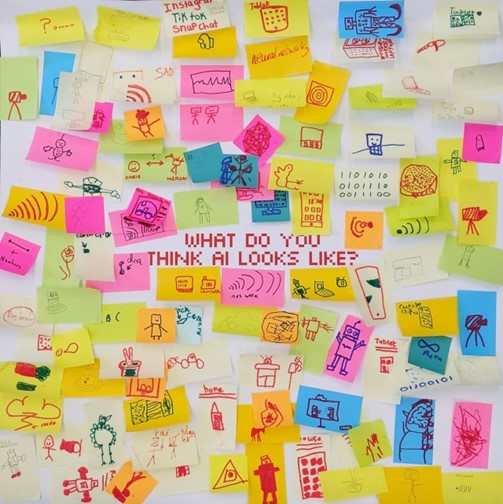
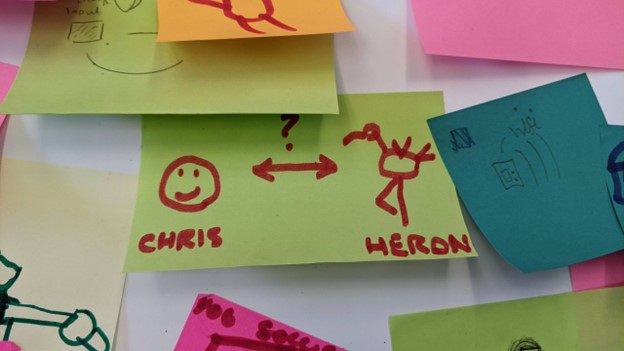
Selection of Post-It notes representing childrens views of AI

The BBC Research and Development team asked hundreds of children this question as part of their Get Curious event at the Manchester Science Festival. The event aimed to help children and families understand what AI is and share the interesting ways that it is used at the BBC.

“What do you think AI looks like?”

That was the question we posed to hundreds of children and families passing through the 2022 Manchester Science Festival at the Science and Industry Museum. Representing the work of BBC R&D, we set up shop in the main hall, primed with demos of intelligent wildlife cameras used on BBC productions, and interactive games that explain how AI works.

However, one task was something that all ages could have a go at. We handed each passerby a post it note, asked them to draw what they thought artificial intelligence looked like, and encouraged them to stick it on our wall of AI images.

As well as being an artsy refuge from the busy museum, this collective mind map-come-collaborative art project had a purpose. We wanted to to see how early unhelpful AI image tropes set in, and explore what inspiration can be taken from the youngest of all generations in creating Better Images of AI.

So, with an empty wall, we started collecting drawings.

With such a range of ages and understanding of artificial intelligence, a lot of this exercise involved the team helping kids understand what AI is and where they might come across it. Getting a 7-year-old to understand what you meant by AI called for a lot of obvious reference points. Talking about apps on smartphones, and voice assistants like Alexa both proved to be useful, and of course, robots! As a result, plenty of sketches of iPads, smart speakers and wacky androids lined the wall.

Some drawings were also inspired by our other activities demonstrating AI. Many latched on to the idea of birds and smart cameras from our wildlife identification demo. A few also tried to represent the confusion seen when AI comes across something it is not trained to recognise.

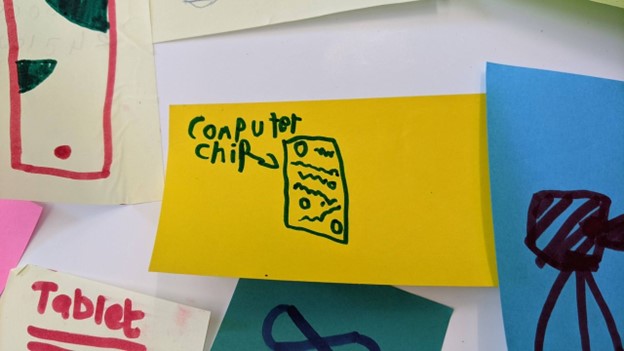
The older children at the festival were also curious about what was going on under the hood. “But how does it actually work?”. These explanations and discussions prompted more literal interpretations of what AI looks like. An overworked laptop, computer chips and even sketches of the streams of coded data.

A number of drawings pulled from the biological tropes of AI, including the classic disembodied brain to make a comparison with human intelligence. Another sketch used a DNA double helix, presumably to represent a kind of ‘programmed’ intelligence. Other less helpful tropes also emerged; to one participant, the answer to “what do you think AI looks like?” was the Meta logo.

My favourite image of AI from the festival came from a father trying to explain AI to his son. “AI is just like…” He paused, before suggesting:

“Magic?”

The two then sketched an image that perfectly encapsulated the wonder of AI, along with the mystery that many feel when faced with results from ‘black box’ algorithms. A rabbit appearing from a magician’s hat. 

At the end of the day, we were left with a wall containing over one hundred creative images of AI. I was also left with two conclusions. Firstly, people’s images of AI are shaped heavily by how AI has been explained to them. If the explanation contains certain tropes, so will their understanding of what AI looks like.

Secondly, asking children, families, and other non-technical people the simple question of “what do you think AI looks like?” showed how curious the public really are about AI. The imaginative responses to this question provide fresh inspiration of what to do — and what not to do — when creating images of AI.

About the Authors

Ben Hughes is a research engineer at BBC R&D. His work in AI and ML has involved research in music information retrieval and creating experiences for explaining machine learning to the general public. The latter work has led to school workshops and outreach on AI education.

Tristan Ferne is the lead producer for the Internet Research & Future Services team where he develops and runs projects that use technology and design to prototype the future of media. He has over 15 years experience in R&D for the web, TV and radio. 

Learn more about this project

This project was conducted as part of a BBC R&D’s Get Curious event at the Manchester Science Festival. The event aimed to help children and families understand what AI is and share the interesting ways that it is used at the BBC.

Illustrating the Materiality of AI

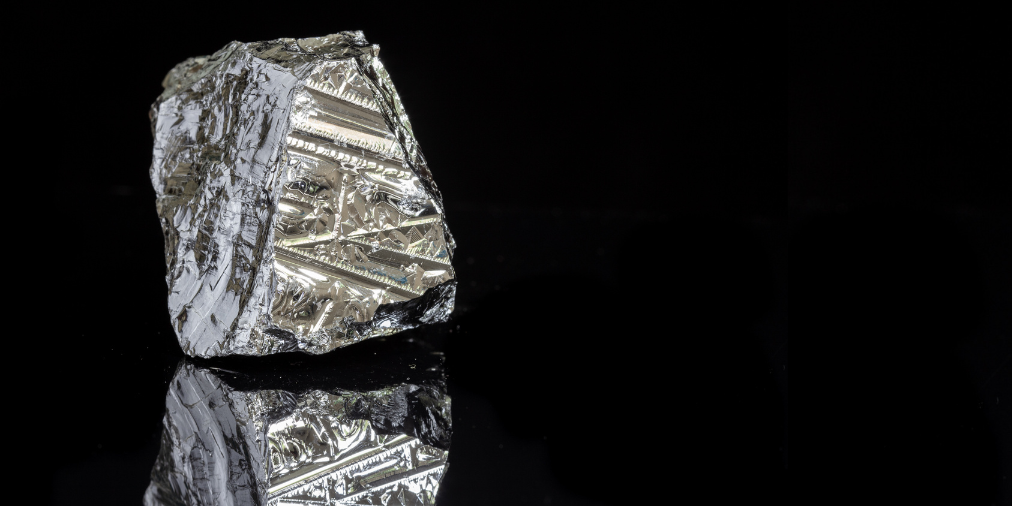
Silicon block on a plain black background

The physical materials involved in designing, producing, and running artificially intelligent systems are all-too-frequently largely absent from discussions of AI itself. As a result, the implications of AI’s intense materiality continue to be overlooked and unremedied.

By picturing the physicality of artificial intelligence within the Better Images of AI repository, with the contributions of Catherine Breslin and Fritzchens Fritz, we hope to foster more accurate representations of these emerging technologies.

Picturing Silicon

Catherine Breslin

Silicon is a crucial component of AI manufacture. A block like the one pictured here would be sliced into 12 inch diameter wafers to form the base of CPUs. Picturing silicon visually illustrates that the ‘mining’ of AI is not purely metaphorical (e.g. data mining) but also a literal, material undertaking. Catherine Breslin, the photographer, operates within the AI supply-chain first-hand in her work as a machine-learning voice engineer and consultant, previously involved in the production of Amazon’s Alexa.

A block of silicon (also known as a mono-crystal) placed on a plain black background and photographed in HD to make its rich, reflective and complex surface visible.
Catherine Breslin / Better Images of AI / Silicon on Black 1 / CC-BY 4.0
A block of silicon (also known as a mono-crystal) placed on a plain black background and photographed in HD to make its rich, reflective and complex surface visible.
Catherine Breslin / Better Images of AI / Silicon Closeup / CC-BY 4.0

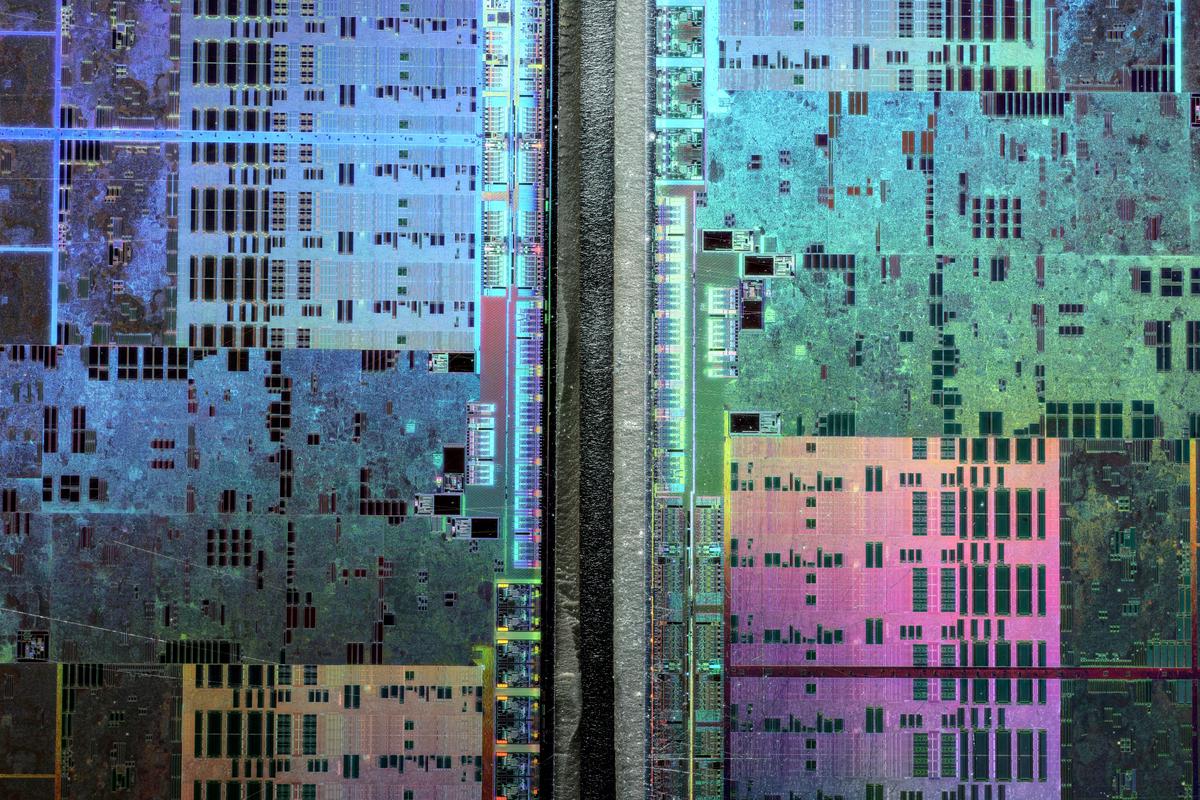
GPUs, etched.

Fritzchens Fritz

Three colorful GPUs with their packaging cleanly removed laying on a white surface
Fritzchens Fritz / Better Images of AI / GPU shot etched 2 / CC-BY 4.0

The GPU (Graphics Processing Unit) is an essential part of modern AI infrastructure. It’s a special type of chip or electronic circuit, originally designed to process images and render graphics and now used for other computational tasks, including training neural networks in deep learning. Die-shots are close-up photographs of computer chips, from which the “packaging“ is removed, usually by undergoing a quite dangerous etching process involving sulfuric acid and high temperatures. The artist has used a combination of external light sources, polarising filters on the camera lense and image post production to create the colourful effect, capturing with this shot three NVIDIA Turing Chips (TU104, TU106, TU116).

Abstract microscopic photography of a Graphics Processing Unit resembling a satellite image of a big city
Fritzchens Fritz / Better Images of AI / GPU shot etched 5 / CC-BY 4.0

Why these images?

Tania Duarte, who coordinates the Better Images of AI collaboration, explains why the project has elected to commission and include these images as part of their repository:

“All too often we see images of AI in virtual, holographic forms, or find ourselves repeatedly presented with circuit brains in shiny 3D outlines suspended in blue space. These images of AI can make the technology seem intangible and ungovernable; something removed from real-world origins and consequences, perhaps even magical.

Catherine Breslin’s striking silicon rock images show the materiality of AI, and allude to the environmental impact: the physical reality of extracting natural resources for the industry and its toll on people and the planet. It also showcases the stunning beauty of the natural rock, in an iconic image echoing the shiny sci-fi robots in representations of AI, but falling much closer to its physical reality.

The next images of GPUs – made from silicon, are fascinating in that they show a further stage in the production of the hardware which enables AI systems. They are also visually compelling, showing a vibrant use of colour much more reflective of the many outputs of AI, and makes me wonder why in trying to make AI exciting, organisations use such limited and cliched colour palettes.”

Press release: Better Images of AI launches a free stock image library of more realistic images of artificial intelligence


  • Non-profit collaboration starts to make and distribute more accurate and inclusive visual representations of AI
  • Follows research showing that current popular images of AI using themes like white human-like robots and glowing brains and blue backgrounds create barriers to understanding of technology, trust, and diversity
  • Available for technical, science, news and general media and marketing communications

December 14, 2021 08:00 AM Coordinated Universal Time (UTC)

LONDON, UK. Today sees the launch of Better Images of AI Image Library, which makes available the first commissioned and curated stock images of artificial intelligence (AI) in response to various research studies which have substantiated concerns about the negative impacts of the existing available imagery.

betterimagesofai.org is a collaboration between various global academics, artists, diversity advocates, and non-profit organisations. It aims to help create a more representative and realistic visual language for AI systems, themes, applications and impacts. It is now starting to provide free images, guidance and visual inspiration for those communicating on AI technologies. 

At present, the available downloadable images on photo libraries, search engines, and content platforms are dominated by a limited range of images, for example, those based on science fiction inspired shiny robots, glowing brains and blue backgrounds. These tropes are often used as inspiration even when new artwork is commissioned by media or tech companies.

The first few images to be released on the library showcase different approaches to visually communicating technologies such as computer vision and natural language processing and to communicating themes such as the role of ‘click workers’ who annotate data use in machine learning training and other human input to machine learning.

A photographic rendering of a young black man standing in front of a cloudy blue sky, seen through a refractive glass grid and overlaid with a diagram of a neural network
Image by Alan Warburton / © BBC / Better Images of AI / Quantified Human / Licenced by CC-BY 4.0
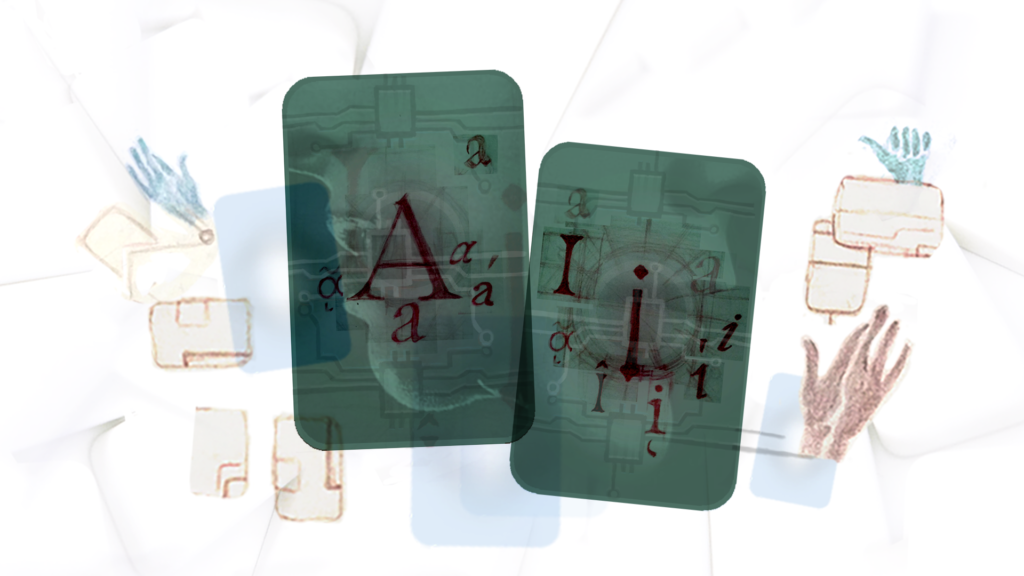
Two digitally illustrated green playing cards on a white background, with the letters A and I in capitals and lowercase calligraphy over modified photographs of human mouths in profile.
Alina Constantin / Better Images of AI / Handmade A.I / Licenced by CC-BY 4.0
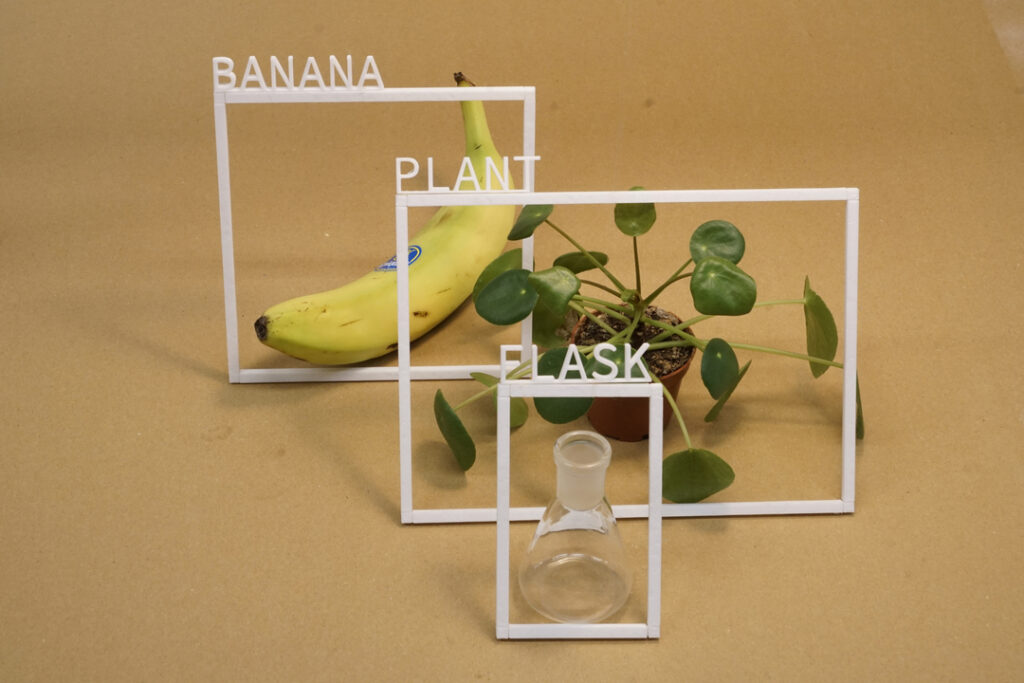
A banana, a plant and a flask on a monochrome surface, each one surrounded by a thin white frame with letters attached that spell the name of the objects
Max Gruber / Better Images of AI / Banana / Plant / Flask / Licenced by CC-BY 4.0

Better Images of AI is coordinated by We and AI and includes research, development and artistic input from BBC R&D, with academic partners Leverhulme Centre for the Future of Intelligence. Founding supporters of the initiative include the Ada Lovelace Institute, The Alan Turing Institute, The Institute for Human-Centred AI, Digital Catapult, International Centre for Ethics in the Sciences and Humanities (IZEW), All Tech is Human, Feminist Internet and the Finnish Center for Artificial Intelligence (FCAI). These organisations will advise on the creation of images, ensuring that social and technical considerations and expertise underpin the creation and distribution of compelling new images.

Octavia Reeve, Interim Lead, Ada Lovelace Institute said:

“The images that depict AI play a fundamental role in shaping how we perceive it. Those perceptions shape the ways AI is built, designed, used and adopted. To ensure these technologies work for people and society we must develop more representative, inclusive, diverse and realistic images of AI. The Ada Lovelace Institute is delighted to be a Founding Supporter of the Better Images of AI initiative.”

Dr. Kanta Dihal, Senior Research Fellow at the Leverhulme Centre for the Future of Intelligence, University of Cambridge said:

“Images of white plastic androids, Terminators, and blue brains have been increasingly widely criticized for misinforming people about what AI is, but until now there has been a huge lack of suitable alternative images. I am incredibly excited to see the Better Images of AI project leading the way in providing these alternatives.”

Dr. Charlotte Webb, Co-founder of Feminist Internet said: 

“The images we use to describe and represent AI shape not only how it is understood in the public imaginary, but also how we build, interact with and subvert it. Better Images is trying to intervene in the picturing of AI so we can expand beyond the biases and lack of imagination embedded in today’s stock imagery.”  

Professor Teemu Roos, Finnish Center for Artificial Intelligence, University of Helsinki said:

Images are not just decoration – especially in today’s fast-paced media environment, headlines and illustrations count at least as much as the actual story. But while it’s easy to call out bad stock photos, it’s very hard to find good alternatives. I’m extremely happy to see an initiative like the Better Images of AI filling a huge gap in the way we can communicate about AI without perpetuating harmful misconceptions and mystification of AI.

David Ryan Polgar, Founder and Director of All Tech Is Human said:

“Visual representation of artificial intelligence greatly influences our overall conception of how AI is impacting society, along with signalling inclusion of who is, and who should be, involved in the process. Given the ubiquitous nature of AI and its broad impact on most every aspect of our lives, Better Images of AI is a much-needed shift away from the intimidatingly technical and often mystical portrayal of AI that assumes an unwarranted neutrality. AI is made by humans and all humans should feel welcome to participate in the conversation around it.”

Tania Duarte, Co-Founder of We and AI said:

“We have found that misconceptions about AI make it hard for people to be aware of the impact of AI systems in their lives, and the human agency behind them. Myths about sentient robots are fuelled by the pictures they see, which are overhyped, futuristic, colonial, and distract from the real opportunities and issues. That’s why We and AI are so pleased to have coordinated this project which will build greater public engagement with AI, and support more trustworthy AI.”

The Better Images of AI project has so far been funded by volunteers at We and AI and BBC R&D, and now invites sponsors, donations in kind and other support in order to grow the repository and ensure that more images from artists from underrepresented groups, and from the global south can be included. 

Better Images of AI invites interest from organisations who wish to know more about the briefs developed as part of the project and to get involved in working with artists to represent their AI projects. They also wish to make contact with artists and art organisations who are interested in joining the project.

Contact

For further information: info (at) betterimagesofai.org

For funding offers: tania.duarte (at) weandai.org

Website: https://www.betterimagesofai.org

Twitter: https://twitter.com/ImagesofAI

Notes

We and AI are a UK non-profit organisation engaging, connecting and activating communities to make AI work for everybody. Their volunteers develop programmes including the Race and AI Toolkit, and AI Literacy & AI in Society workshops. They support a greater diversity of people to get involved in shaping the impact and opportunities of AI systems.
Website: https://weandai.org/ Email: hello (at) weandai.org