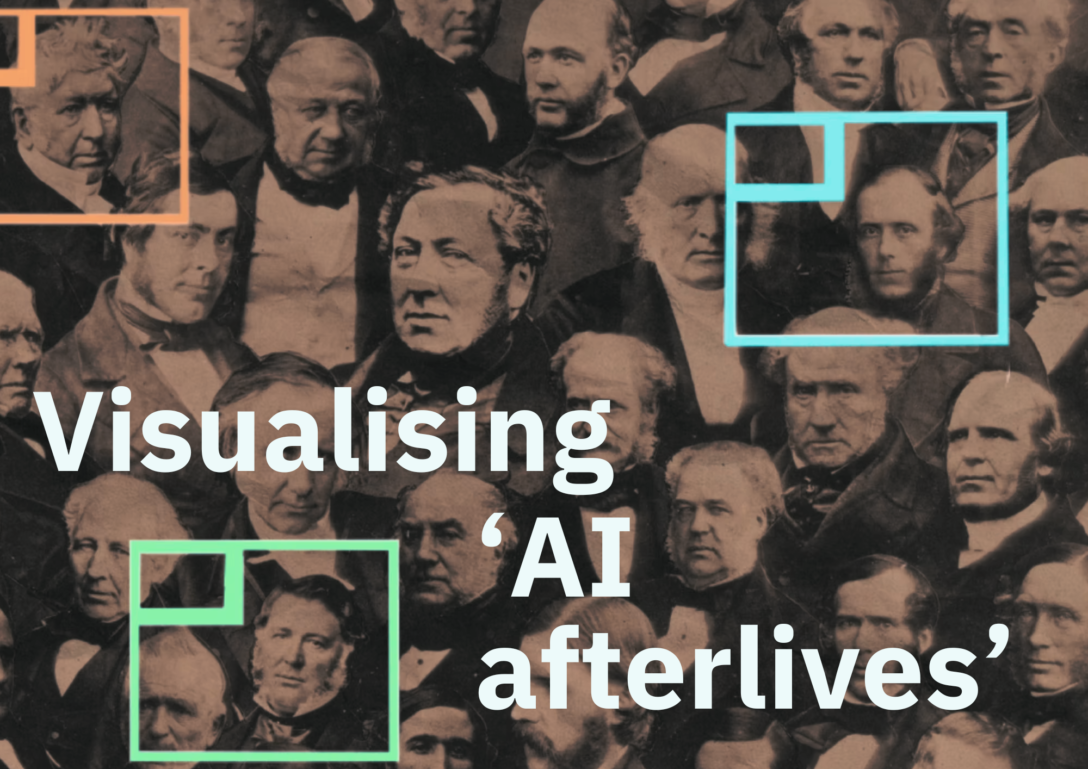
In this blog post, Jenny Kidd and Eva Nieto McAvoy from the Synthetic Pasts project share their own experiences of visualising their research outputs on ‘AI afterlives’. They comment on the need for better visuals to depict the use of generative AI in the digital afterlives and digital memory ‘industry’ (see here). Current stock images are suggestive of human continuance or immortality and represent death as a transition from body to data. To counter these visual tropes, they began using generative AI to create more helpful images, but later found that these images also raised challenges with respect to the way ‘past-ness’ was represented. Later, however, they turned to create their own visuals from archival materials, and while these still remain challenges, the process and outputs enabled more reflection and “encourage[d] us to notice the things that frictionless systems work to erase.” Some of the project’s visuals can be found on the Better Images of AI library, with a larger collection on their own site.
Since 2023, the Synthetic Pasts project has been exploring how AI is being used to animate, or re-animate, persons from the past through the creation of (for example) ‘deathbots’, avatars of historical characters, and voice clones of deceased artists. The project responds to the increasing use of such practices across a range of contexts, whether in museums and heritage sites, on stage and screen, or in our own personal archival and ancestral settings. It is clear that the creation of what we call ‘AI afterlives’ is becoming more mainstream.
The significance of visual tropes used for AI afterlives
One challenge for us as researchers has been how best to visualise our research interests when communicating about this work. Stock images of ‘digital afterlives’ and ‘digital memory’ are full of unhelpful tropes–glowing figures, ghostly spectres, and outstretched hands. These tropes echo those that the Better Images of AI initiative has catalogued so well. In the context of AI afterlives such ghostly spectres are suggestive of human continuance, or even immortality, as if these might be somehow facilitated through the use of AI. However, as we and others working in this area have shown, the ‘afterlife’ that is actually on offer through AI systems (in the ‘digital afterlife industry’) is more an infrastructural one—the survival of our data traces through commercial platforms—than a metaphysical one.
The depiction of glowing human figures, often with their hands outstretched, echoing Michelangelo’s Creation of Adam, is suggestive of human connections through time and into the afterlife and is in keeping with broader imaginaries of AI (see, for example, this depiction on the cover of a book about the digital afterlife). The gap separating the two hands, the images suggest, is to be closed by an AI that is capable of overcoming the human limitation and inconvenience of death. Other frequent depictions show spectral figures entering glowing digital portals that remind us of traditional imaginaries that present death not as an ending but as a transition into the afterlife, in this case, a seamless one from body to data. Such imaginaries are shaped by science fiction, and maintain that AI is uniquely placed to solve human problems; in this case, grief and loss.
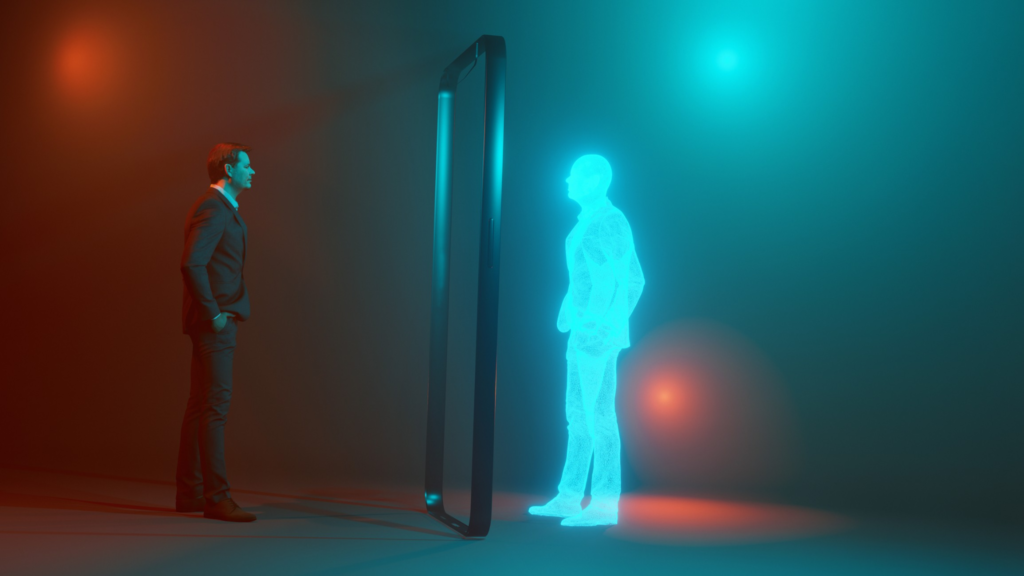
Such visions of AI lose sight of the fact that endings—and forgetting—are important and healthy components of how human memory works.
AI-generated images of ‘AI afterlife’
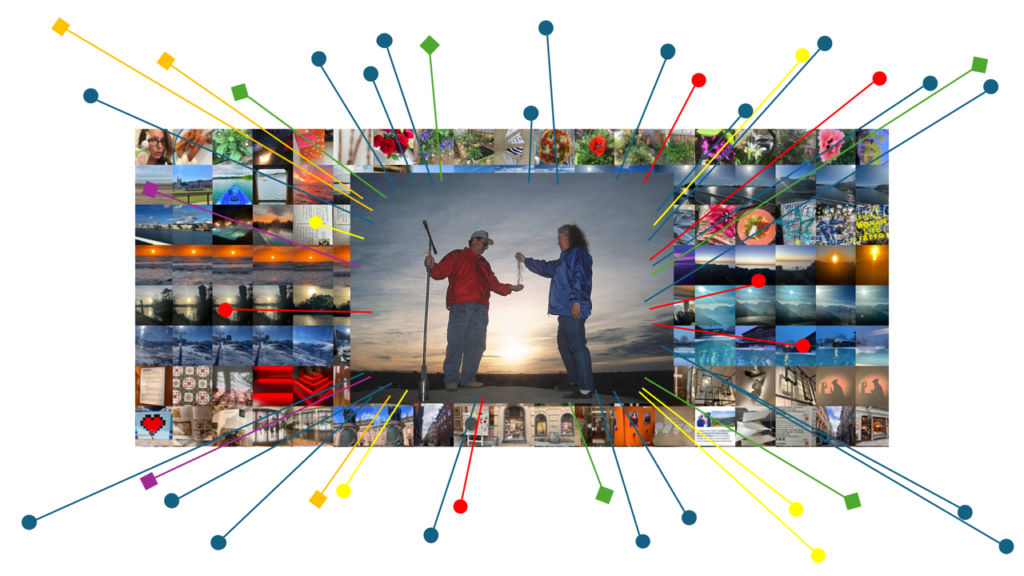
At the start of our project, rather than use such images, we leaned heavily into generative AI imagery in order to try to communicate some of these concerns. At that time Dall-E3’s weirdness and the haunting images produced by Midjourney seemed to usefully make visible our discomfort about how AI might interact with memory. Images of people that never lived, depicted in incoherent places and with evident temporal (dis)locations, were suggestive of the ways memory too can distort and deceive, and of the complex entanglement between remembering and forgetting. Over time these AI-generated images became part of the visual language of our project.
Whilst we have been working on the project however, the pervasiveness and persistence of generative AI imagery has clearly increased. As synthetic media has filtered into social networks, advertising, politics, and even our communications with friends and loved ones, we have been talking more and more about the erosion of trust in images, including historical ones.
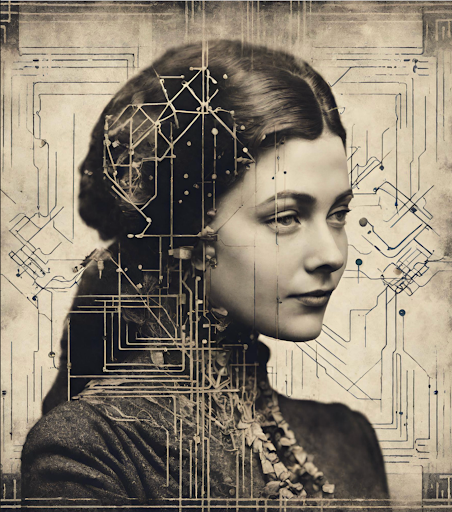
We have been troubled by the ways ‘past-ness’ has been aestheticised and hollowed out by generative AI systems.
In this context, that visual strangeness that once felt uncanny and helpful in the images we were producing has not aged well. Whereas we started using generative AI images to critique synthetic culture and the ethical challenges it presents – e.g., datafiction, exploitation, or bias – over time, our AI-generated images have themselves become a part of the problem.
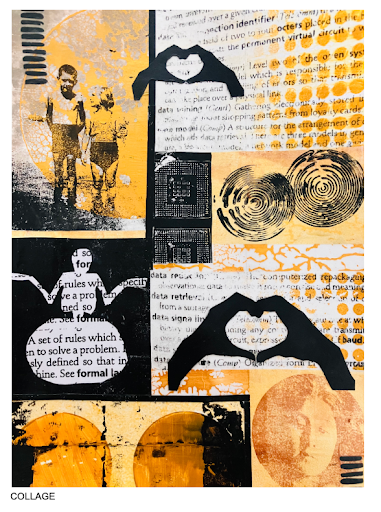
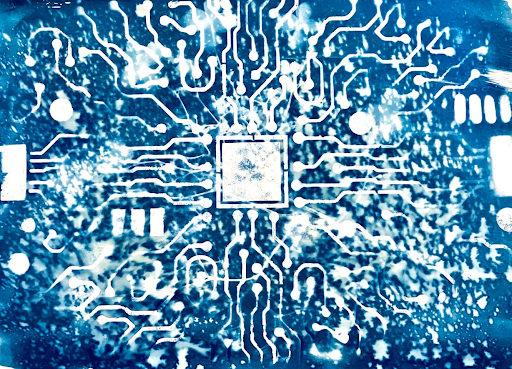
So in the closing months of our project we are finding new ways of trying to visualise how AI interacts with memory and impacts our understanding of the past. Some of our approaches are digital – making films and games for example, as can be seen on our project website – and others embrace more analogue and hybrid approaches – making zines, prints and collages. A few of the results can be seen on this page.
Working in this way slows us down, draws attention to memory’s affective and material qualities, and encourages us to notice the things that frictionless systems work to erase.
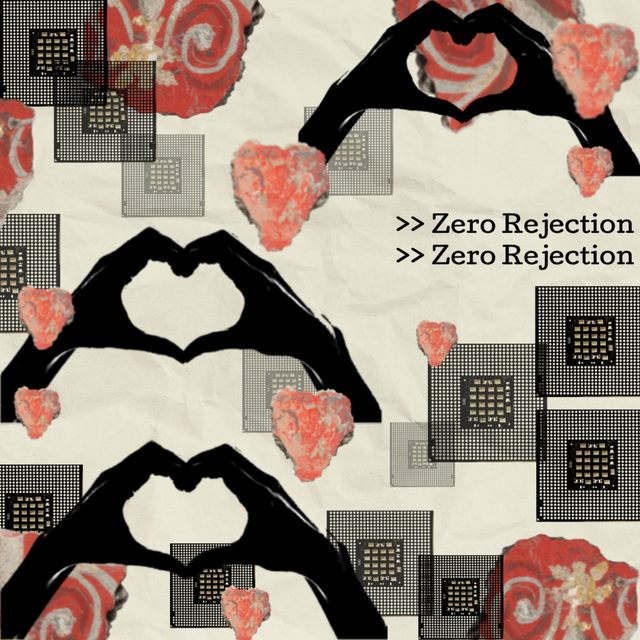
‘The intimacy factory 1′ is one of the images created for the Synthetic Pasts project. It reflects on the increasing use of ‘companion bots’; conversational bots designed to mimic human-like conversations. It references these systems’ synthetic and mechanical qualities, as well as their very real emotional impacts. These systems manufacture intimacy, creating the illusion of bi-directional attachment and even care. The image is compiled in Photopea and includes extracts from four public domain images.
Jenny Kidd & Synthetic Pasts / Better Images of AI / CC BY 4.0
You can find some of the visuals used in the Synthetic Pasts project in the Better Images of AI library; see the collection here.
From AI-generated images to archival images
As a part of this more hands-on exploration, we have been making use of public domain imagery made freely available through online collections, archives, and libraries. This too raises interesting questions that we felt were productive for us at this stage of our project.
Creating collages with archival material entails working with the traces of actual people and moments of the past. This might feel initially similar to what generative AI systems offer, just at a smaller scale. But focusing on individual photographs allows us to become more mindful of the specificity of their historical situatedness. Repurposing these in our work is not a straightforward or neutral process.
For example, the fact that an image is technically and legally available does not automatically make it ethically unproblematic. Such collections—like the AI images they have made possible as source materials—also reproduce multiple biases and inconsistencies. Our reuse of archival material still makes past persons visible for new purposes that are very different from those for which they were originally intended.
The use of archival material forces us to confront questions about who gets to speak for the past and which stories get centred, as well as about consent and dignity. For us, the process of re-working makes these tensions visible, as the choices involved in representing the past become unavoidable. Through this approach archival contradictions and outliers are not glossed over by automated blending, and we are able to see how echoes of the archive reflect in generative AI imagery. As a result we can better advocate for more intentionality and scrutiny of these visions.
“I like that this one is about repetition and homogeneity – this is the nature of archives anyway – and how these AI systems will hardly challenge these constructs with these datasets. Where are the gaps? The non-archived peoples and stories?” – Dr Eva Nieto McAvoy
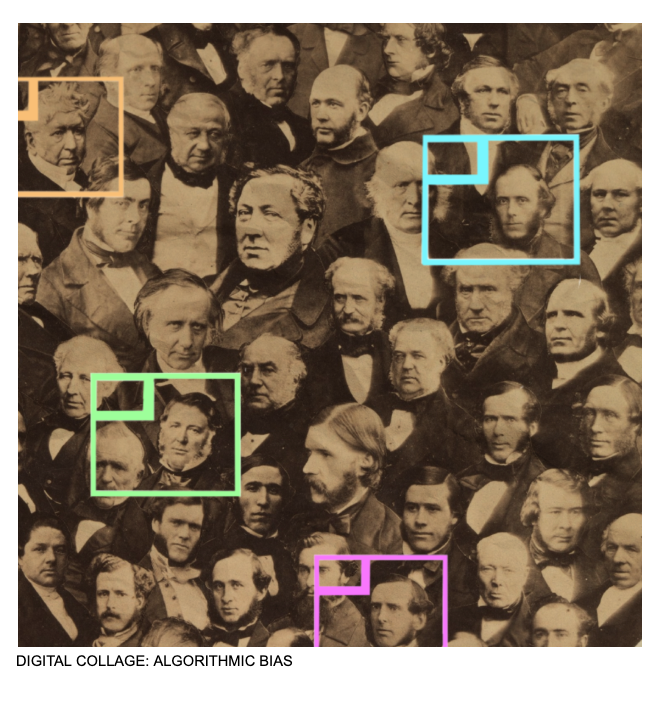
Better images of ‘AI afterlives’
Below are some images created by the Synthetic Pasts researchers to visualise their work:
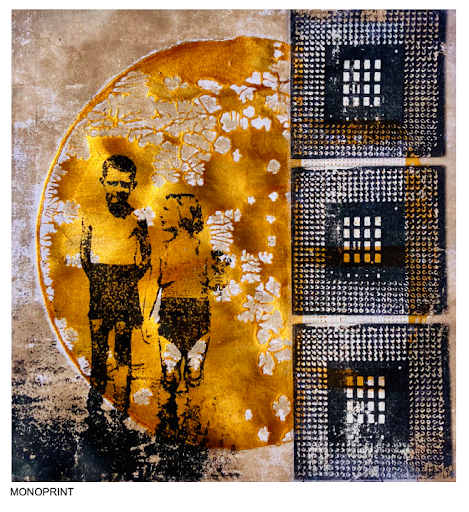
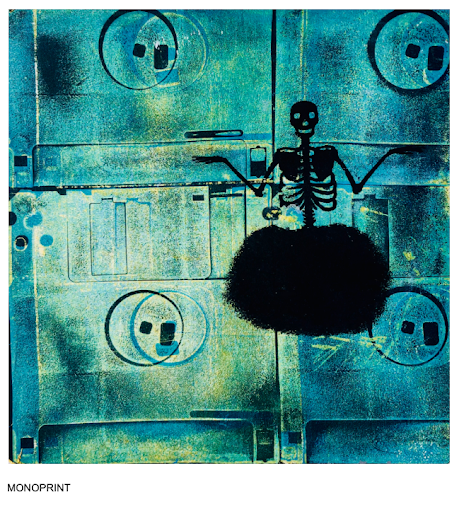
You can see more of the visuals created by the Synthetic Pasts project by scrolling to the bottom of their webpage.
About the authors
Jenny Kidd is a Reader in the School of Journalism, Media and Culture at Cardiff University and researches in the interdisciplinary fields of Digital Heritage and Digital Culture. She has led applied research projects with a range of practical and other outputs including two immersive experiences, a series of reports for policy makers and industry, and many publications. She is author of Museums in the New Mediascape (2014) and AI Afterlives: digital memory and synthetic pasts (2026). Jenny is Principal Investigator on the Leverhulme Trust-funded Synthetic Pasts project (2024-2026).
Dr. Eva Nieto McAvoy researches digital media and culture, with a focus on the theories and practices of new and interactive media in cultural and memory work at the intersection of knowledge, power, and technology. She has published widely and is co-lead on the Leverhulme Trust funded Synthetic Pasts project and co-author of AI Afterlives: digital memory and synthetic pasts (2026).
About the Synthetic Pasts project
Synthetic Pasts is a critical-creative inquiry into what future(s) for personal and collective memory our algorithmic present anticipates and paves the way for. Funded by the Leverhulme Trust, the project explores how fragments from the past – photos or audio recordings of our deceased relatives for example – are remediated/animated through algorithmic systems, and with what consequences for how we remember and commemorate. The creation of unanticipated ‘afterlives’ in the present has ethical, emotional, and political dimensions, and it is crucial that we critically examine these unprecedented processes, as well as the socio-technical infrastructures and platforms that enable and encourage them (for example, genealogy sites, Amazon, OpenAI and Google).
If you’re interested in Synthetic Pasts, you can explore some of their work below:
Digital story, project overview: Eva Nieto McAvoy introduces the research context and key project concerns in a 5 minute digital story.
The Responsible AI Afterlives Workbook
Kidd, J., Nieto McAvoy, E., Jones, B. and John, A. (2025). The Responsible AI Afterlives
Workbook: exploring AI to ‘revive’ museum collections and engage users. Synthetic
Pasts. https://doi.org/10.5281/zenodo.17619346
AI Afterlives Digital Memory and Synthetic Pasts
Kidd, J., & Nieto McAvoy, E. (2026). Bloomsbury [part of the Bloomsbury Studies in Digital Cultures series].
Synthetic afterlives: Deathbots as affective infrastructures of memory
Kidd, J., & Nieto McAvoy, E. (2025) in Memory, Mind and Media (4), doi:10.1017/mem.2025.10013
Nieto McAvoy, E. & Kidd, J. (2024) in Memory, Mind and Media (3), doi:10.1017/mem.2024.10
Deep Nostalgia: Remediated memory, algorithmic nostalgia and technological ambivalence
Kidd, J., & Nieto McAvoy, E. (2023) in Convergence, 29(3), 620-640. https://doi.org/10.1177/13548565221149839
