
In this post, we discuss how to correctly attribute images downloaded from our image library. It’s the legal requirement under which the images are made freely available, and we think it’s only fair to recognise the community of volunteers and artists who made it possible! Our Attribution Guide includes tips to ensure that you are attributing Better Images of AI’s images without violating the terms of the Creative Commons (CC) BY 4.0 license, and also tricks on making attribution text look best in different formats. If you’re a user of our images, you might also find some interesting examples, and be able to send the Guide to others who might need it.
All the images in the library are available to freely download, even for commercial purposes, via a CC BY 4.0 license. CC is a non-profit that provides open licences that allow creators to share their work under a standard set of terms and conditions. The CC BY 4.0 license gives users the maximum freedom to freely share, use and adapt images in the Better Images of AI library, including for commercial purposes.
However, this is upon the condition that users include the correct form of attribution every time any of the images in the library are used.
Failing to attribute the image violates and terminates the CC license under which the images are provided. We’ve made it easy to include the correct attribution on our image cards which offer a custom plain text and HTML copy and paste attribution.
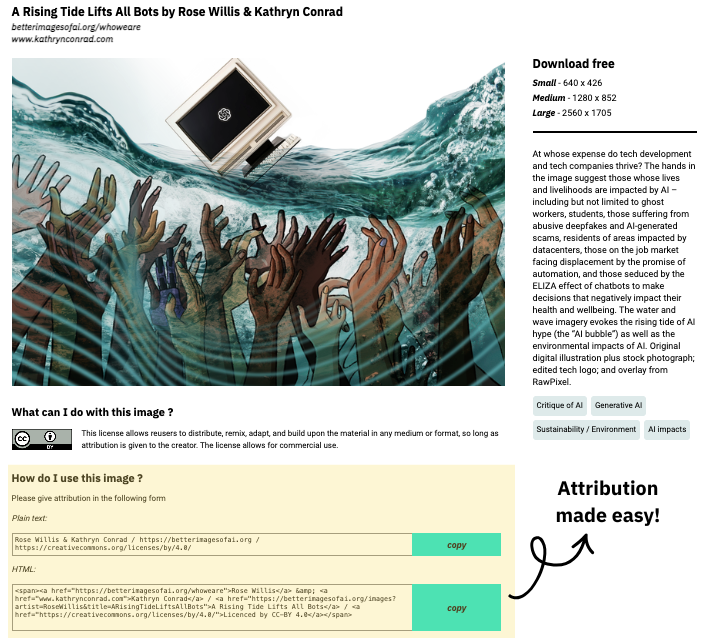
Typically, the correct form of attribution follows the following template: Artist name [& partner if applicable] / https://betterimagesofai.org / https://creativecommons.org/licenses/by/4.0/. Sometimes, users fail to include the hyperlinks to the CC BY 4.0 licence and/or Better Images of AI (reasons why this is important are discussed below). Furthermore, depending on how the image(s) is being used or the display, the attribution might take various forms or appear in different places.
As a result, we’ve created a simple guide to provide you with information and tips on how to attribute Better Images of AI. The guide is a live community working document which we will continue to update as we find more examples and learn best practices about attributing Better Images of AI. Do not hesitate to get in touch if you ever have any questions about attribution or feedback on the guide ([email protected]).
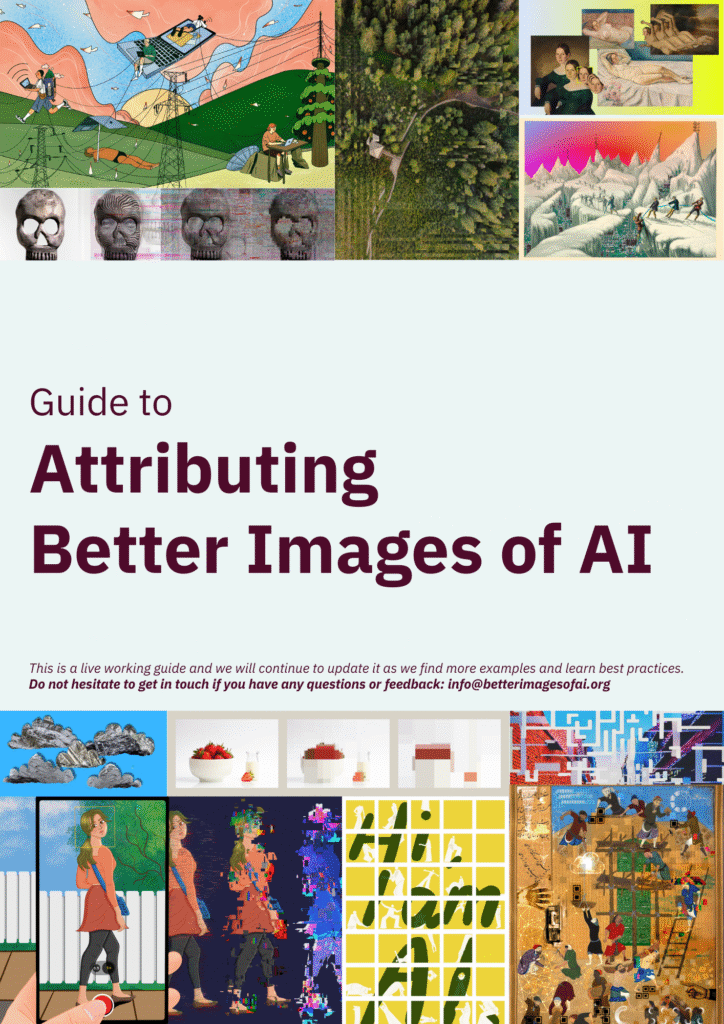
The Attribution Guide includes some quick top tips to attributing Better Images of AI via CC BY 4.0 licenses and a breakdown of examples of attribution best practices depending on display, e.g., social media, presentation slides, blog posts, banners, events, in-print, newsletters, and physical exhibitions.
The Attribution Guide also provides some common examples of insufficient attribution. We’ve outlined them on page 11 to help avoid any easy mistakes.
Why is attribution important?
Attribution is a legal requirement under the CC BY 4.0 license that the images in our library are available under. This licence allows the free use of images, but only if you give an attribution in the correct format which includes a link to the licence, and an indication if any changes that were made. Failing to attribute violates and terminates the CC license under which the images are provided. In particular, providing a (hyper)link to the CC license is important so that others can see the specific terms and conditions under which they are allowed to use and reuse the work.
Attribution is also about fairness and respect for the creators who contribute to the library, frequently by donation. Providing the artist names ensures recognition for creators and helps others to find their works. The purpose of our library is to improve the representation and inclusivity of AI visuals, so by linking to our library, we want to allow others to find our resources, enabling us to challenge the harmful visual tropes of AI by encouraging greater use of alternative images.
As a non-profit, we’re always very grateful when users provide a shoutout to our library to let others know that we exist and the purpose of our community. We are run entirely by volunteers, so we rely on word-of-mouth and the brilliant visuals from our artists to gain a greater presence among the sea of harmful images that feature human brains and humanoid robots pushed by profitable stock image companies.
Is the CC BY 4.0 license the best to use?
The CC BY 4.0 license has been drafted to be internationally valid, and it provides users with the maximum freedom to use images, provided that they include the correct attribution. We believe that this license offers an appropriate balance between protecting creators’ rights and enabling us to pursue our goal of challenging harmful AI tropes reinforced by dominant imagery by creating new visuals to represent AI.
As part of the goal of our community, it is important for us to make the images in the library as accessible as possible for those communicating about AI, such as journalists, marketers, educators and researchers, so they can use alternative images instead of dominant stock imagery, or just explore them as inspiration for more helpful and diverse representations of AI.
This means that we have chosen the CC BY 4.0 license, which makes the images freely available, even for commercial purposes. Commercial entities are part of the main drivers of AI hype and misleading AI tropes, so offering free resources makes it more possible that we can improve the public understanding of the uses and implications of AI.
The CC BY 4.0 license requires users to include the name of the artist in the attribution which we have seen to provide recognition to the creators and helps others find and support their works. Despite common misconceptions, the CC licenses also do not require artists to relinquish the copyright in their work; these licenses are a way to allow others to use your work under specific conditions while the creator retains copyright.
We understand that some artists will (rightly) not want their work to be offered freely for commercial use in our library. We support these artists and their decision to be adequately compensated for their work, time, and efforts. However, in accordance with the objectives of our library, we have decided to make the images widely available for all uses and purposes. We are always open to discussions about how we can better respect the rights of artists and their work, so please get in touch if you have any ideas.
Disclaimer
Any of the information provided in the Attribution Guide does not constitute legal advice. The Attribution Guide has been created by our volunteer community and it serves as informational guidance about our understanding of how to attribute the images in our library in accordance to the CC BY 4.0 license. The Guide is a working document and will be continuously updated as we learn best practices and spot new, innovative ways of displaying our images.
If you spot any mistakes, errors or have suggestions for ways to improve the Attribution Guide, please do get in touch with us by emailing [email protected]. We’d love to hear from you.
Finally, we would like to express the greatest gratitude to Stefan Kaufmann from Wikimedia for providing invaluable comments and thoughts which led to the curation and development of the Attribution Guide.
This Guide is licensed under CC BY 4.0 licence. Please attribute as follows: Guide to Attribution / Better Images of AI and Zoya Yasmine / https://creativecommons.org/licenses/by/4.0/
