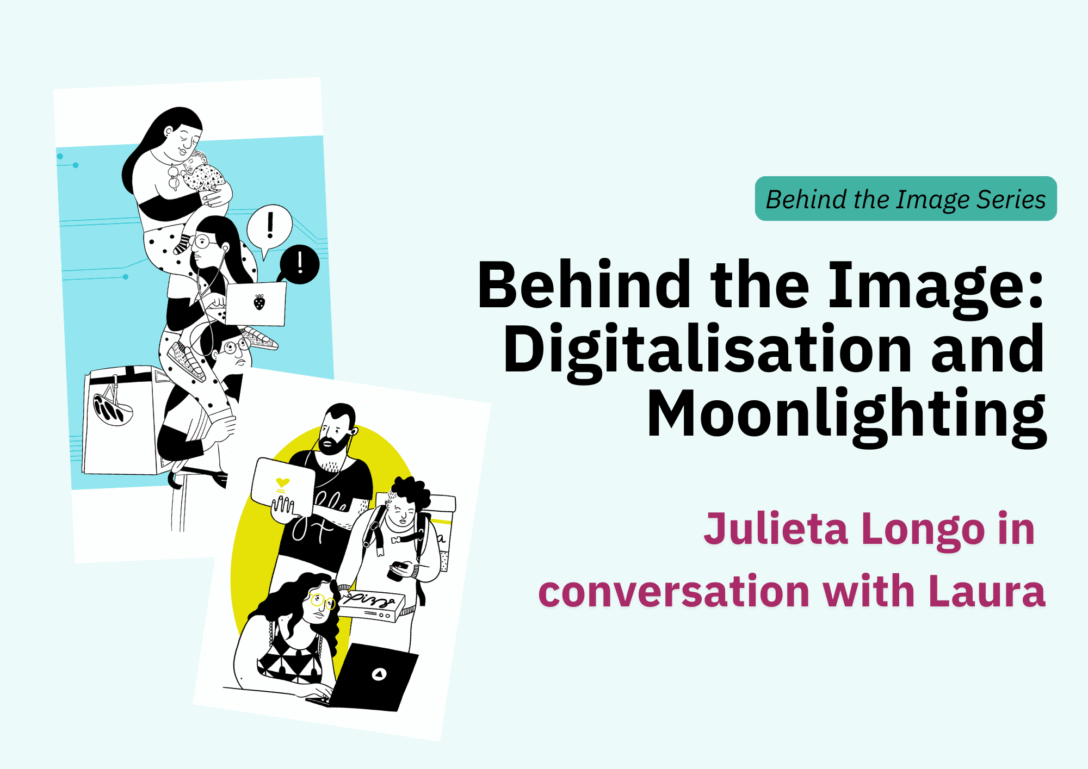
In this blog post, Laura Martinez Agudelo (volunteer steward) chatted to Julieta Longo (artist) behind the series of images ‘Digitalisation and Moonlighting’ that were awarded as a runner-up in the Digital Dialogues competition that we ran this summer.
The aim of the Digital Dialogues competition was to visualise some of the Digit Centre’s research on work and technology. Julieta speaks to the importance of visualising research, advocating for artistic approaches that better represent authenticity and collective experience.
The discussion was conducted in Julieta’s native language, Spanish, which has been translated by Laura in English below. You can access the Spanish version here (albeit in a slightly different format and structure, but all the same content).
The rhythms of life and facets of working life
Digitalisation and Moonlighting (1 and 2) focuses particularly on how precarious jobs affect mothers and people with care responsibilities. Through her graphic choices, Julieta highlights the tensions and the balance between paid and unpaid work, which in many cases is operated and/or mediated by digital platforms and/or artificial intelligence systems.
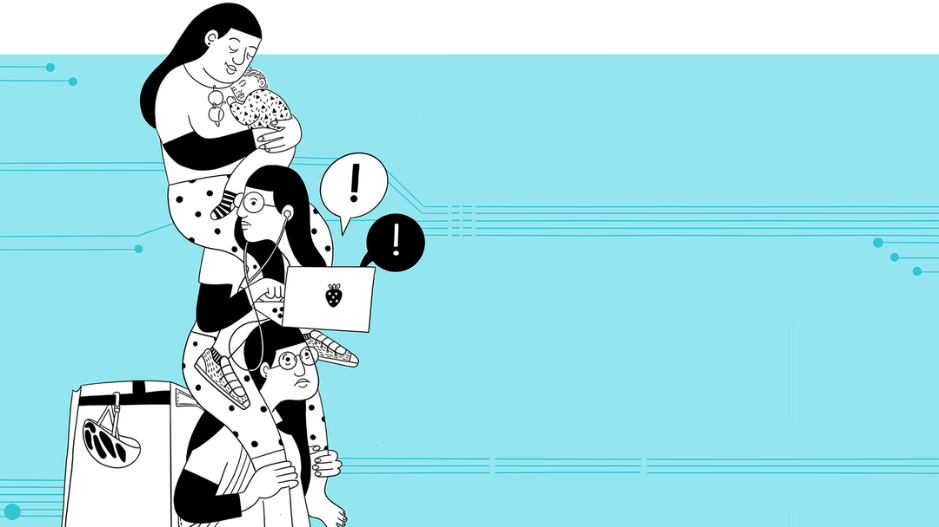
Julieta shares her motivations and the link between her images and the topics she explores in her research and personal life:
“It was an image that was initially intended to reflect on multi-job holding, which is a global issue, but in Argentina in particular it is being hotly debated because incomes have fallen too much in recent years. The use of platforms and remote or distance work has to do with the need to supplement income. It seemed to me, then, to be a central issue for thinking about artificial intelligence and technology. Also, because this type of work does not produce a new type of technological worker, but rather adds to the existing workforce and is often linked to traditional jobs.”
In Digitalisation and Moonlighting, we see a person, a woman, who supports and sustains herself in her many roles. The last step represents the role of mother and seems to finally be in a moment of rest. Julieta’s illustration is a very telling and thoughtful way of bringing various topics into dialogue: gender, informal and remote work, the question of everyday life, time, motherhood and care. This last aspect is also mentioned in the description, and it should be noted that it is not always included in the graphic representation of the theme of the digitalisation of work.
Julieta confesses that she even made this illustration while she was a little tired: “… I drew the last woman looking after the baby with her eyes closed, a little bit tired but also relaxed… because it reflects a very genuine need to organize our time better, to have jobs that allow us to organize ourselves better and, above all, to have more non-working time.”
The inspiration for this work came from a reflection on how to graphically represent the phenomenon of having multiple jobs (moonlighting) in contemporary societies, a situation marked by digitalization, intimate life stories and the time devoted to work. From her point of view, new technologies play a role in transforming our rhythms of life: “there is a certain idea that technologies will allow us not to be in an office all our lives and therefore to organize our lives differently… not to be in a workplace all the time, whether it be an office, factory or shop… I think that the idea of moving away from traditional work and having more time for life is a very important demand that technologies introduce, resolving contradictions and creating new ones.”
As for the illustration process, Julieta created it digitally using Procreate and Adobe Fresco, and she gives us details about the decisions and changes made along the way, as well as the inclusion of self-referential elements, especially the balance between motherhood and remote work:
“I often work remotely, from home or at an office, but not every day. And this, which at first seemed ideal, or at least I thought it was ideal for motherhood, comes with a lot of additional burdens and responsibilities. In fact, I came to romanticize the idea of being able to work and look after my daughter at the same time, even though it wasn’t always possible, but I thought it was nice to work close to my daughter. I think that romanticization is often present in remote working because it allows you to balance different aspects of your life. You are at home and your children are playing nearby, but that balance has many contradictions, and I did not resolve them.”
Returning to her perspective as an illustrator, Julieta tells us that she draws frequently, mainly digitally, and also shares her thoughts on her own artistic practice: “I’m drawing a lot digitally at the moment. I would like to go back to not doing everything digitally, but I find it really difficult, especially because it takes much less time, which raises several contradictions related to technology and work in general.”
Connected, Yet Disconnected
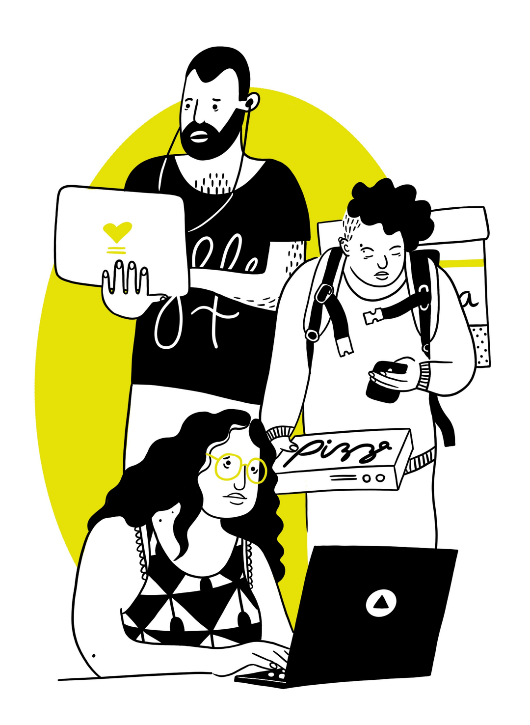
The image ‘Connected, Yet Disconnected’ evokes themes such as the emotional and social isolation of the digital worker and shows the paradox of AI-driven work and spatial disconnection in contemporary employment. Julieta tells us that it is the first image she made for her research, thinking about people who work connected and who are close together, sometimes only momentarily, sharing the same space:
“It is very likely that next to a person working in an office, or as a freelancer, there is someone bringing them food or deliveries. They probably don’t talk or know each other, and sometimes the transaction is very quick, such as delivering food, for example.”
Julieta believes that the space shared between these people is completely fragmented by digital technology. In the first image, we see overlapping people (actually the same person in different roles), but in this one we identify an overlap and spatial convergence of different people who could be very close to each other and, at the same time, working with people who are far away or remotely.
Through this graphic proposal, Julieta seeks to illustrate that: “people are not only close because they are connected. Today there is a very interesting ambiguity, which is that virtual space breaks down physical space a little, and it does so in both directions. It connects us with people who are far away, but it also disconnects us from all the people who are close to us. On the other hand, there are a lot of everyday problems that are solved digitally, breaking the link with the physical world and other strategies for being in it.
I think, for example, of mobility and how I used to travel before I had a mobile phone. The first time I travelled alone, I didn’t have a mobile phone and I spoke to a lot of people to get to the place I had rented. The intention of travelling also has to do with being present in the places I go and getting to know the people who live there, but now I could solve almost everything on my own.”
The same thing happens in the world of work, with digital work and even in the dissemination of knowledge: “Many people who work use a lot of the knowledge produced by others, but the social link has been lost. It is also very positive to have the possibility of socializing knowledge in a very agile and useful way. But I am very nostalgic for everything that has been lost in social terms.”
Visualising Research Through Better Images
Julieta thus revisits the idea of the importance of creating images that can be articulated with research: “… I am somewhat in search of trying to articulate research and illustration, increasingly and better, and also thinking more collectively about this articulation.’ Julieta points out that even for book covers, using meaningful images helps a lot to bring people closer to certain texts, content and topics:
“images could be integrated much more into research, both to disseminate results and to reflect on research results or conduct interviews. I think images have a lot of power, because it is much easier to see whether they represent your reality or not. They also allow for discussion or encourage conversation on certain topics. For example, being able to conduct interviews with images to elicit interactions, testimonials, and make other issues visible.”
It is for these very reasons that when Julieta discovered the Better Images of AI library, she decided to share information about this image bank with her fellow researchers: “ I sent the information about the Better Images of AI image library and database to all the researchers I work with, because I think it’s great and often, we want to incorporate images into our research but we don’t have much artistic training, there isn’t much reflection in general and this type of training doesn’t exist in our fields. So, what we do is use royalty-free images from the internet that seem more or less appropriate.”
Regarding the role of the artist in proposing new visual narratives, Julieta believes that: “There are artists who are artists and who interpret reality very well. There is a certain idea that art captures reality, unconsciously, but I think there could still be more opportunities for dialogue with artists. There are many artists who reflect a lot, based on their own interests, because they read about current affairs or listen to talks according to their preferences. The same thing happens with researchers, who often want their research to be articulated through artistic expression. I think it’s interesting that broader debates begin to take place. It might be a good idea to bring together artists, workers and researchers so that we can think together about the images we want to use to represent reality. Obviously, not all artistic production has to be like this, but I believe that if these dialogues exist, they can encourage more critical reviews of why we are doing things the way we do!”
Julieta believes it is important to have this reflection at a collective level, among illustrators and researchers: “There are many artists who read and question themselves from similar places and topics but from an individual interest. I think that there is a lack of articulation, or more explicit dialogue, between those who make art and those who research.”
Julieta began to develop a connection with art from a very young age: she studied at an art school and years later enrolled at the Faculty of Fine Arts in Argentina. It was later that she decided to study Sociology and pursue a professional career in that field. That is why, even though she was already a sociologist, Julieta continued to do some illustration work: “I always felt quite hybrid… For many years, I was unsure what to do, whether to devote myself to illustration or sociology, and there was a period when I almost exclusively devoted myself to illustration.”
Julieta believes that visual narratives surrounding technology and artificial intelligence are sometimes abstract, and emphasizes the need to show images that conjure up and combine other realities that are more diverse and inclusive:
“When you search for technology, you see lots of images that are far removed from reality and make you feel that technology doesn’t affect us. The same thing happens with artificial intelligence. If you search on Google, many images appear that are far removed from our daily lives. I think we forget to show that everything is integrated into our intimate and collective experience, in the city, in the world, with people, in the distance and with ourselves.”
Gender is another issue that has enabled Julieta to question this connection and the need to produce new and better illustrations: “There is another issue that also challenges me greatly when it comes to connecting research and illustration, and that is gender. With this issue, something similar happens to what happens with images related to technology: there are many clichés.”
Julieta recalls that when she was about to devote herself fully to illustration, she worked on some very interesting projects at the Ministry of Women, Gender Policies, and Sexual Diversity of the Province of Buenos Aires: “We had to do a lot of visual production for different materials, and what you always do is look for what already exists. And when we looked for what already existed, in visual terms, it was always the same thing. For a specific project, I had to change the gender of all the images I saw on the subject of traditional professions. For example, I was looking for images of builders, and they always showed men or hyper-stereotypical and even very sexist images of women. It was very shocking not to be able to use any images. This made me realize that there were very few that represented what we wanted to illustrate in the project. It’s incredible that we always have to do that, like a translation, that is, change the meaning of the images we see.”
Julieta also points out that, within these projects, it did her a lot of good to question who was represented in her drawings and how. In other words: “How can we represent diversity in a way that does not make it seem like a minority? How can we find ways of representation that challenge more traditional views? Why are certain sectors made invisible and not others? Most of the time, we just reproduce stereotypes!”
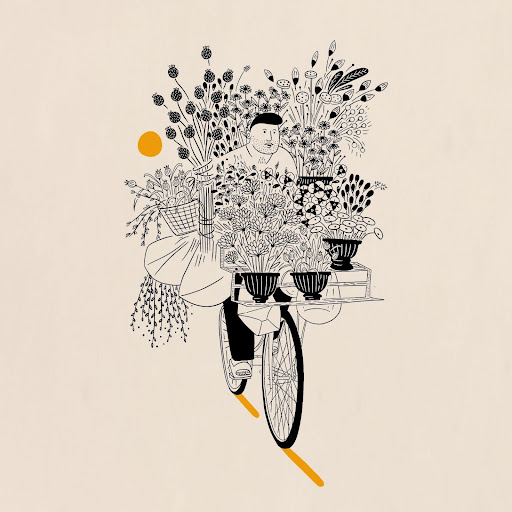
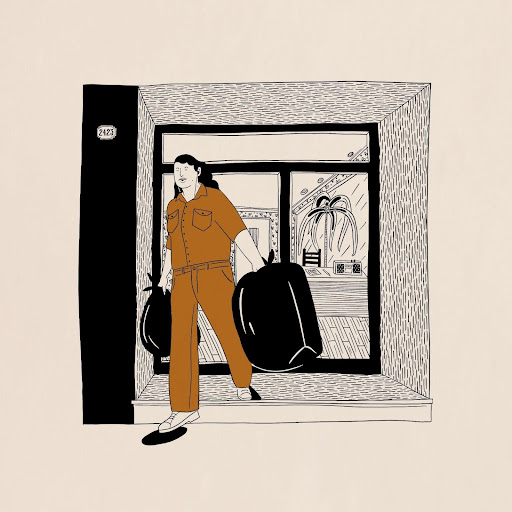
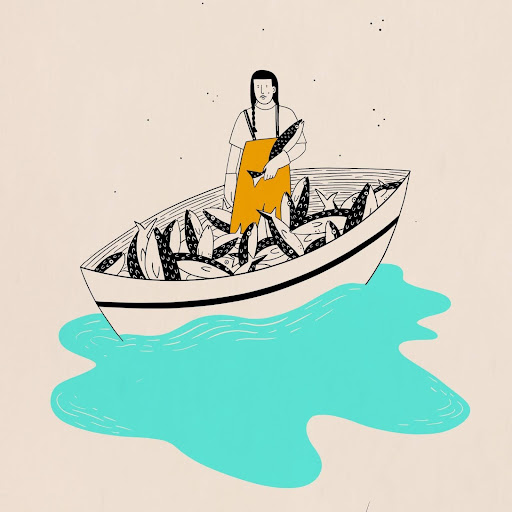
Some of Julieta’s previous artistic works
Similarly, returning to the subject of technology, it is not always possible to find images that adequately describe different techno-realities: “very abstract images appear, with very neat environments and people, all with good living conditions or very settled lives. These are ideal worlds, and it would be wonderful if everyone had those opportunities, but these images are very far removed from what exists in the real world.”
About the artist
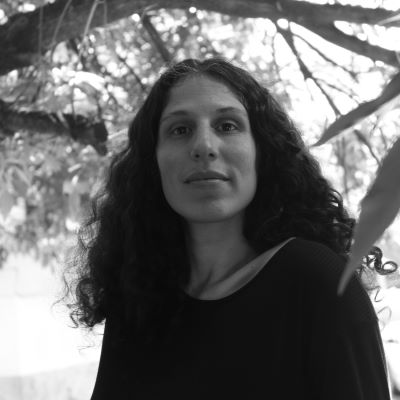
Julieta Longo, illustrator and sociologist, was born in La Plata, Argentina, in 1985. She is a researcher (CONICET) and teaches Sociology at the National University of La Plata. She also continues to draw. Recently, was illustrator for the Ministry of Women, Gender Policies, and Sexual Diversity of the Province of Buenos Aires. In 2019, with Mercedes Roch, she published Primeras (second edition 2024, Malisia-Ediciones Bonaerenses), a book that tells the stories of women who, for the first time, did things previously reserved for men.
About the author
Laura Martinez Agudelo is a Teaching and Research Assistant at the University Marie & Louis Pasteur – ELLIADD Laboratory. She holds a PhD in Information and Communication Sciences. Her research interests include socio-technical devices and (digital) mediations in the city, visual methods and modes of transgression and memory in (urban) art.
Cover image (top and bottom): Julieta Longo & Digit / Better Images of AI / CC BY 4.0
